Last Updated: October 21, 2026
New tank syndrome symptoms arrive in a predictable order, and that is the genuinely useful part: the sequence tells you exactly where in the nitrogen cycle your tank currently sits. Cloudy water, fish hanging at the surface and sudden losses in weeks two to six are all expressions of the same underlying event.
As an Amazon Associate we earn from qualifying purchases.
As an Amazon Associate we earn from qualifying purchases at no extra cost to you.


By David Nguyen
Measure and Identify the Stage
New tank syndrome is ammonia and nitrite accumulating faster than bacteria can process them, in a tank stocked before the cycle finished. Reading new tank syndrome symptoms correctly means matching what you see to a test result rather than to a list of diseases.
The Four Numbers That Locate Your Tank in the Cycle
Test ammonia, nitrite, nitrate and temperature with a liquid kit rather than strips. Ammonia rising with nitrite and nitrate both at 0 ppm is week one or two. Ammonia falling while nitrite climbs is week two to four, the most dangerous stage.
Nitrite falling with nitrate appearing means the cycle is finishing, usually week four to eight. All three at 0 ammonia, 0 nitrite and measurable nitrate means it is done, provided that holds twenty-four hours after an ammonia input.
Record the tank’s age in weeks and how many fish went in at once. Six fish added on day one to an uncycled 10 gallon (38 L) tank is a completely different situation from two fish added to a cycled 29 gallon (110 L) tank.
The Decision Tree: Symptom to Stage
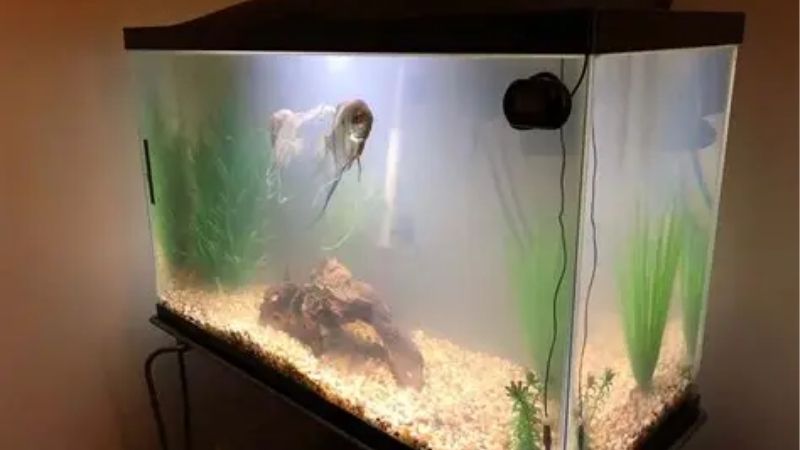
Milky cloudiness in week one or two is a bacterial bloom feeding on organics, and on its own it is harmless. Fish hanging at the surface with rapid gill movement points to ammonia or nitrite impairing oxygen uptake, which is urgent.
Fish sitting on the substrate, refusing food, or showing red or inflamed gill covers points the same way. Sudden losses without warning, particularly of the smallest or most sensitive fish, usually arrive during the nitrite stage rather than the ammonia one.
Order of loss is informative too. Shrimp and snails go first, then small or delicate fish, then hardier species, so an invertebrate death in a young tank is an early reading rather than an accident and deserves an immediate test.
| What you see | Readings that go with it | Stage | First action |
|---|---|---|---|
| Milky water, fish behaving normally | Ammonia 0, nitrite 0 | Organic bloom, tank maturing | Feed less, wait 3-10 days |
| Fish at surface, gills working hard | Ammonia above 0.25 ppm | Week 1-2, ammonia stage | Change 50%, add aeration |
| Fish lethargic, sudden losses | Nitrite above 0.25 ppm | Week 2-4, nitrite stage | Change 50% daily until it falls |
| Fish recovering, water clearing | Nitrate appearing, nitrite falling | Week 4-8, cycle completing | Continue changes, do not add fish |
| Symptoms with clean readings | All four normal for several days | Not new tank syndrome | Seek professional advice |
When It Is Not New Tank Syndrome
An established tank showing new tank syndrome symptoms has a specific cause behind it: filter media rinsed under the tap, a cartridge replaced entirely, a filter left off, or medication that affected bacteria. The readings look identical, but the fix is finding the event.
Where all four numbers have been clean for several days and fish are still affected, this is no longer a water quality question. Describe what you observe to an aquatic veterinarian or an experienced fish store rather than working through a list of possible conditions.
Fixing It Step by Step
These steps run in order and the first one is not optional. Managing new tank syndrome symptoms with fish already in the tank is damage limitation, and the cycle will finish on its own schedule regardless of what you add.
Step 1: Water Changes Are the Only Reliable Tool
Change 50% whenever ammonia or nitrite reads above 0.25 ppm, with temperature matched to within 1-2 °F (about 1 °C) and dechlorinated water. Repeat daily if needed. This does not slow the cycle, because the bacteria live on surfaces rather than in the water.
Test twice daily during the nitrite stage, since that reading can climb from 0.5 to 2 ppm inside a day in a small tank. The frequency of testing matters more than the size of any single change you make.
Keep a record of each reading with the date. Two weeks of numbers shows you which stage the tank is in and whether it is progressing, which is information that no single test on any given afternoon can give you.
Step 2: Cut the Input While the Colony Catches Up
Stop feeding for one day, then feed half portions once daily until readings stabilise. Healthy adult fish tolerate several days without food easily, and every uneaten flake becomes ammonia within hours in a tank with no working filter.
Add no further livestock, plants aside. Fast-growing stems and floating plants take up ammonium directly and genuinely help, and they are the one addition worth making during this period rather than after it.
Step 3: Support the Bacteria Rather Than Replacing Them
Keep temperature steady at 78-80 °F (26-27 °C) if your species allow it, since nitrifying bacteria grow faster in that range. Add an air stone, because both bacterial groups need oxygen and the colony builds more slowly without it.
Seeded media from an established tank is the only genuinely effective accelerator. Bottled bacteria can help depending on storage and shelf age, but nothing produces an instant cycle, and a product promising one is describing marketing rather than biology.
Step 4: Tank Size, Placement and Fit
Volume is the main protection you have. A 5 gallon (19 L) tank concentrates the same ammonia four times more than a 20 gallon (76 L) tank, which is why new tanks under 10 gallons produce the worst outcomes for beginners.
Work from real capacity. A 20 gallon (76 L) tank holds roughly 17-18 gallons (64-68 L) after substrate and hardscape, so a bucket-measured 50% change is nearer 55% of the actual water in the tank.
Measure before you order: heater length against water depth, 4-6 in (10-15 cm) behind the tank for a hang-on-back filter, and stand capacity against roughly 10 lb/gallon (about 1 kg/L) filled. A 55 gallon (208 L) tank passes 600 lb (272 kg) full.
What Never to Do During a Cycle
Three actions make new tank syndrome symptoms considerably worse, and all three are common advice. Each either removes the bacteria you are waiting for or hides the reading that tells you what is happening.
Never Clean or Replace Filter Media
The nitrifying colony you are waiting for lives on that media. Rinsing it under the tap kills it outright, since chlorine and chloramine are lethal to those bacteria on contact, and replacing a cartridge discards it entirely.
Leave the filter completely alone until the cycle is finished and stable for several weeks. When cleaning does become necessary, rinse in a bucket of tank water and do only one part of the filter at a time.
Never Change 100% of the Water
A full change swings temperature, pH and hardness at once while removing minerals, and it does not remove the surface-dwelling bacteria causing or curing anything. Fish already stressed by ammonia handle that chemistry shift badly.
Partial changes of 50% do the necessary work without the swing, and can be repeated daily for as long as the readings demand. That gives you a tool you can use again tomorrow rather than one dramatic intervention with nothing after it.
Never Dose Ammonia Binders and Then Stop Testing
Detoxifying conditioners convert ammonia into a less harmful bound form for roughly 24 to 48 hours, which is a genuine emergency bridge. They do not remove it, do not speed the cycle, and on most liquid kits the total ammonia reading barely changes.
The risk is behavioural rather than chemical. People dose, see no reading change, dose again, and stop doing the water changes that were actually protecting the fish. Use a binder to buy one night, then change water the next day.
Preventing It in the Next Tank
New tank syndrome is entirely avoidable, and the method has been settled for years. A fishless cycle takes three to eight weeks and costs nothing except patience, which is the only ingredient in short supply.
Run a Fishless Cycle Before Any Livestock
Dose ammonia to 2-4 ppm and keep it there, holding temperature at 78-80 °F (26-27 °C) with the filter running and good aeration. Test every few days and expect nitrite to appear in week one or two.
The finish line is specific rather than approximate: twenty-four hours after dosing ammonia to 2-4 ppm, both ammonia and nitrite read 0 ppm and nitrate is present. Anything short of that is an unfinished cycle, whatever the water looks like.
Equipment and Habits That Prevent Recurrence
A filter taking loose media lets you keep colonised biological media indefinitely while replacing only mechanical floss, which prevents the mini-cycles that produce these symptoms in tanks that have run for years. Cartridge systems discard the colony monthly by design.
Heaters drift ±2-4 °F (±1-2 °C) on budget units and cold water slows the cycle noticeably, so keep a separate thermometer. Test reagents expire and read low with age. Every powered device beside water belongs on a GFCI outlet with a drip loop and a UL or ETL mark.
Early Signals in the First Three Months
January is when this arrives at scale. Tanks given over the December holidays reach weeks two to six in the new year, which is exactly when ammonia and nitrite peak, and the losses that follow are the most predictable seasonal failure in the hobby.
Test ammonia and nitrite weekly for the first three months regardless of how the tank looks, and add fish in small groups spaced two to three weeks apart. Both habits catch the problem while it is still a reading rather than a symptom.
Frequently Asked Questions
These four come up most often when a tank is a fortnight old and something has clearly started going wrong.
How long do new tank syndrome symptoms last?
Three to eight weeks from setup, depending on temperature, bioload and whether seeded media was used. The nitrite stage in weeks two to four is generally the longest and the most dangerous, and it cannot be reliably shortened.
Do water changes restart the cycle?
No. The bacteria live on filter media, substrate and hardscape rather than in the water column, so changing water removes the toxins without removing the colony. Protecting fish always outweighs any theoretical delay to the process.
Can I add plants during the cycle?
Yes, and it helps. Fast-growing stems and floating species take up ammonium directly, reducing the load while the bacteria establish. They also arrive carrying some bacteria of their own, which is a small additional benefit.
My fish died. Can I add more once it clears?
Wait until ammonia and nitrite hold at 0 ppm for several consecutive days with nitrate present, then add two or three fish rather than restocking at once. Adding a full load to a barely finished cycle produces new tank syndrome symptoms all over again.
The Bottom Line on New Tank Syndrome
New tank syndrome symptoms are a reading problem before they are a fish problem. Test ammonia and nitrite twice daily, change 50% whenever either passes 0.25 ppm, cut feeding to half portions, and leave the filter entirely alone for the three to eight weeks the cycle takes. Keep temperature at 78-80 °F (26-27 °C) with an air stone running, add plants but no more fish, and treat ammonia binders as a way to buy one night rather than a solution. Next time, cycle the tank before anything goes in it.
What Size Pond Aerator Do You Need for a Pond: Sizing Help
Houseplants in Fish Tanks: Pothos, Peace Lily and Lucky Bamboo