Last Updated: October 4, 2026
Quick answer: Our top pick in 2026 is the Inert aquarium gravel — our #1 rated choice. See the full ranked comparison, alternatives and buying advice below.
The Short Answer
Yes, active substrate is worth it for a planted tank if you want demanding plants, soft acidic water, or a convenient nutrient base—and you are willing to manage its early water chemistry. If your tank has hardy plants, alkaline water, a tight budget, or fish that prefer neutral-to-hard conditions, inert gravel or sand is usually the better value.
“Active substrate” generally means a baked clay-based aquasoil made with organic and mineral ingredients. Unlike ordinary gravel, it can provide nutrients to plant roots and influence water chemistry. The benefit is real, but it is not a substitute for proper lighting, carbon dioxide, fertilization, circulation, or routine maintenance. For 2026, the smartest purchase is less about finding the most expensive soil and more about matching the substrate to your plants and tap water.
As an Amazon Associate we earn from qualifying purchases at no extra cost to you.

What You Actually Get
A quality active substrate gives you three useful functions in one layer. First, its porous granules provide a rooting medium for stem plants, crypts, swords, carpeting plants, and other species that benefit from anchoring in soil-like material. Second, many aquasoils release nutrients early in the tank’s life. This can help establish plants before their roots are fully developed, although heavy root feeders may still need additional root tabs later.
Third, active substrate can lower or stabilize pH and reduce carbonate hardness (KH). The exact effect depends on the product, your source water, water-change schedule, and how much buffering capacity the substrate has left. A tank filled with high-KH tap water may show only a modest change, while softer water can become noticeably more acidic.
That chemistry is useful for planted aquariums and many soft-water fish, shrimp, and plants. It can also be inconvenient. Fresh aquasoil may release ammonia or other compounds during its first days or weeks, so test the aquarium before adding livestock. A fishless cycle is the safest approach. Test ammonia, nitrite, nitrate, pH, and KH, and perform water changes according to the readings and the manufacturer’s instructions.
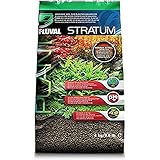
As a practical sizing example, a 24-by-12-inch aquarium footprint needs roughly 18 to 25 liters of substrate for a 2- to 3-inch planting bed, with extra depth toward the back. A small 8.8-pound bag may suit a nano tank or provide a shallow layer, but it may not be enough for a typical 20-gallon aquarium with a sloped layout. Read the bag’s coverage guidance rather than choosing by weight alone; granule density varies.
Pros
- Better root support: Rounded or irregular granules hold plants securely while allowing roots to spread more naturally than they can in coarse gravel.
- Initial nutrient availability: Fresh aquasoil can supply nutrients to rooted plants without requiring immediate root tabs throughout the entire tank.
- Useful water chemistry: Its pH- and KH-lowering properties can help create conditions favored by many tropical plants and soft-water species.
- Easy planting: A 2- to 3-inch layer is generally deep enough for most common aquarium plants, especially when the back is raised to 3 or 4 inches.
- Cleaner visual style: Dark brown or black soil makes green foliage and red plants stand out, and it can give a layout a more natural appearance.
- Good long-term plant performance: When paired with adequate light, nutrients, and carbon dioxide, active substrate can make it easier to maintain a densely planted aquascape.
- Helpful for shrimp setups: A buffering soil can be useful for some soft-water shrimp aquariums, provided the selected shrimp and source water are compatible.
Cons
- Higher upfront cost: Active substrate commonly costs about $20 to $40 for a bag suited to a small or medium setup, and a large aquascape may require two or more bags.
- Finite lifespan: Its buffering capacity and easily available nutrients decline over time. Depending on water chemistry and maintenance, useful buffering may last roughly 1 to 3 years, not indefinitely.
- Initial ammonia: New soil can produce an ammonia reading that requires cycling and water changes. It is not a “set it and add fish” material.
- Potential pH mismatch: Fish that need alkaline, mineral-rich water may fare poorly if the substrate continuously pushes conditions downward.
- It can break down: Granules gradually soften and become muddy, particularly under heavy gravel-vacuuming or repeated disturbance.
- More demanding maintenance: Deep vacuuming can remove soil and disturb plant roots, so debris is usually siphoned gently from the surface.
- Not a complete plant system: A substrate cannot compensate for inadequate light. Many medium-to-high-light plants still need a suitable aquarium light, often in the approximate 20- to 40-watt range for a small planted tank, depending on tank depth and fixture efficiency.
Who Should Buy It
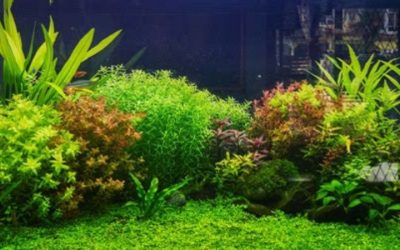
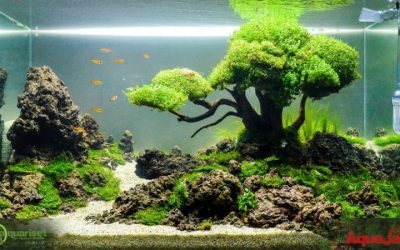
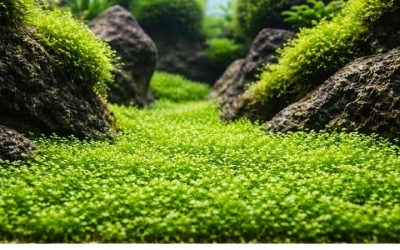
Buy active substrate if you are building a planted aquarium around rooted plants, carpeting species, or a natural aquascape and you want the substrate to contribute nutrients from the start. It is particularly worthwhile when your source water is already soft or moderately acidic and you are keeping plants and livestock that appreciate those conditions.
It is also a strong choice for aquascapers who plan to use a 2- to 3-inch planting bed, slope the substrate for depth, and cycle the aquarium before introducing fish or shrimp. A product such as Fluval Plant and Shrimp Stratum, listed at about $30 for 8.8 pounds, is the kind of purchase that makes sense for a nano tank or a partial soil layer. Confirm the expected coverage before ordering; weight alone does not tell you how thick the finished bed will be.
Choose active soil when you value easier planting and water chemistry control more than the lowest initial price. The investment is most defensible when replacing or rebuilding the tank later would be more expensive than spending an additional $15 to $40 on suitable substrate now.
Who Should Skip It
Skip active substrate if your aquarium is primarily for hardy plants such as anubias, Java fern, Java moss, or many low-demand stem plants. These species can grow attached to wood or rock, so nutrient-rich soil may offer little practical advantage.
It is also a poor fit for fish that require stable neutral or alkaline water, unless you are prepared to test and adjust the water regularly. Beginners who want to add livestock immediately should choose inert material instead. Finally, skip it if you frequently rearrange the aquarium or aggressively vacuum the bottom; active granules are easier to disturb and replace than ordinary gravel.
Cheaper Alternatives
| Option | Cost | Trade-off |
|---|---|---|
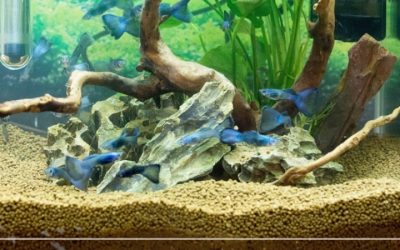
| Inert aquarium gravel | About $1 to $3 per pound | Affordable and chemically stable, but provides little nutrition for roots and does not lower pH or KH. |
| Inert aquarium sand | About $10 to $25 for 10 to 20 pounds | Clean, attractive, and easy to find; compacted sand may restrict roots if laid too deeply, and it has no buffering benefit. |
| Plain baked clay or planted-tank gravel | About $15 to $35 per bag | Offers porous rooting space without the same nutrient load or chemistry changes as aquasoil; supplemental fertilizer is usually needed. |
| Inert base plus root tabs | About $20 to $45 total for a small tank | Often cheaper over a full setup and more controllable, but requires periodic tab replacement and does not alter pH or KH. |
| Aqua Natural Bio-Substrate Galaxy Sand | About $15 for 5 pounds | A budget-friendly decorative substrate for a shallow layer or top dressing, but it should not be treated as an equivalent replacement for nutrient-rich aquasoil. |
For many community tanks, inert substrate plus root tabs is the best compromise. You get stable water chemistry, lower cost, and the ability to target fertilizer at heavy root feeders. You can also layer a small amount of active soil beneath inert sand, but avoid sealing it so thoroughly that planting or future maintenance becomes difficult.
FAQ
How long does active substrate last?
Expect the strongest nutrient availability and buffering early in its life. Many aquasoils remain physically usable for several years, but their chemistry changes sooner. A realistic planning range is about 1 to 3 years for meaningful buffering, depending on KH, water changes, and the product. Replace it when granules collapse, the layout becomes difficult to maintain, or your water tests no longer match the intended conditions.
Does active substrate replace fertilizer?
No. It may provide an initial nutrient supply, but plants still consume nutrients from the water column and substrate. Fast-growing plants, mature aquariums, and high-light setups commonly need liquid fertilizer. Root tabs can support heavy root feeders once the original nutrients decline.
Can I put fish in a tank with new active substrate?
Do not assume it is safe immediately. Test ammonia and nitrite, allow the biological filter to cycle, and perform water changes when needed. Some soils require frequent changes during the first week or two. Add livestock only when ammonia and nitrite are consistently zero and the water chemistry is appropriate for that species.
Is active substrate better than sand?
It is better for rooted plants and for aquariums that benefit from lower pH and KH. Sand is better when you want stable chemistry, a low-cost bottom, or a habitat for fish that prefer digging. Neither is universally superior; the right choice depends on your plants, livestock, tap water, and willingness to manage the startup period.
Ready to decide? Our #1 pick for 2026 is the Inert aquarium gravel.
Live price & availability on Amazon.
Related Reviews & Guides
Best Heater for 5 Gallon Shrimp Tank in 2026: Compared and Ranked
Low Light Aquarium Plants Lighting: PAR, Hours and Care