Last Updated: October 17, 2026
- Female Betta Quick Facts
- How to Tell a Female Betta From a Male
- Female Betta Colors and Fins
- Female Betta Temperament
- Can Female Bettas Live Together? Sorority Tanks Explained
- Tank Size and Setup
- Water Parameters and Maintenance
- Feeding a Female Betta
- Tank Mates for Female Bettas
- Female Betta Breeding Notes
- Common Health Problems
- Common Mistakes
- Who Female Bettas Suit
- Frequently Asked Questions
A female betta fish is the smaller, shorter-finned, usually duller-colored sex of Betta splendens, and she needs the same basics as a male: a heated, filtered tank of at least roughly 10 to 11 gallons (about 40 liters), warm water around 78 to 80 F (25 to 27 C), and a protein-rich diet. Females are generally less aggressive than males, but they are not peaceful community fish, and keeping several together in a “sorority” is a high-risk arrangement that suits only experienced keepers with a large, heavily planted tank.
Quick answer: Our top pick in 2026 is the Scientific name — our #1 rated choice. See the full ranked comparison, alternatives and buying advice below.
Female Betta Quick Facts
| Trait | Typical value |
|---|---|
| Scientific name | Betta splendens |
| Adult size | Seriously Fish gives a maximum of about 2.8 inches (7 cm) for the species; females are typically somewhat smaller, often around 2 to 2.5 inches (5 to 6.5 cm) |
| Minimum tank (single fish) | About 10 to 11 gallons (40 liters); Seriously Fish lists a 45 x 30 cm footprint as the floor |
| Temperature | Wild range 72 to 86 F (22 to 30 C); a steady 78 to 80 F (25 to 27 C) suits most aquarium fish |
| pH and hardness | pH 6.0 to 8.0, 1 to 15 dGH; stability matters more than the exact number |
| Diet | Carnivorous: quality betta pellets, frozen or live small foods |
| Lifespan | Roughly 2 to 5 years in captivity depending on the source, genetics and care; 3 to 4 years is a common figure |
| Temperament | Territorial, less intense than males, still unpredictable |
| Care level | Beginner-friendly alone; advanced if kept in groups |
How to Tell a Female Betta From a Male
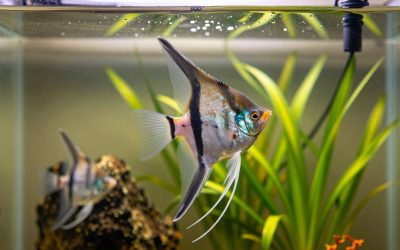
The easiest check is fin length and body shape. Males of most ornamental strains grow long, flowing fins and have a slimmer, more elongated body. Females have shorter fins, a rounder and often slightly plumper belly, and colors that tend to be softer. Seriously Fish notes that males display more vibrant coloration and more elaborate finnage, and it also warns that some breeders sell short-finned males that are passed off as females, so fin length alone is not proof.

TetraBetta PLUS Floating Mini Pellets, Fish Food With Natural Color Enhancer, 1.2 ounces
Included for 'Female Betta Fish: Differences, Sorority Tanks and Care' because the listing specifies Fish Food With Natural Color Enhancer and 1.2 ounces, details this guide uses to compare options.
View on Amazon
API BETTA FOOD Fish Food Pellet .78-Ounce Container
Included for 'Female Betta Fish: Differences, Sorority Tanks and Care' as a relevant option in this category; details come from the product listing.
View on Amazon
Tetra TetraBetta Plus Floating Mini Pellets, Fish Food with Natural Color Enhancer, 1.2 Ounces (Pack of 2)
Included for 'Female Betta Fish: Differences, Sorority Tanks and Care' because the listing specifies Fish Food with Natural Color Enhancer and 1.2 Ounces (Pack of 2), details this guide uses to compare options.
View on Amazon
Aqueon 3 Pack of Color Enhancing Betta Food Pellets, 0.95 Ounces Per Container
Included for 'Female Betta Fish: Differences, Sorority Tanks and Care' because the listing specifies 0.95 Ounces Per Container, details this guide uses to compare options.
View on AmazonReliable signs of a female
- Egg spot (ovipositor): a small white dot just behind the ventral fins on the belly. It is the tube through which eggs are released. Males may show a much smaller or less obvious spot, so judge it together with other traits.
- Shorter ventral fins: the thin pelvic “feelers” are short in females and noticeably longer in males.
- Shorter anal and dorsal fins: males usually have a long anal fin that sweeps toward the tail.
- Vertical breeding stripes: receptive females can show pale vertical bars on the flanks. Stress also produces stripes, so they are not a sex test on their own.
- Less beard development: males have a more pronounced gill cover, which is sometimes called a beard when flared.
Why sexing can be tricky
Young bettas of both sexes look alike. Many keepers report that sex becomes clear at around two to three months of age. Plakat and some “halfmoon plakat” strains have short fins in both sexes, so you need to rely on the egg spot, ventral fin length and body proportions rather than fin spread. Certain mutations, such as some dragon-scale and marble lines, also hide the usual colour differences.
Female Betta Colors and Fins
Females come in nearly the same palette as males: red, blue, steel, turquoise, yellow, white, black and multicolor patterns. The intensity is usually lower, and the fins are short and rounded, which makes them hardy and active. Short fins also mean fewer problems with fin tears and drag in the water, so females tend to swim more energetically than heavily finned males.
Colour can change with age, mood and water quality. A faded or washed-out female may be stressed, ill or simply resting at night. Persistent pale stripes, clamped fins or hiding all day point to a problem worth investigating, not a normal phase.
Female Betta Temperament
Female bettas are territorial, but their aggression is usually lower than a male’s. They flare at reflections and at each other, and they establish a pecking order. Seriously Fish describes the species as highly aggressive and not recommended for a standard community aquarium, and that description is aimed mainly at males; keepers report that females can be territorial too, so the same caution is sensible. Individual personality varies a lot: some females ignore tank mates, others harass them relentlessly.
Females are not inherently “safe” for community tanks. Keepers who succeed with mixed groups usually do so with a lot of space, dense plants and constant observation, and they keep a backup tank ready for an aggressive individual.
Can Female Bettas Live Together? Sorority Tanks Explained
Yes, some females can live together in a group of five or more, usually called a sorority, but it is a risky arrangement and not a guaranteed success. Seriously Fish notes that in most cases only a single betta should be kept per tank, and many experienced keepers consider a sorority a project for people who can watch the tank daily and separate fish when needed.
What a sorority needs
- Space: a footprint-driven tank of at least 20 gallons (75 liters) is commonly suggested for a group of five to seven, and larger is better. Sources vary: some hobby guides accept 10 gallons as a bare floor, others advise 20 to 30 gallons or more, and minimum group sizes are quoted anywhere from four to five fish. Floor area and length matter more than height because bettas defend territory along the bottom and mid-water.
- Five or more fish: aggression gets spread across the group instead of focused on one fish (odd numbers are often preferred, though how much this matters is debated). Two or three females together often goes badly because one becomes the target.
- Heavy planting and visual breaks: floating plants, tall stem plants, driftwood and caves. Every fish needs a spot where it can break line of sight with the rest.
- Introduce them together: add all fish on the same day, ideally after rearranging the decor, so no one has an established territory.
- A quarantine and backup tank: keep a spare tank for removing a bully or an injured fish.
- Similar size: big size gaps lead to bullying.
Honest risks
Even in a well-built sorority, a fish can turn into a persistent bully, and the weaker fish may be chased, shredded of fins or killed. Stress lowers immunity, so disease spreads more easily in a group. Some keepers report a sorority that stays calm for months and then breaks down as the fish mature. A fish that has been separated and then reintroduced is often attacked again. If you cannot monitor the tank or lack a plan for removing fish, keep each female alone.
Sorority or single: decision table
| Situation | Better choice |
|---|---|
| First-time betta keeper | One female in a 10 to 11 gallon or larger tank |
| Tank under 20 gallons | One female |
| Can plant heavily and watch daily | Sorority of five or more is possible |
| No spare tank for separation | One female |
| Mixed with livebearers or tetras | Single female with careful selection of tank mates |
Tank Size and Setup
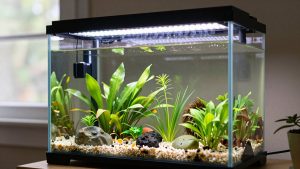
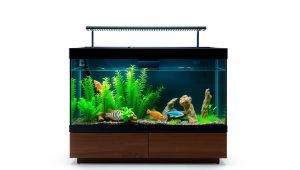
A single female betta does best in a tank of about 10 to 11 gallons, which is consistent with the 45 x 30 cm footprint Seriously Fish gives as a minimum. Bowls, vases and unheated small containers are not suitable: the fish needs steady warmth, filtration and room to explore. A lid is important, because bettas jump and also breathe from the surface using their labyrinth organ, so the air above the water should be warm and humid.
- Heater: a small adjustable heater sized for the tank keeps the temperature steady. Bettas are tropical and become sluggish and disease-prone in cool water.
- Filter: a gentle sponge filter or a filter with an adjustable flow. Long-finned bettas struggle in strong current, and females with shorter fins cope better but still prefer calm water.
- Plants: live or silk plants and floating cover. Avoid sharp plastic decor that can tear fins; the pantyhose test (drag a piece of nylon over the decor) catches rough edges.
- Substrate: sand or smooth gravel is fine.
- Lighting: a regular day-night cycle of around eight to ten hours.
Water Parameters and Maintenance
The species tolerates a wide range, but quality matters more than perfection. Keep ammonia and nitrite at zero in a cycled tank and nitrate low. Use a dechlorinator on tap water, and match new water temperature to the tank to avoid shocks.
Sample weekly maintenance schedule
| Frequency | Task |
|---|---|
| Daily | Feed one or two small meals, look at fins and behaviour, confirm temperature |
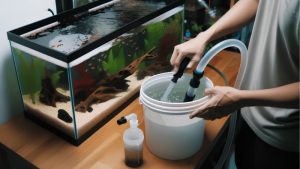
| Weekly | Change around 25 to 30 percent of the water, vacuum visible waste, wipe algae from glass |
| Weekly | Test ammonia, nitrite and nitrate until the tank is stable, then every few weeks |
| Monthly | Rinse the filter sponge in removed tank water, trim plants, check heater function |
| Sorority tanks | Increase observation to several checks per day for the first weeks and after any change |
Feeding a Female Betta
Bettas are carnivores that feed on insects and larvae in the wild. A good betta pellet or small-granule food high in protein should be the base, with frozen bloodworms, brine shrimp or daphnia as variety. Feed what she can eat in about a minute or two, once or twice daily. Bettas are prone to overeating, constipation and bloating, and a fasting day each week is a common practice among keepers. Females carrying eggs look plump, but a persistently swollen belly with raised scales needs attention.
Tank Mates for Female Bettas
Because temperament varies, any pairing is a gamble, and the best tank mates are fish that stay out of the betta’s way and are not brightly colored or long-finned. A larger tank (20 gallons or more) improves odds.
| Category | Examples | Notes |
|---|---|---|
| Generally good | Snails (nerite, mystery), small bottom-dwelling catfish such as Corydoras in groups, Kuhli loaches | Different zones and non-threatening shapes; Corydoras need a group of six or more and a smooth substrate |
| Risky | Harlequin rasboras, ember tetras, neon tetras, shrimp | Some bettas ignore them, others hunt them; shrimp and small fry are often eaten |
| Avoid | Guppies and fancy goldfish, fin-nippers such as tiger barbs, other bettas (males), gouramis | Colourful or flowing fins trigger attacks; nippers shred fins; males fight to the death |
Seriously Fish notes that species with elaborate fins should be avoided. Always keep an extra tank available to separate a betta that does not tolerate company.
Female Betta Breeding Notes
Breeding bettas is not a casual experiment. A pair is usually conditioned separately, introduced with a divider, and watched closely because males can seriously injure females. The male builds a bubble nest, wraps around the female to release eggs and tends the nest, while the female should be removed after spawning. Eggs hatch in about one to two days, and fry need infusoria-sized food at first, followed by baby brine shrimp or microworms. A single spawn can produce dozens to hundreds of fry, which need many tanks and homes within weeks. Keepers who cannot rehome or raise the fry should not breed. Females can also carry eggs and release them without a male; unfertilised eggs are simply eaten or dissolve.
Common Health Problems
| Symptom | Likely cause | What to do |
|---|---|---|
| Frayed or shortened fins | Fin rot from poor water, or nipping from tank mates | Test water, increase changes, remove nippers; treat bacterial infection if it progresses |
| White grains like salt | Ich (white spot) | Raise temperature gently to around 82 F (28 C) and use a suitable ich treatment |
| Swollen body with raised scales | Dropsy, often an internal bacterial or kidney problem | Isolate in a hospital tank; often hard to treat; seek an aquatic vet or experienced advice |
| Floating or sinking oddly | Swim bladder issue from overfeeding or cold water | Fast one to two days, warm to a stable temperature, offer a blanched, shelled pea |
| Hiding, clamped fins | Stress, aggression, cold or poor water | Check parameters and heater, add cover, separate from aggressors |
Common Mistakes
- Keeping a betta in a tiny unheated bowl or vase.
- Assuming a female is safe for a community tank without a backup plan.
- Putting two or three females together instead of a proper group, or no group at all.
- Overfeeding and skipping water changes.
- Buying a “female” without checking for a mislabeled short-finned male.
- Using decor with rough edges or strong filter flow.
Who Female Bettas Suit
A single female suits a keeper who wants an active, hardy and colorful fish in a modest tank and can commit to a heater, filter and weekly maintenance. A sorority suits an experienced hobbyist with a large, well-planted tank, time for daily observation and a plan to separate fish. They do not suit anyone who wants a decorative fish in a small bowl or a peaceful community centerpiece without monitoring.
Frequently Asked Questions
Are female bettas less aggressive than males?
Generally yes, but they are still territorial. Females flare, chase and establish a pecking order, and individual personalities vary widely. Treat any betta as a potential aggressor when planning tank mates.
How many female bettas can live together?
Groups of five or more in a large, heavily planted tank of around 20 gallons or more are the usual guideline. Even then, a bully can emerge and fish may need to be removed. Two or three together tends to focus aggression on one individual.
Can a male and female betta live together?
Not as a permanent pair. Males attack females outside of brief, supervised breeding, and injuries and deaths are common. Seriously Fish notes that males are highly aggressive and generally kept singly, and the sexes are kept apart outside of breeding.
How long do female bettas live?
Sources give roughly two to five years in captivity, with three to four years a common figure, when water is warm and clean and the diet is good. Poor conditions and stress shorten that lifespan considerably.
Do female bettas make bubble nests?
Rarely. Bubble nesting is almost entirely male behaviour, and females generally do not build nests on their own, although an occasional bubble or two is sometimes reported. A nest is not a sign that she needs a male, and bubbles alone do not mean she is carrying viable eggs.
Why is my female betta striped?
Vertical bars can indicate readiness to breed, but they also appear under stress or when the fish is intimidated. If the stripes persist alongside hiding or clamped fins, check water quality, temperature and tank mates.
What size tank does one female betta need?
About 10 to 11 gallons (roughly 40 liters) is a sensible minimum, matching the 45 x 30 cm footprint listed by Seriously Fish, with a heater, gentle filter and lid. Smaller containers make temperature and water quality hard to hold steady.
Ready to decide? Our #1 pick for 2026 is the Scientific name.
Live price & availability on Amazon.
Related Reviews & Guides


CO2 for Planted Aquariums: Do You Need It and How Systems Work
How Often to Change Aquarium Water: A Schedule by Numbers