Last Updated: October 4, 2026
Quick answer: Our top pick in 2026 is the Angle the existing filter return upward — our #1 rated choice. See the full ranked comparison, alternatives and buying advice below.
The Short Answer
Do you need an aquarium air pump? It depends: you need one if your aquarium does not already have reliable surface agitation, or if your fish, temperature, stocking level, or setup creates a higher-than-usual demand for dissolved oxygen.
An air pump is not automatically necessary for every fish tank. A hang-on-back filter, canister filter return, internal filter, or circulation pump may already move the surface enough to exchange gases. In that case, adding an air pump is optional. If the water surface is unusually still, the tank is heavily stocked, or you want backup aeration during a power outage, a pump can be inexpensive insurance.
As an Amazon Associate we earn from qualifying purchases at no extra cost to you.

What You Actually Get
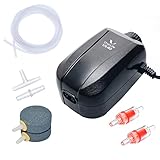
An aquarium air pump sits outside the tank and pushes room air through airline tubing. The tubing usually connects to an air stone, which breaks the airflow into small bubbles. The bubbles rise, but their main benefit is not that they “put oxygen” directly into the water. The bubbling disturbs the surface, helping oxygen enter and carbon dioxide leave.
A basic kit commonly includes the pump, airline tubing, one or two air stones, check valves, and connectors. A single-outlet pump supplies one air line; a dual-outlet model can run two air stones, sponge filters, or separate tanks. Adjustable models let you reduce the airflow when the current is too strong.
Most small freshwater aquarium pumps use roughly 1 to 5 watts, making their electricity cost modest. A pump rated for a 10- to 60-gallon tank may measure about 4 to 6 inches long and weigh under 2 pounds, while larger or commercial models can be bigger. Manufacturer gallon ratings are useful starting points, not guarantees: a tall 40-gallon aquarium, a tank with dense plants, or a setup with multiple air devices may need more airflow than a shallow tank of the same volume.
For example, a low-cost Pawfly pump advertised for 10- to 60-gallon tanks is listed around $10 and includes dual outlets and common accessories. A Uniclife model advertised for 10- to 100-gallon tanks is listed around $15, also with dual outlets and accessories. Prices can change, and neither product replaces a properly sized filter or good maintenance.
Pros
- Improves surface movement. An air stone creates steady ripples, which can improve gas exchange in a stagnant aquarium.
- Helps during stressful conditions. Warm water holds less oxygen than cool water, and oxygen demand rises when fish are crowded, ill, or unusually active.
- Useful with sponge filters. Air pumps power sponge filters, which provide mechanical filtration and a large surface for beneficial bacteria. They are especially useful in quarantine tanks, fry tanks, shrimp tanks, and breeding setups.
- Provides backup aeration. If a filter stops working, an air pump can keep the water moving. A battery-powered air pump can be especially valuable during outages.
- Supports deeper or heavily decorated tanks. Tall aquariums, tanks with limited circulation, and aquariums filled with rocks or wood can benefit from an additional source of movement.
- Usually inexpensive to operate. A 2-watt pump running continuously uses about 1.44 kilowatt-hours per month, before local electricity rates and any changes in actual power draw.
- Can be adjusted. Dual-outlet adjustable pumps let you balance airflow between two devices instead of running both at full output.
Cons
- It can be noisy. Vibration against a cabinet or wall may create a hum or buzzing sound. “Quiet” pumps are not silent, and air stones can also hiss or splash.
- It may create too much current. Small, slow-moving fish, bettas, fry, and some shrimp can be stressed by vigorous bubbling. Use an airflow control valve, smaller air stone, or sponge prefilter.
- It takes up equipment space. You need a dry location above or beside the aquarium, plus tubing and a check valve. The pump itself should never sit where water can run into its electrical parts.
- It does not replace filtration. An air stone provides aeration, not meaningful removal of debris or dissolved waste. A sponge filter is different because the sponge itself performs filtration.
- It can increase evaporation. More surface movement usually means faster evaporation, particularly in warm rooms or tanks without lids.
- Accessories wear out. Air stones can clog, tubing can harden, and check valves may need replacement. A blocked airline can make a pump run loudly or reduce output.
- Bubbles are not a cure for poor care. Overfeeding, overcrowding, infrequent water changes, and untreated ammonia cannot be fixed with extra aeration alone.
Who Should Buy It
Buy an aquarium air pump if your filter produces little visible surface movement. The surface should show a gentle ripple rather than looking completely flat. You do not need a violent boil; excessive turbulence can be counterproductive for some fish.
An air pump is also a smart purchase for a heavily stocked aquarium, a warm aquarium, a tall tank, or a tank with several fish that gather near the surface. It is useful when running a sponge filter, protein skimmer, undergravel filter, or an air-driven decoration. A quarantine or hospital tank is another strong use case because it may have minimal filtration and fish may be breathing harder from illness or medication.
Consider a dual-outlet adjustable model if you maintain two tanks or want to run both a sponge filter and an air stone. At about $10 to $20 for many basic consumer pumps, the cost is relatively low compared with replacing fish after an oxygen emergency. Place the pump on a soft pad to reduce vibration, use a check valve in every airline, and create a drip loop in the power cord.
Who Should Skip It
Skip a separate pump if your existing filter creates consistent surface agitation, your aquarium is appropriately stocked, and your fish show normal behavior. Clear water alone does not prove that oxygen levels are ideal, but a well-maintained, lightly to moderately stocked tank with good circulation often does not need another device.
You may also skip it if your aquarium houses fish that prefer calm water and the pump would be used only for appearance. Instead, angle the filter return slightly upward or add a small circulation adjustment. If you are considering an air pump because fish are gasping, treat that as an urgent warning: add aeration while immediately checking temperature, ammonia, nitrite, filtration, and water quality. Do not assume the pump addresses the underlying problem.
Cheaper Alternatives
| Option | Cost | Trade-off |
|---|---|---|
| Angle the existing filter return upward | $0 | Best first step if the filter has enough flow; may not help during a filter failure. |
| Lower the water level slightly | $0 | Creates more splash from a return, but increases evaporation and is not suitable for every aquarium. |
| Battery-powered emergency air pump | About $10–$30 | Excellent for outages, but batteries require replacement and it may not be ideal for continuous operation. |
| Airline tubing with a basic air stone | About $3–$10, if you already have a pump | Cheap way to distribute airflow, but it cannot work without an air source. |
| Small internal or sponge filter | About $10–$30 | Adds filtration as well as movement, but requires cleaning and may create more current. |
| Low-cost dual-outlet aquarium pump | About $10–$20 | Provides dependable aeration and flexibility, but adds noise, tubing, and another electrical device. |
FAQ
Does an air pump add oxygen directly to the water?
Mostly, it improves oxygen exchange at the surface. The bubbles themselves have limited contact time with the water, especially in a typical home aquarium. Their movement breaks surface tension and encourages atmospheric oxygen to dissolve. A properly positioned filter return can accomplish a similar job.
Should an air pump run all the time?
It can run continuously when it is correctly sized and the airflow is not stressing the fish. Continuous operation is common with sponge filters because beneficial bacteria and filtration depend on steady water movement. If you use an air stone only for extra circulation, a timer may be appropriate, but do not switch off a sponge filter for long periods without understanding the effect on its biological media.
Do planted aquariums need an air pump?
Not automatically. Healthy aquatic plants can produce oxygen during the light period, while plants and fish consume oxygen at night. A planted aquarium still benefits from surface movement, especially overnight, but a filter may provide enough. Very strong agitation can drive carbon dioxide from the water, which may slow growth in a high-tech planted setup.
What size air pump should I buy?
Match the manufacturer’s range to your aquarium volume, then consider depth, tubing length, and how many devices you will run. For a 20-gallon tank, a model rated for 10 to 60 gallons is generally a reasonable starting point; for a 75-gallon tank, choose a model whose stated range includes at least 75 gallons. Select an adjustable dual-outlet pump if you want flexibility. Add a check valve, and reduce the airflow if fish struggle against the current.
Bottom line: An air pump is optional in many well-filtered aquariums, but it becomes worthwhile when surface movement is weak, oxygen demand is high, or you need a sponge filter or emergency backup. In 2026, the best buying decision is still the simple one: inspect your circulation first, then add only as much aeration as your fish and setup actually need.
Ready to decide? Our #1 pick for 2026 is the Angle the existing filter return upward.
Live price & availability on Amazon.
Related Reviews & Guides

Best Aquarium Heater for 75 Gallon Tank in 2026: Compared and Ranked
6 Best Aquarium Water Chillers 2026