Last Updated: October 4, 2026
The short answer to chiller vs cooling fan for a reef tank is that fans handle small seasonal warmth through evaporation, typically a few degrees, while a compressor chiller is what you need for a larger, reliable temperature drop regardless of humidity.
As an Amazon Associate we earn from qualifying purchases.
As an Amazon Associate we earn from qualifying purchases at no extra cost to you. Prices and availability are accurate as of the date shown and are subject to change.
By David Nguyen
How Reef Tank Cooling Actually Works
These two approaches remove heat by completely different mechanisms, which is why their limits differ so sharply. A fan cools by accelerating evaporation from the surface; a chiller moves heat out of the water through a refrigeration cycle and dumps it into the room. That difference in mechanism, not brand quality, sets the ceiling on what each can achieve.
Evaporative Cooling With a Fan
Blowing air across the water surface speeds evaporation, and evaporation carries heat away. JBJ rates the C-Breeze Nano at roughly 1 to 4F of reduction with 12 CFM of airflow on 12VDC, for tanks up to 40 gallons. The effect is the same physics that makes you feel cold stepping out of a pool on a breezy day.
That reduction is not a fixed figure. It depends on tank size, surface area, airflow and above all room humidity, so the same fan delivers noticeably less in a humid room than in a dry one. Treat published ranges as typical outcomes rather than guarantees. Surface agitation and an open lid both help, since a closed lid traps the humid air the fan is trying to move away.
Compressor Cooling With a Chiller
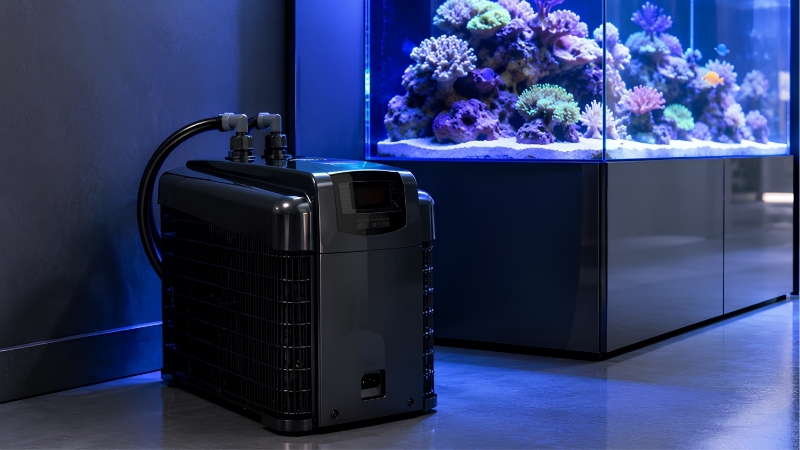
A chiller circulates tank water through a heat exchanger and uses a refrigeration cycle to pull heat out, then exhausts that heat into the room through a fan and condenser. The JBJ Mini Arctica, for example, runs 1/15 HP with a 100 to 200 GPH flow requirement. That loop needs a feed pump sized to the published window, plus hose and fittings that add head.
Because it does not rely on evaporation, a chiller holds a setpoint in humid conditions where fans stall. The trade-off is plumbing, ventilation, noise and cost, with the Mini Arctica published at 39 dB and priced around $600 as of 09/2026. That published dB figure is unusual, since most cooling gear states nothing measurable about noise.
Why Humidity Decides So Much
Evaporation slows as surrounding air approaches saturation. In a closed, humid fish room a fan may achieve very little, while the same unit in a dry air-conditioned space performs near the top of its stated range. This is why two reefers with identical fans report very different results in July.
Tunze quotes 2 to 4C for its Aquawind 7028.500 with sizing up to 800 litres, around 211 gallons, and explicitly frames that as humidity dependent. Any fan spec without a humidity caveat should be read with that limitation in mind.
Where the Heat Actually Goes
A fan moves heat and water vapour into the room, raising humidity in that space. A chiller moves heat as warm air from its condenser, raising room temperature instead, which is why ventilation clearance matters around the unit.
In small closed rooms both effects compound. A humid room makes the fan less effective over time, while a hot cabinet makes the chiller run longer, so consider where the heat ends up rather than only what leaves the water. Neither device destroys heat; each simply relocates it, so room conditions decide how well that relocation works.
What Cooling Looks Like in Practice
Four common situations cover most reef tanks. The thresholds below give a starting frame, though the right action depends on your measured temperature rise rather than a general rule.
| Factor | Normal Range | Watch-out Threshold | What to Do |
|---|---|---|---|
| Daily temperature swing | Under about 1F | Roughly 2F or more | Add surface airflow, check lighting hours |
| Needed reduction | 1-4F | Beyond what a fan achieves | Move to a compressor chiller |
| Room humidity | Dry, well-ventilated | Persistently humid | Fan output falls; chiller unaffected |
| Top-off demand | Steady daily volume | Rising sharply with fan use | Automate top-off before salinity drifts |
A Short Seasonal Spike
If your tank climbs only during a few hot weeks and needs a couple of degrees, a fan is usually the sensible answer. The JBJ C-Breeze Nano at roughly $40 as of 09/2026 costs about 93.2% less than the Mini Arctica, a gap near under $600. For a problem lasting three weeks a year, that difference is hard to argue with.
Pair it with simple measures that cost nothing: shorten the photoperiod during heat waves, raise lights slightly, and open the cabinet for airflow. Those changes often close the remaining gap without additional equipment. Fans also fail cheaply and are easy to replace, which suits equipment only needed a few weeks a year.
A Dry Room Where Fans Excel
In an air-conditioned or naturally dry room, evaporative cooling performs near the top of its range. The Tunze Aquawind draws around 1.7W and covers sizing up to 800 litres, making it inexpensive to run continuously through summer.
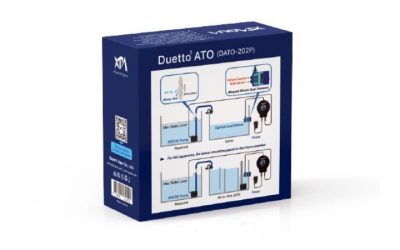
The cost appears as freshwater consumption. Faster evaporation means more top-off, and if that is not automated, salinity rises as water leaves and salt stays behind, which stresses corals more than the original temperature did. An automatic top-off unit is effectively mandatory alongside heavy fan use on a small reef.
Persistent Heat or High Humidity
When the room stays warm for months or humidity keeps evaporation slow, a fan cannot deliver consistently. This is the situation where a compressor chiller earns its cost, since its output does not depend on surrounding air moisture. Fish rooms and warm upstairs spaces are the classic examples.
Budget beyond the purchase price for plumbing, a feed pump within the required flow window, ventilation clearance and the noise a compressor makes when cycling. Those installation realities matter as much as the sticker on the box. Compressors also need clearance and periodic exchanger flushing, and they wear faster when forced to run continuously in a hot cabinet.
Sensitive Livestock and Tight Stability
Some systems need a narrow, reliable band rather than an approximate reduction. SPS-dominant reefs and cold-water species both fall into this category, where a fan’s variable output is the wrong tool regardless of room conditions.
A chiller with a proper controller holds a setpoint within a defined differential, which is something evaporation cannot do. If your livestock reacts to a two-degree swing, that repeatability is the feature you are actually buying. Check the controller differential too, since a wide band lets temperature drift further than the display suggests.
Frequently Asked Questions
Four questions come up constantly: how many degrees a fan really delivers, what happens to salinity, how the running costs compare, and where the honest switching point sits between the two approaches.
How many degrees can a fan actually drop?
Published figures land in a modest range: roughly 1 to 4F for the JBJ C-Breeze Nano and 2 to 4C for the Tunze Aquawind. Both manufacturers frame those as conditional rather than fixed outcomes.
Humidity, airflow, surface area and tank size all shift the result, so the same fan performs differently in two rooms. Measure your own reduction over a hot week before assuming the top of any published range. Log readings at the hottest point of the afternoon rather than in the morning, when the gap looks smaller.
What does a fan do to salinity?
It accelerates evaporation, which removes fresh water and leaves salt behind, so salinity climbs unless top-off keeps pace. On a small reef that drift can happen within a day of heavy fan use.
Automate top-off before relying on a fan through summer, and check salinity more often during heat waves. The extra freshwater demand is the hidden operating cost of evaporative cooling, and it grows with how hard the fan works. A refractometer check during a heat wave often reveals drift long before corals show visible stress.
Which one costs more to run?
A fan draws very little, with the Tunze rated around 1.7W, while a compressor unit draws far more and cycles according to heat load. The Mini Arctica lists 115V at 2A, which is a volt-amp figure rather than verified real watts. Duty cycle matters more than the label, since a chiller idle at night costs nothing.
That means the two cannot be compared precisely without measured consumption and actual duty cycle. What is clear is the direction: evaporative cooling is cheap to run but limited, while compressor cooling is capable but consumes considerably more.
When should I switch from a fan to a chiller?
When your measured temperature rise exceeds what a fan reliably removes, when humidity keeps output low, or when livestock needs a tighter band than evaporation can hold. Those three conditions cover most switching decisions. Measure first, then decide which side of the line your system sits on.
Before upgrading, reduce the heat load itself: LED lighting instead of halide, pumps positioned outside the sump, shorter photoperiods and room air conditioning. Cutting the load often keeps a fan viable and saves the larger purchase entirely. Cooling equipment also discounts hardest around Prime Day and Black Friday, which is worth timing if the upgrade can wait.
Final Thoughts
In the chiller vs cooling fan for a reef tank decision, match the tool to the size of the gap you need to close. A fan near $40 handles a few degrees in a dry room at almost no running cost, while a compressor chiller near under $600 delivers a dependable setpoint whatever the humidity.
Best Calcium Reactor for a First Reef Tank: Top Expert Guide

Best Fleece Roller Filter For Reef Tanks: Top Compared Guide