Last Updated: October 4, 2026
On a small tank, the lowest setting a pump can hold matters far more than its top number. The best wave maker for 10 gallon tank setups is one with a verified minimum flow and genuine control, so you can keep movement gentle instead of blasting a nano with a pump built for a much bigger tank.
As an Amazon Associate we earn from qualifying purchases.
By David Nguyen
Quick answer: For most people in 2026, the best wave maker for 10 gallon tank is the TUNZE 6040 HUB — our #1 rated choice. See the full ranked comparison, alternatives and buying advice below.
How to Choose Flow for a 10 Gallon Tank
A 10-gallon tank is easy to overpower, so control beats capacity here. The specs that decide a good match are a published minimum flow, an honest read of what a controller percentage means, the flow pattern, and the pump’s footprint and mounting. These four keep flow tunable rather than brute force.
Minimum Flow First
The number that matters on a nano is how low a pump goes, not how high. TUNZE publishes the 6040 HUB’s full range as 53 to 1,190 GPH with a tank rating from 5.3 to 132 gallons (TUNZE, 2026), so you know it can dial genuinely gentle, which many pumps never state.
That span is about 22.5 times from bottom to top, a range rather than a promise of even steps. Many wavemakers advertise only a maximum, leaving you guessing whether they run soft enough for a small tank. A stated minimum is the clearest sign a pump can suit 10 gallons.
Controller Percentage Is Not GPH
A percentage setting is not a linear slice of maximum flow. The hygger HG222 offers six settings labeled 10 to 100 percent (hygger, 2026), but the maker does not publish flow for each step, so a 10 percent setting does not mean exactly 10 percent of the 660 GPH maximum.
Read percentage labels as relative positions, not GPH figures, and judge the result by watching the tank. Do not calculate a step’s flow from the maximum, because that math is not supported. What your livestock and substrate experience is local velocity, which the label only roughly indicates.
Flow Pattern
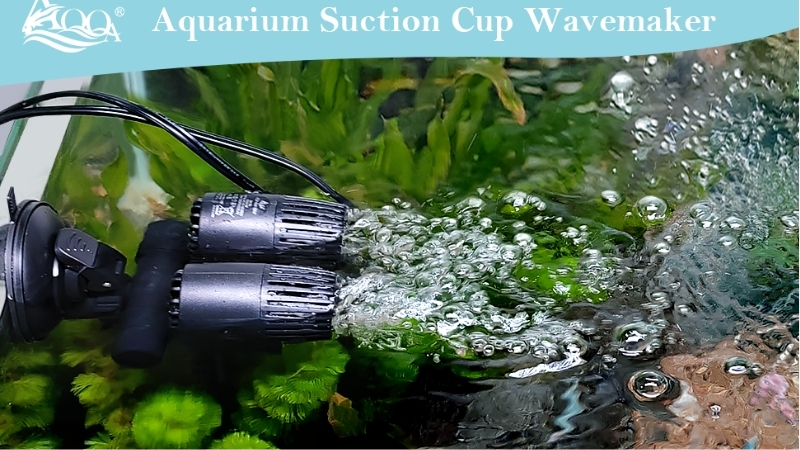
How a pump spreads water shapes a small tank more than its headline output. A wide, gentle flow keeps detritus moving without a jet that stresses fish, which is why modes matter. The HG222 offers constant, wave and pulse modes (hygger, 2026) to soften and vary movement on a nano.
Pulse and wave patterns create gentle back-and-forth motion many animals prefer to a steady stream. On 10 gallons, aim for movement that clears dead spots without a strong current, and remember that headline max GPH does not equal the local flow effect your tank actually feels.
Glass and Pump Footprint
A pump has to physically fit and mount on your tank. The AI Nero 3 is a compact 2.25 by 2.25 by 1.4-inch body rated for up to 0.5-inch glass, while the TUNZE 6040’s magnet holder supports up to 15 mm glass (AI, 2026; TUNZE, 2026). Check your rim and glass before buying.
On a small tank, a bulky pump dominates the view and eats swimming space, so a compact body helps. Confirm the magnet or mount suits your glass thickness, since an external-magnet pump will not couple properly through glass thicker than its rating, leaving a weak or slipping mount.
Best Wave Makers for a 10 Gallon Tank
These three span a verified low-end all-rounder, a budget pump sized exactly to this class, and a compact app-controlled option. They are separated by minimum flow and control, not by their biggest GPH number. Prices vary widely, so confirm the current model and variant before buying.
| Product | Best For | Key Spec | Watch Out For |
|---|---|---|---|
| TUNZE 6040 HUB | Best overall, verified low end | 53–1,190 GPH; 5.3–132 gal | Premium; needs controller |
| hygger HG222 9W | Best value, 5–10 gal SKU | 660 GPH max; six settings | Step flow not published |
| AI Nero 3 | Compact app control | 2.25 in body; ≤0.5 in glass | Minimum flow not published |
TUNZE 6040 HUB
The TUNZE 6040 HUB earns the top slot because its low end is verified: a 53 to 1,190 GPH range with its controller, a 5.3 to 132-gallon rating, 1.5 to 13W draw, and a magnet holder for up to 15 mm glass (TUNZE, 2026). It runs around $225 as of 09/2026, the priciest here.
That published minimum is exactly what a 10-gallon tank needs, letting you run genuinely gentle flow. It is premium and relies on its controller to reach the low end. For a nano keeper who wants to dial movement down with confidence rather than guess, it is the safest overall pick.
hygger HG222 9W
The hygger HG222 9W is the value choice sized to this class, rated 660 GPH for 5 to 10-gallon tanks with six settings and constant, wave and pulse modes (hygger, 2026). At around $45 to under $50 as of 09/2026, it costs a fraction of the TUNZE while giving real adjustability for a nano.
Picking the 9W SKU matters, since the 12W version targets 10 to 20 gallons; match the variant to your tank. Its step flow is not published, so treat the percentage labels as relative. For a straightforward, affordable nano wavemaker, it delivers the control that counts on 10 gallons.
AI Nero 3
The AI Nero 3 is the compact app-controlled option, a small 2.25 by 2.25 by 1.4-inch body rated for 2.5 to 60-plus gallons and up to 0.5-inch glass, with a 2,000 GPH maximum (AI, 2026). At about $200 at BRS as of 09/2026, it brings app scheduling to a nano-friendly footprint.
The tidy size and app control suit a clean nano build. The caveat for a 10-gallon tank is that AI does not publish a minimum flow, so you cannot confirm how gentle it runs from specs alone. Set it conservatively and watch the tank, since its headline maximum is far more than a nano needs.
Frequently Asked Questions
Nano keepers ask the same flow questions: how much movement a 10-gallon needs, whether a percentage equals that share of GPH, whether a big pump is too strong, where to place it, and whether glass thickness matters. Short answers first, then the caveats.
How much flow does a 10-gallon tank need?
It depends on the livestock, so treat any turnover figure as a starting point. Most nano fish and corals want gentle, even movement rather than a strong current, and the goal is enough flow to keep detritus suspended without stressing the animals. A tunable pump lets you find that by watching.
Because local velocity is what matters, start low and increase only if detritus settles or corals look under-served. A pump with a published minimum, like the TUNZE, makes this easier because you can begin genuinely soft rather than starting too strong on a small tank.
Does a 10% setting mean 10% of max GPH?
No. Percentage labels are relative positions, not exact fractions of maximum flow, and makers like hygger do not publish flow for each step. So a 10 percent setting on the HG222 does not equal 66 GPH from its 660 maximum; that calculation is not supported.
Judge settings by how the tank looks rather than by doing math on the label. Adjust until movement clears dead spots without blasting livestock, and treat the percentages as a convenient dial rather than a precise flow readout you can convert to GPH.
Will a big wavemaker be too strong for 10 gallons?
It can be, if it cannot dial low enough. A pump with a high maximum is only suitable if its minimum is gentle, which is why a published low end matters more than the ceiling. A large pump stuck at a high floor will overpower a nano no matter how you aim it.
Prioritize a low, verified minimum and good modes over a big maximum. If you do run a stronger pump, keep it at its lowest setting, use a pulse mode, and aim it across the surface rather than into the tank to soften the effect on small livestock.
Where should I place a wavemaker in a small tank?
Aim it to sweep across the tank and clear the spots where detritus collects, usually toward the surface or along a back corner rather than straight into the substrate or at fish. On a nano, placement changes the felt current as much as the setting does.
Avoid pointing it directly at corals or delicate fish, and watch how animals respond. A single well-placed pump usually circulates a 10-gallon tank; if a corner stays stagnant, adjust the angle before increasing output, since more flow aimed poorly just creates a stronger dead spot elsewhere.
Does glass thickness matter for the magnet mount?
Yes, for magnet-mounted pumps. The magnet has to couple through the glass, so a pump rated for up to 0.5-inch or 15 mm glass will not hold well on a thicker wall. Check your tank’s glass against the pump’s rated maximum before buying an external-magnet wavemaker.
Most nano tanks have thin enough glass that this is not an issue, but rimless tanks with thick walls can exceed the limit. If the mount feels weak or slips, the glass is likely too thick for that pump, and a different mounting style or model is the fix.
Final Thoughts
The best wave maker for 10 gallon tank setups is the one you can turn down, with a verified minimum, real modes, and a footprint that fits. The TUNZE 6040 HUB leads on published low-end control, the hygger HG222 9W is the value pick sized to this class, and the Nero 3 adds compact app control. Match the low end to your livestock first.
As an Amazon Associate we earn from qualifying purchases at no extra cost to you. Prices and availability are accurate as of the date shown and are subject to change.
Ready to decide? Our #1 pick for 2026 is the TUNZE 6040 HUB.
Live price & availability on Amazon.
Related Reviews & Guides

Best Budget Aquarium Rack: Affordable and Smart Top Picks
Best Black Sand Substrate for Aquarium: Well-Researched Pick