Last Updated: October 4, 2026
Thermoelectric chillers are small and quiet, which is why nano keepers love them, but the number that matters is degrees of cooling at your actual water volume, not the wattage on the box. The best semiconductor aquarium chiller for nano tanks is judged by verified temperature pulldown, with ventilation planned so the rejected heat has somewhere to go.
As an Amazon Associate we earn from qualifying purchases.
By David Nguyen
Quick answer: For most people in 2026, the best semiconductor aquarium chiller for nano tanks is the IceProbe — our #1 rated choice. See the full ranked comparison, alternatives and buying advice below.
How to Choose a Semiconductor Aquarium Chiller
Lead with measured performance, not electrical labels. A Peltier unit’s usefulness is how many degrees it drops your specific volume, and whether you can vent its heat. These four checks keep you from buying watts and hoping for cooling that was never specified.
Start With Verified Temperature Pulldown
Look for a degree figure tied to a volume. The IceProbe publishes a pulldown of 6 to 8 degrees Fahrenheit below ambient on a typical 10-gallon aquarium, which is exactly the kind of measured claim to prioritize over a bare wattage.
A verified pulldown tells you what the unit can realistically achieve; a wattage does not. Treat any chiller without a stated pulldown at a stated volume as unproven on the one metric that actually decides whether it will cool your tank.
Match Water Volume
Cooling scales down as volume grows. The same IceProbe drops roughly 3 to 4 degrees on 20 gallons and only 1 to 2 degrees on 40 gallons, so a unit that suits a 10-gallon nano tank does far less on a larger one.
Read the pulldown at your volume, not the smallest figure quoted. A thermoelectric unit is a nano-scale tool, and expecting a 10-gallon-rated pulldown to hold on a bigger tank is the fastest way to be disappointed by its performance.
Separate Electrical Watts From Cooling Capacity
Do not equate input power with cooling. The IceProbe draws 60 watts of electricity but is rated around 50 watts of cooling power, two different figures, so a “70W” unit does not automatically deliver 70 watts of cooling.
Peltier devices move heat from one side to the other, and a fan and heatsink reject it to the air; they do not destroy heat. Judge by the cooling figure or, better, the measured pulldown, rather than the electrical draw on the label.
Plan Ventilation and Installation
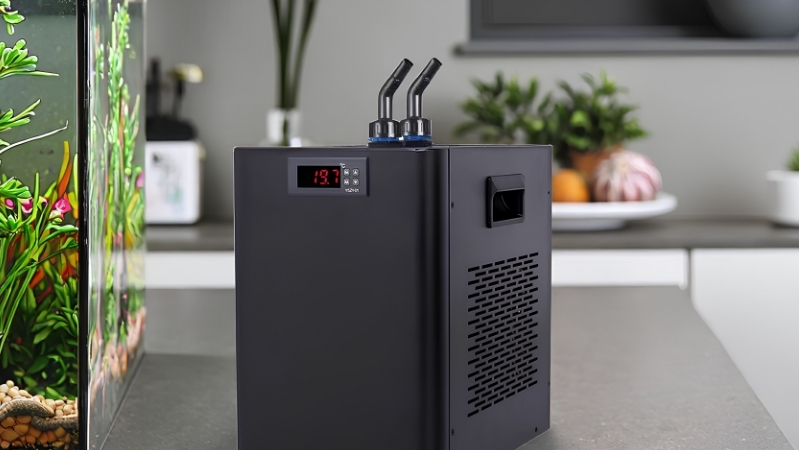
These units only work if the heat can escape. The IceProbe needs a 1.25-inch hole for installation and open air around its heatsink, so a sealed cabinet traps the rejected heat and cripples cooling.
Plan airflow before you buy. Leave clearance around the unit, avoid enclosing it, and confirm your setup can accommodate the installation cutout, since even a capable chiller fails when the heat it moves has nowhere to go.
Top Picks and Verified Limits
The verified market here is small, so this shortlist will not pretend generic units match the IceProbe’s tested performance. The IceProbe is the eligible Best Overall on verified pulldown; others are context. Prices are display figures checked in September 2026.
| Product | Best For | Key Spec | Watch Out For |
|---|---|---|---|
| IceProbe | Best Overall verified nano cooling | 6-8 degrees F at 10 gal | Ventilation/controller required |
| HURRISE 20L | Budget seller-listed option | 70W; 1-3 L/min | Cooling delta unverified |
| Generic 20L units | Comparison only | Often quote electrical watts | SKU data inconsistent |
| Compressor chiller category | Larger heat loads | Different architecture | Outside semiconductor keyword |
IceProbe
The IceProbe is the Best Overall for verified nano cooling, dropping 6 to 8 degrees Fahrenheit on a 10-gallon tank while drawing 60 watts of input power, for around $250 at BRS as of September 2026. Its published, volume-specific pulldown is what earns the top spot.
Plan for a 1.25-inch installation hole, open ventilation around the heatsink, and typically a separate controller to switch it. Its cooling scales down on larger tanks, so keep it to nano volumes where its measured pulldown genuinely holds.
HURRISE 20L
The HURRISE 20L is a budget, seller-listed option at around $125 as of September 2026, roughly 43.6 percent below the IceProbe. Its lower price and compact form appeal to keepers watching cost on a small tank.
The catch is that its actual temperature pulldown is unverified; the listing quotes 70 watts and a 1 to 3 liter-per-minute flow, but no matched cooling delta. Treat it as unproven on performance until a real degree figure at a stated volume appears.
Generic 20L Units
Generic 20-liter thermoelectric units exist mainly for comparison here, since they typically quote electrical watts rather than a measured pulldown. Their SKU data is often inconsistent, making it hard to know what you are actually buying.
Without a verified degree figure at a stated volume, a wattage number tells you little about cooling. Use these as a caution: a low price paired with only electrical specs is not evidence the unit will cool your nano tank as claimed.
Compressor Chiller Category
When the heat load is larger, a compressor chiller is the different architecture to consider, sitting outside the semiconductor keyword entirely. Compressor units handle continuous, heavier cooling that a Peltier device cannot sustain.
If your tank runs warm from strong lighting and pumps, or exceeds nano size, size a compressor chiller to the real heat load instead of stretching a thermoelectric unit. Recognize when semiconductor cooling is simply the wrong category for the job.
Frequently Asked Questions
Nano keepers ask how much these units actually cool and how to run them. The answers below stay with the IceProbe’s published figures and refuse to convert watts into a cooling promise.
How Much Can the IceProbe Cool a 10-Gallon Tank?
About 6 to 8 degrees Fahrenheit below ambient, according to its published table for a typical 10-gallon aquarium. That measured pulldown is the figure to plan around for a nano setup.
Ambient temperature and ventilation affect the real result, so treat the range as a guide under good airflow. It is enough to counter modest heat from lights and a small pump, not to fight a hot room without other measures.
Does 70W Electrical Mean 70W Cooling?
Not necessarily. Electrical input and cooling capacity are different figures; the IceProbe itself draws 60 watts but is rated around 50 watts of cooling, so a 70-watt electrical label does not equal 70 watts of cooling.
Peltier units move heat rather than destroy it, and efficiency depends on design and ventilation. Judge a chiller by its cooling figure or measured pulldown, never by assuming the electrical draw converts directly into cooling power.
Can One IceProbe Cool a 20-Gallon Tank?
Somewhat. The IceProbe’s published pulldown on 20 gallons is about 3 to 4 degrees Fahrenheit, less than on a 10-gallon tank, because the same cooling spreads across more water.
That may be enough for a small offset on a 20-gallon setup but not for aggressive cooling. Read the pulldown at your actual volume, and if you need more, look at a larger or different chiller rather than overtaxing one nano unit.
Can It Sit in a Closed Cabinet?
No. A thermoelectric chiller rejects heat through its heatsink and fan, so it needs open air; a closed cabinet traps that heat and cripples cooling, potentially raising temperatures instead.
Provide ventilation and clearance around the unit, and never seal it inside an enclosure. The whole design depends on moving heat to the surrounding air, so airflow is not optional for a semiconductor chiller to work.
Final Thoughts
Pick the best semiconductor aquarium chiller for nano tanks by verified degree pulldown at your actual volume, not by wattage, and plan ventilation so the rejected heat escapes. The IceProbe leads with a published 6-to-8-degree drop on 10 gallons, the HURRISE is a cheaper but unproven option, generic units mostly serve as cautionary comparisons, and a compressor chiller is the right call once the heat load outgrows nano scale.
As an Amazon Associate we earn from qualifying purchases at no extra cost to you. Prices and availability are accurate as of the date shown and are subject to change.
Ready to decide? Our #1 pick for 2026 is the IceProbe.
Live price & availability on Amazon.
Related Reviews & Guides



Best Mesh Lid for Aquarium: Top Compared DIY Screen Picks
Fluval vs Marineland Canister Filters Compared: Key Facts