Last Updated: October 4, 2026
These two planted-tank lights sit at opposite ends of the price and control spectrum, which makes an honest comparison tricky. With hygger vs fluval aquarium lights compared, the fit and price differences are clear, but light output can only be compared at the same depth, and one brand publishes depth-specific PAR while the other does not.
As an Amazon Associate we earn from qualifying purchases.
By David Nguyen
Quick answer: Our top pick in 2026 is the Fit — our #1 rated choice. See the full ranked comparison, alternatives and buying advice below.
How to Choose Between Hygger and Fluval Aquarium Lights
Match the fixture to your tank length first, then compare output only where the conditions align. Control style and water resistance round out the choice. These four checks keep a big price gap from masking what each light can actually document.
Match Fixture to Tank Length
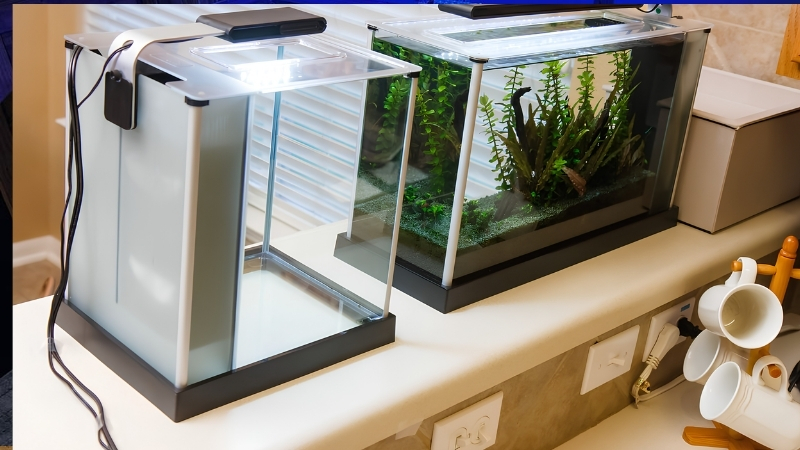
Confirm the light spans your tank. The Hygger HG999 in its 22-watt form fits 24 to 30-inch tanks, while the Fluval Plant 3.0, the Plant 4.0 here, fits 23 to 35 inches, so both cover common mid-size lengths.
Buy the size that matches your rim, since a fixture that is too short leaves dark ends and one too long overhangs. Note that both lines come in multiple wattages and lengths, so verify the exact variant fits before comparing anything else.
Compare PAR Only at the Same Depth
Light output is only comparable under matched conditions. The Fluval Plant 4.0 publishes 120 PAR at 12 inches and 70 PAR at 18 inches, while the Hygger lists a PAR claim of 153.4 with no stated measurement depth.
Because the Hygger’s depth is unstated, you cannot compare its number to Fluval’s depth-specific figures, so do not conclude the Hygger is stronger from 153 versus 120. Matched-depth PAR is the only fair basis, and only one light provides it here.
Choose Onboard 8-Period vs App Control
Decide how you want to program the light. The Hygger offers 8 onboard periods per day in its DIY mode, while the Fluval uses the FluvalConnect app for a 24-hour cycle, a local-control versus app-control difference.
Onboard scheduling works without a phone and avoids app dependence, while app control adds spectrum flexibility and remote tweaks. Neither is universally better; choose based on whether you prefer a self-contained controller or the convenience and firmware reliance of an app.
Check IP Ratings Without Assuming Submersion
Read the water-resistance ratings for what they mean. The Hygger carries an IP68 rating and the Fluval an IP67, but neither rating is an invitation to submerge the fixture in normal use.
IP ratings describe resistance to splashes and moisture around a tank, which matters for a humid aquarium hood. Treat them as protection against the environment, not a license to dunk the light, and mount either fixture to stay dry in routine operation.
Hygger vs Fluval by Use Case
This table compares the two lights on fit, power, control and output evidence, with PAR flagged as not directly comparable. The price and control gaps are large. Prices are display figures checked in September 2026 and move with stock.
| Factor | Hygger HG999 22W | Fluval Plant 4.0 32W | Best For |
|---|---|---|---|
| Fit | 24-30 in | 23-35 in | Similar mid-size |
| Power | 22W | 32W | Different electrical loads |
| Programming | 8 onboard periods | FluvalConnect app | Local vs app |
| PAR evidence | Condition unstated | 120@12in; 70@18in | Fluval has usable depth data |
Hygger for Lower Upfront Cost
The Hygger HG999 is the pick for lower upfront cost, a 22-watt fixture with 115 LEDs for around $30 as of September 2026, about 84 percent below the Fluval. For a tight budget, it is dramatically cheaper to buy.
Its 22-watt draw is roughly 45.5 percent below the Fluval’s 32 watts, but wattage is not plant-growth performance, so do not read the lower power as weaker light without matched PAR data. On price alone, the Hygger is the clear value.
Hygger for Controller-Based Scheduling
The Hygger also offers onboard, controller-based scheduling with 8 periods per day in DIY mode. If you prefer to program the light without an app, that self-contained control is a practical advantage.
Onboard periods let you build a daily ramp and hold without relying on phone connectivity or firmware. For keepers who want simple, local scheduling on a budget fixture, the Hygger’s 8-period control covers the basics well.
Fluval for Depth-Specific Output Planning
The Fluval Plant 4.0 is the pick for depth-specific output planning, publishing 120 PAR at 12 inches and 70 PAR at 18 inches, plus 2550 lumens, for around $175 as of September 2026. That data lets you plan for your tank’s depth.
Because it states PAR at defined depths, you can judge whether it suits demanding plants at your substrate level. That usable output evidence, absent from the Hygger’s unstated figure, is the Fluval’s strongest advantage for a serious planted tank.
Fluval for App-Based Spectrum Control
The Fluval also brings app-based spectrum control through FluvalConnect, with a full 24-hour cycle and adjustable color. For keepers who want fine spectrum tuning and remote scheduling, that flexibility justifies part of the premium.
App control adds convenience but also firmware dependence, so weigh that trade-off. If you value programmable spectrum and depth-specific output together, the Fluval delivers both, which is why it commands a price roughly 525 percent above the Hygger.
Frequently Asked Questions
Buyers ask which light is brighter, cheaper and better fitting. The answers below keep PAR comparisons honest and refuse to rank unmatched conditions.
Is Fluval Brighter?
The available data do not support a clean yes or no. The Fluval publishes 120 PAR at 12 inches and 70 at 18 inches, while the Hygger’s 153.4 figure has no stated depth, so the two cannot be compared directly.
Without matched-depth measurements, calling either brighter is guesswork. Judge the Fluval on its depth-specific data for your tank, and treat the Hygger’s unstated PAR as unverified for comparison rather than proof it is stronger.
Which Costs Less?
The Hygger, by a wide margin. At around $30 versus the Fluval’s under $200 as of September 2026, the Hygger is about 84 percent below the Fluval, a gap near under $200 at current prices.
That large difference reflects the Fluval’s app control and depth-specific output, not just brand. If budget is the priority and you do not need documented PAR at depth, the Hygger is the far cheaper entry.
Which Fits a 24-Inch Tank?
Both. The Hygger HG999 22-watt version covers 24 to 30 inches and the Fluval Plant 4.0 covers 23 to 35 inches, so either fits a 24-inch tank.
Since fit is not the deciding factor at that length, choose on price, control and output evidence instead. Just confirm you are buying the correct wattage and length variant, since both lines offer multiple sizes.
When Are Both Wrong?
Both are wrong when your tank falls outside their physical span or when you need a PAR level you cannot verify for the fixture. If demanding plants require documented output the Hygger does not provide, its unstated figure is a liability.
They are also poor fits for tanks longer or shorter than their ranges. Match the fixture to your length and your verifiable light needs, and step outside these two when neither can document the output your plants require.
Final Thoughts
With hygger vs fluval aquarium lights compared, the fair verdict is that price and control differ enormously while output is only comparable at matched depth. The Hygger HG999 wins on low cost and onboard scheduling, the Fluval Plant 4.0 wins on depth-specific PAR data and app spectrum control, so choose the budget fixture for simple planted setups and the Fluval when you need documented output at your tank’s depth.
As an Amazon Associate we earn from qualifying purchases at no extra cost to you. Prices and availability are accurate as of the date shown and are subject to change.
Ready to decide? Our #1 pick for 2026 is the Fit.
Live price & availability on Amazon.
Related Reviews & Guides

Aquarium Activated Carbon Media
Best Aquarium Heater With Over Temperature Protection Guide