Last Updated: October 4, 2026
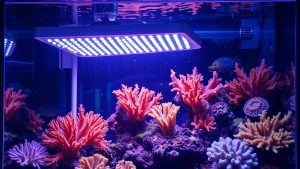
Corals respond to the photon field where they actually sit, not to the number on the box. The best reef safe aquarium light for corals is the current-generation fixture with verified PAR under stated conditions and coverage that matches your footprint, so you light the whole tank without guessing from wattage.
As an Amazon Associate we earn from qualifying purchases.
By David Nguyen
How to Choose Coral Lighting Without Guessing
Reef lights are easy to mis-buy because the marketing leans on wattage and surface brightness. What actually matters is PAR quoted with depth and conditions, coverage matched to your corals, spectrum control, and a footprint that fits before price enters the picture. These four criteria keep the choice grounded.
PAR Must Include Depth and Conditions
A PAR number is meaningless without the depth and setup it was measured at. Red Sea rates the ReefLED G2 60 at about 500 µmol/m²/s at the surface but roughly 100 at 20 inches deep, with the fixture about 7 inches above a 20-inch tank (Red Sea, 2026), which is unusually explicit.
Because makers test differently, you cannot compare one brand’s PAR directly to another’s. Do not calculate that one light produces a set percentage more or less than another when their conditions differ. Read PAR at your coral’s depth, and treat any single surface figure as only half the story.
Mixed Reef Coverage Is Not SPS Coverage
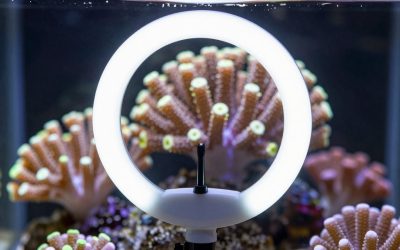
Coverage shrinks as light demand rises, so one fixture covers a smaller area for SPS than for softies. Kessil lists the A360XE at 24 by 24 inches for a mixed reef but 20 by 20 inches for SPS (Kessil, 2026), which is the same light rated honestly for two different demands.
Plan coverage around your most light-hungry corals, not the easiest. A fixture that blankets a mixed reef may leave SPS at the edges underlit, so size the footprint to the harder case. Two smaller lights sometimes beat one big one for even coverage across a demanding tank.
Spectrum Control vs Raw Wattage
Wattage tells you power draw, not coral light or spectrum quality. The ReefLED G2 60 runs 60W, the AI Hydra Edge 44HD 95W and the Kessil A360XE 90W (Red Sea, 2026; AI, 2026; Kessil, 2026), yet those numbers do not rank their output, because efficiency and optics differ between them.
What matters is a coral-friendly spectrum you can tune and enough delivered PAR at depth. The ReefLED covers 8,000 to 23,000K, running full power from 10,000K up (Red Sea, 2026). Judge a light by controllable spectrum and conditioned PAR, never by inferring output from the wattage alone.
Match Fixture Footprint Before Price
Buy for coverage first, then compare cost. The ReefLED G2 60 is rated for a 20 by 20-inch footprint, while the Hydra Edge 44HD spreads up to 30 by 30 inches at a 9-inch mounting height thanks to a 100-degree optic (Red Sea, 2026; AI, 2026). A cheaper light that under-covers is not a saving.
Map your tank’s footprint and coral depth, then pick a fixture that lights it evenly, and only then weigh the price difference. It is easy to overpay for a bright light that leaves corners dark, or to underspend and need a second unit, so let coverage lead the decision.
Current Reef-Safe Coral Lights
These three current-generation fixtures are separated by how their output is documented and how they cover a tank, not by wattage. Because each maker tests differently, treat their PAR figures as brand-specific rather than directly comparable. Confirm the current model and pricing before buying, since generations change.
| Product | Best For | Key Spec | Watch Out For |
|---|---|---|---|
| Red Sea ReefLED G2 60 | Best overall (20×20 in) | ~100 PAR @20 in; 60W | Footprint limited to 20×20 |
| AI Hydra Edge 44HD | Wider controllable spread | Up to 30×30 in; 100° optic | PAR map conditions partial |
| Kessil A360XE | Mixed and SPS guidance | 24×24 mixed; 20×20 SPS | Not the older A360X |
Red Sea ReefLED G2 60
The ReefLED G2 60 earns the top slot within its footprint because its output is unusually well documented: about 500 µmol/m²/s at the surface and 100 at 20 inches, over a 20 by 20-inch coverage, with a tunable 8,000 to 23,000K spectrum (Red Sea, 2026). It runs around $289 at US retail as of 09/2026.
That depth-specific PAR is exactly what buyers need and rare to find stated so clearly. The trade-off is coverage: it is designed for a 20 by 20-inch area, so larger tanks need multiple units. For a nano or standard reef within that footprint, it is the strongest evidence-backed pick.
AI Hydra Edge 44HD
The AI Hydra Edge 44HD is built for wider, controllable spread, using a 100-degree EdgeField optic to cover up to 30 by 30 inches at a 9-inch mounting height, with a 95W draw (AI, 2026). At about $400 at BRS as of 09/2026, it targets keepers who want broad, even coverage from one fixture.
Its manufacturer PAR map peaks around 125 with roughly 60 to 125 across the field, though the map is taken at a 24-inch height and the water geometry is incomplete, so read it as condition-limited. For spreading light evenly over a wider footprint with strong control, it is a compelling option.
Kessil A360XE
The Kessil A360XE gives clear coverage guidance for different corals: 24 by 24 inches for a mixed reef and 20 by 20 inches for SPS, at a 90W maximum draw (Kessil, 2026). Kessil also states a 15% output increase over the older A360X at the same power. It runs around $499 as of 09/2026.
That coverage-by-coral-type guidance makes planning easier, and the compact pendant look is popular. It is the priciest here, and you must confirm you are getting the current XE, not the older A360X, since listings can overlap. For flexible mixed-to-SPS coverage from a single pendant, it delivers.
Frequently Asked Questions
Reefers ask the same coral-lighting questions: how much PAR corals need, whether wattage indicates output, whether a reef spectrum is safe at any intensity, how high to mount a light, and whether one fixture covers a tank. Short answers first, then the caveats.
How much PAR do corals need?
It varies by coral. Softies and LPS generally want lower PAR than SPS, which favor higher light, and the useful figure is PAR at the coral’s actual depth, not the surface. Because a light like the ReefLED reads far higher at the surface than at 20 inches, always target the number where the coral sits.
Acclimate corals to new light gradually rather than jumping to full intensity, since even the right spectrum can bleach a coral if the intensity is too high too fast. Start moderate, watch coloration and polyp extension, and adjust over weeks rather than days.
Does higher wattage mean more coral light?
No. Wattage is power draw, and two fixtures at similar watts can deliver very different PAR depending on efficiency and optics. The ReefLED at 60W, Hydra Edge at 95W and A360XE at 90W cannot be ranked by those numbers, so wattage is not a proxy for coral light output.
Judge output by conditioned PAR and coverage instead. Use wattage only to estimate running cost and to sanity-check that a fixture is not underpowered for its footprint, never as the deciding spec for how much light reaches your corals.
Is a reef-safe spectrum safe at any intensity?
No. A coral-friendly spectrum still delivers photons, and too much intensity can bleach or burn corals regardless of the color mix. Reef-safe describes the spectrum, not a guarantee that any brightness is fine, so intensity and acclimation matter as much as the spectral quality.
Ramp intensity up slowly and match it to the coral’s needs and depth. The safe approach is a gradual acclimation with dimming or a shorter photoperiod at first, then increasing as corals adjust, rather than assuming a reef spectrum removes the risk of too much light.
How high should I mount a reef light?
It depends on the fixture, because mounting height changes both coverage and intensity. Raising a light widens the footprint but lowers PAR at depth, which is why makers quote coverage at specific heights, like the Hydra Edge’s 30 by 30 inches at 9 inches (AI, 2026).
Follow the manufacturer’s recommended height for your coverage goal, then verify PAR at coral depth if you can. Mounting too low concentrates a hot spot and leaves edges dark; too high spreads light thin. The right height balances even coverage against enough intensity where corals sit.
Can one fixture cover my whole tank?
Only if your tank fits within the fixture’s rated footprint for your corals. A single ReefLED covers 20 by 20 inches, so a larger tank needs multiple units, while a wider-spread light like the Hydra Edge covers more from one fixture. Match the rated coverage to your tank’s dimensions.
For long or SPS-heavy tanks, multiple fixtures usually give more even coverage than one stretched to its limit. Plan the number of lights around the harder coverage case, then confirm there are no dim corners once installed, adding a unit if the edges fall short.
Final Thoughts
The best reef safe aquarium light for corals is the current-generation fixture whose PAR is stated with depth and whose coverage fits your footprint, chosen on delivered light rather than wattage. The ReefLED G2 60 leads on documented depth PAR within 20 by 20 inches, the Hydra Edge spreads wider, and the A360XE guides mixed and SPS coverage. Match coverage and PAR to your corals first.
As an Amazon Associate we earn from qualifying purchases at no extra cost to you. Prices and availability are accurate as of the date shown and are subject to change.
Red Sea Reefmat 500 Vs Nanomat Which Roller: Top Compared

Aquarium Calcium Reactor for Reef Tanks