Last Updated: October 4, 2026
Quiet is hard to shop for, because the decibel numbers on the box are measured differently by every brand. The best quiet aquarium air pump for bedroom use is judged by real-world noise and vibration in your room, not by comparing published dB figures that use different, often unstated test distances and conditions, so there is no single winner.
As an Amazon Associate we earn from qualifying purchases.
By David Nguyen
Quick answer: For most people in 2026, the best quiet aquarium air pump for bedroom is the Hygger HG215 — our #1 rated choice. See the full ranked comparison, alternatives and buying advice below.
How to Choose a Quiet Bedroom Air Pump
Choosing well means reading dB claims carefully, separating pump noise from bubble noise, reducing furniture vibration, and not oversizing airflow. These four points matter because the published decibel numbers are not measured the same way, so real-world quietness depends on setup as much as on the pump itself.
Read dB Claims Carefully
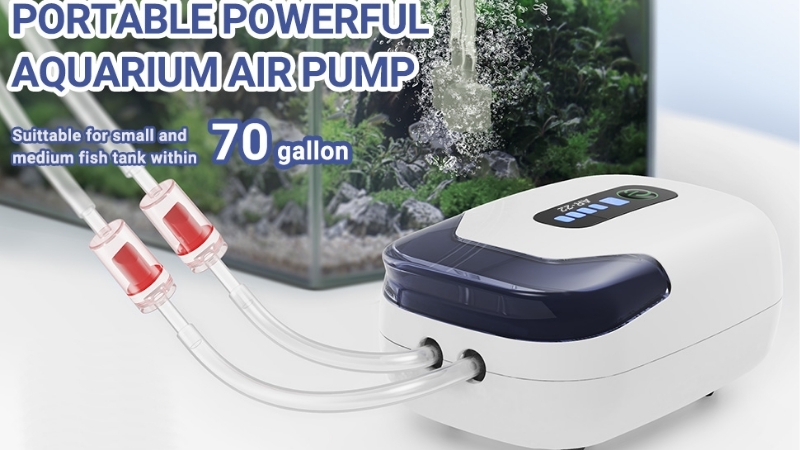
Published decibel figures look precise but are not comparable when the test conditions differ or go unstated. The hygger HG215 claims under 30 dB, the AQQA AQ012-2 claims 30 dB or less, and the Aquarium Co-Op single lists 43.5 dB, yet none share a stated measurement distance and method.
So treat these as rough indications, not a ranking, since decibels are logarithmic and the setups vary. Do not calculate that one is a set percentage quieter than another, because a lower number measured differently may not sound quieter in your actual bedroom at all.
Separate Pump Noise From Bubble Noise
The sound you hear at night is two things: the pump’s mechanical hum and vibration, and the bubbling and surface noise the air creates. A pump can be mechanically quiet yet still produce audible bubbling, so identify which noise bothers you before blaming the pump.
Reducing bubble noise may mean adjusting airflow, diffuser placement, or surface agitation, while reducing pump noise is about the unit and its mounting. So separate the two sources, since a quieter pump does nothing about a noisy air stone, and the fix differs depending on which one is keeping you awake.
Reduce Furniture Vibration
Much of a pump’s audible noise comes from vibration coupling into the furniture it sits on, which amplifies the hum. Placing the pump on rubber feet, a soft pad, or a folded towel isolates that vibration, and hanging it or setting it on a soft surface often helps more than the pump’s rating.
Do not, however, seal the pump inside an airtight enclosure, since it needs ventilation and its air intake unobstructed. So dampen vibration with soft isolation and keep tubing unpinched, which can quiet a pump in a bedroom far more than a small difference in a published decibel figure.
Do Not Oversize Airflow
A bigger pump run wide open is often louder, so match airflow to the tank rather than buying maximum output for a bedroom. The hygger HG811 moves a modest 420 milliliters per minute, suited to a nano, while higher-output pumps push far more air and, with it, more bubble and mechanical noise.
So size the pump to what the tank actually needs, or choose an adjustable model and turn it down. Right-sizing the airflow reduces both bubble noise and the strain that makes a pump hum, which for a bedroom often matters more than chasing the lowest headline decibel number.
Top Picks
Four pumps suit a quiet bedroom in different ways, and there is no verified overall winner on noise because the dB figures are not measured comparably. Prices are relative and current as of 09/2026, so choose by how each fits your tank size and room rather than by ranking the published decibel numbers.
| Model | Best For | Noise / Airflow | Watch Out For |
|---|---|---|---|
| Hygger HG215 | Low published dB with more flow | <30 dB; up to 80 GPH | dB test distance not given |
| Hygger HG811 | Nano bedroom tank | 1.5 W; 420 mL/min | Low airflow; nano only |
| AQQA AQ012-2 | Quiet rechargeable backup | <=30 dB; 2600 mAh | Noise test method not stated |
| Aquarium Co-Op single | Battery-backup ecosystem | 43.5 dB; 1.1 L/min | Higher published level; perception varies |
Hygger HG215 – Best for Low Published dB With More Flow
The hygger HG215 pairs a low published noise claim of under 30 dB with real output, up to 80 gallons per hour across two outlets at 3.5 watts, for under $30 as of 09/2026. It suits a bedroom tank that still needs meaningful airflow rather than just a trickle.
Its decibel claim does not state the test distance, so treat it as indicative rather than a guarantee it will be the quietest in your room. For a keeper who wants a low published level without sacrificing flow, it is a strong candidate, ideally set on soft isolation to tame vibration.
Hygger HG811 – Best for a Nano Bedroom Tank
The hygger HG811 is the nano bedroom choice, a piezoelectric design drawing just 1.5 watts and moving 420 milliliters per minute, about 6.66 gallons per hour of air, for under $20 to under $20 as of 09/2026, with the maker specifically mentioning bedrooms. Its low output suits a small tank quietly.
That modest airflow is a feature for a nano but too little for a larger tank, so match it to the volume. As a small, low-power pump aimed at bedrooms, it is a sensible pick for a nano where you want gentle aeration without a strong hum or heavy bubbling.
AQQA AQ012-2 – Best Quiet Rechargeable Backup
The AQQA AQ012-2 combines a quiet claim of 30 dB or less with a 2600 mAh rechargeable battery, running 14 to 18 hours normally or 25 to 28 hours intermittently, for under $30 as of 09/2026. It doubles as outage protection while aiming for low bedroom noise.
Its noise test method is not stated, so judge quietness in person rather than by the number alone. For a keeper who wants both a quiet bedroom pump and a rechargeable backup in one unit, it is a practical pick, with the usual caveat that runtime depends on the mode you run.
Aquarium Co-Op single – Best Battery-Backup Ecosystem
The Aquarium Co-Op single lists a higher 43.5 dB but backs a well-supported battery-backup ecosystem, delivering 1.1 liters per minute at 1.2 watts over 5V USB for under $30 as of 09/2026. Its published level is higher, though the method is not stated and perception varies.
So do not rule it out on the number alone, since a 43.5 dB figure measured one way may sound fine in practice, especially on soft isolation. Choose it for its dependable USB and battery-backup design and ecosystem, accepting that its published noise figure is the highest of this group.
Frequently Asked Questions
Quiet-pump questions focus on how many decibels is quiet enough, why pumps sound louder at night, cabinet placement, and whether a tiny pump is always quieter. Each answer leads with the direct call, then the acoustic detail that changes it for your particular room and setup.
How Many dB Is Quiet Enough for a Bedroom?
There is no universal cutoff, because published decibel figures use different, often unstated test protocols, so the same number can sound different in practice. A lower published dB does not guarantee a quieter experience if it was measured at a different distance or under a different load.
So rather than chasing a specific number, judge quietness in your own room and reduce vibration with soft isolation. Treat published figures as rough guidance, and remember decibels are logarithmic, so do not turn the gap between two figures into a simple percentage of how much quieter one is.
Why Is My Air Pump Louder at Night?
Because the background noise floor drops at night, a pump that was masked by daytime sound becomes noticeable, even though it is no louder. Furniture vibration also stands out in a quiet room, since the hum couples into the surface the pump sits on and the surrounding silence exposes it.
So the pump has not changed; your room has gone quiet around it. Reduce the perceived noise by isolating vibration with rubber feet or a soft pad, repositioning the pump, and taming bubble noise, which often helps far more at night than swapping to a slightly lower-rated pump.
Can I Put an Air Pump in a Cabinet?
You can, but only if the cabinet stays ventilated and the tubing is not pinched, since the pump needs airflow to its intake and must not overheat. Enclosing it can muffle noise, but sealing it airtight risks starving the intake and trapping heat, which can shorten the pump’s life.
So place it in a ventilated cabinet on a soft pad to dampen vibration, keeping the air intake clear and the airline unkinked. This can reduce audible noise in a bedroom, but never fully seal the pump away, since ventilation matters more than the extra bit of quiet from a closed box.
Is a Tiny Pump Always Quieter?
No, because noise depends on the mechanical design and how the pump couples to its surface, not just its size. A small pump can hum audibly if it vibrates against furniture, while a well-designed larger pump on soft isolation may be quieter, so size alone does not decide quietness.
So judge by design and mounting rather than assuming smaller is silent. A tiny nano pump like the HG811 can be very quiet, but the fix for any pump is right-sizing the airflow and isolating vibration, which matters more than picking the physically smallest unit you can find.
Final Thoughts
The best quiet aquarium air pump for bedroom use is judged by real-world noise, since published dB figures use different, unstated test setups, so there is no single overall winner. The hygger HG215 pairs a low claim with flow, the HG811 suits a quiet nano, the AQQA AQ012-2 adds a rechargeable backup, and the Co-Op single anchors a battery ecosystem. Isolate vibration, separate pump noise from bubble noise, and right-size the airflow.
As an Amazon Associate we earn from qualifying purchases at no extra cost to you. Prices and availability are accurate as of the date shown and are subject to change.
Ready to decide? Our #1 pick for 2026 is the Hygger HG215.
Live price & availability on Amazon.
Related Reviews & Guides


Best Heater for 10 Gallon Tank: Watts, Fit and Safety Tips
Best External Aquarium Temperature Controller: Top Picks