Last Updated: October 21, 2026
Best filter for 55 gallon aquarium setups is really two separate problems arriving at once. You need enough turnover for the water volume itself, and you need that flow distributed across a footprint 48 in (122 cm) long, which is something a single unit sitting at one end very rarely manages on its own.
As an Amazon Associate we earn from qualifying purchases.
As an Amazon Associate we earn from qualifying purchases at no extra cost to you.



By David Nguyen
Turnover Plus Distribution Across Four Feet
At this size the filter stops being an accessory and starts being infrastructure. Choosing the best filter for 55 gallon aquarium use means sizing for real volume, allowing for loaded flow, and planning where the water actually goes.
The Deciding Numbers: Real Volume, Turnover and Loaded Flow
A 55 gallon (208 L) tank holds roughly 47-50 gallons (178-189 L) once substrate, hardscape and the surface gap are subtracted. That is the figure every calculation below uses rather than the number on the box.
Community stocking wants 4-6 times turnover per hour, or roughly 190-280 GPH (719-1060 LPH) of actual flow. Goldfish and cichlids want 8-10 times, which is 380-470 GPH (1438-1779 LPH) and puts most single hang-on-back units out of contention.
Then allow for loading. Printed GPH is measured with an empty housing and real flow drops 30-50% once media and hoses are in place, so a community tank needs a unit rated around 300-400 GPH (1136-1514 LPH) to land in range.
The Other Criteria: Distribution, Media Capacity and Noise
Distribution is the criterion unique to the best filter for 55 gallon aquarium question. A standard 55 gallon measures about 48 x 13 x 21 in (122 x 33 x 53 cm), and a single outflow at one end leaves the opposite corner slow, which is where black beard algae and cyanobacteria establish first.
Media capacity matters here in a way it does not at 20 gallons. A larger bioload needs more biological surface area, and a filter with a genuinely large media volume handles a stocking increase without needing replacement.
Noise is the third criterion and it depends on the room. Canisters are quietest, hang-on-back units hum and splash increasingly as the water level drops, and air pumps buzz against any hard surface they are resting on.
Tank Size, Placement and Fit
Weight is the constraint people underestimate. A filled 55 gallon tank passes 600 lb (272 kg) with substrate and rock at roughly 10 lb/gallon (about 1 kg/L), which belongs on a purpose-built stand over floor joists rather than on a flat-pack cabinet.
Measure before you order: cabinet interior height against canister height plus the hose bend above it, 4-6 in (10-15 cm) behind the tank for any hang-on-back unit, and the cabinet door opening, since a canister has to come out for maintenance.
The Options by Need
These five cover what works as a best filter for 55 gallon aquarium choice. Each is grouped by the situation it fits rather than ranked, since the best filter for 55 gallon aquarium use depends heavily on stocking and on what sits under the tank.
For Most Community Tanks: One Canister
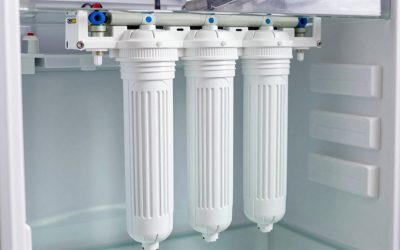
A canister rated 300-400 GPH (1136-1514 LPH) sits in the cabinet, holds substantial media, and lets you place inflow and outflow at opposite ends of the four foot footprint. That last point solves the distribution problem directly.
Who it suits: community tanks with a closed stand and anyone wanting no visible equipment. Who it does not: people unwilling to handle hoses and periodic teardowns, and anyone whose cabinet lacks the interior height, which is a common and expensive discovery after delivery.
For Simpler Maintenance: Two Hang-on-Back Units
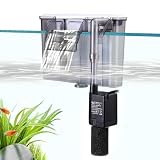
Two hang-on-back filters rated around 200 GPH (757 LPH) each, placed at opposite ends, deliver combined flow in range and cover the footprint. Maintenance is simpler than a canister and either unit can be serviced while the other keeps running.
Who it suits: open stands, anyone nervous about hoses, and anyone who values redundancy. Who it does not: aquascapers, since two units are visible along the back, and tanks pushed against a wall without the rear clearance for either one.
Cleaning them on alternating months is the practical advantage. One fully colonised filter is always running, which removes the mini-cycle risk that follows servicing a single unit and makes the maintenance schedule easier to keep.
For Goldfish and Cichlids: Canister Plus a Second Unit
Heavy bioloads want 8-10 times turnover, or 380-470 GPH (1438-1779 LPH). A single canister plus a hang-on-back or a sponge filter reaches that while spreading flow, and it gives you mechanical capacity that a single unit struggles to provide.
Who it suits: goldfish, larger cichlids and any tank stocked toward its limit. Who it does not: lightly stocked planted tanks, where the combined current disturbs plants and substrate without any biological benefit.
For Quiet Rooms: Canister With a Sponge Backup
Canisters are the quietest powered option at this size, since the motor sits inside a sealed housing in a cabinet. Pairing one with an air-driven sponge filter adds a colonised backup without the hum of a second powered unit.
Who it suits: bedrooms, studios and open-plan living spaces. Who it does not: anyone who finds air pump buzz worse than motor hum, since the pump still needs isolating from hard surfaces to be genuinely quiet.
For Long-Term Builds: Sump
A sump moves all equipment below the tank, offers the largest media capacity available and makes water changes and top-offs easier. It is the most capable option here and the most involved to set up.
Who it suits: people planning to keep this tank for years and comfortable with plumbing. Who it does not: renters, anyone without a drilled tank or willing to use an overflow box, and anyone who has not calculated the drain-down volume during a power cut.
That drain-down figure is the one to work out before buying anything. When power fails, water siphons back until the level drops below the overflow, and the sump has to hold that volume without overflowing onto the floor.
| Option | Rated flow needed | Distribution | Recurring cost | Who it suits |
|---|---|---|---|---|
| Single canister | 300-400 GPH (1136-1514 LPH) | Good, inflow and outflow separated | Floss, seals occasionally | Community tanks, closed stands |
| Two hang-on-back units | 200 GPH (757 LPH) each | Good, one at each end | Floss, impellers | Open stands, redundancy |
| Canister plus second unit | 380-470 GPH (1438-1779 LPH) combined | Best for heavy bioload | Floss for both | Goldfish and cichlids |
| Canister plus sponge | 300-400 GPH (1136-1514 LPH) | Good, quiet | Floss, air stone yearly | Bedrooms and quiet rooms |
| Sump | Return pump after head loss | Excellent, fully adjustable | Floss, pump servicing | Long-term builds, plumbing comfort |
Direct Comparisons and Who Should Not Buy
One comparison decides most best filter for 55 gallon aquarium purchases, one popular choice is a genuine mistake, and one arrangement costs less than the obvious answer while working better.
One Canister Versus Two Hang-on-Back Units
A canister is quieter, hides completely and holds more media, at the cost of hoses, priming and periodic full teardowns. Two hang-on-back units are louder and visible, and either can be cleaned or replaced without the tank ever losing filtration entirely.
Redundancy is the argument people underweight. A single canister failing on a heavily stocked 55 gallon tank is a serious event, while one of two hang-on-back units failing is an inconvenience you notice at the next water change.
Who Should Not Buy a Single Small Filter
A unit rated 200 GPH (757 LPH) alone is the most common undersizing at this volume. After loading it delivers perhaps 100-140 GPH (379-530 LPH), which is under two times turnover on 47-50 gallons of water and leaves half the tank barely circulated.
The symptom is predictable rather than dramatic. Ammonia stays at zero while detritus accumulates in the far corners, black beard algae appears on hardscape at the slow end, and nobody connects it to the filter for months.
The Arrangement That Costs Less and Works Better
Two mid-sized hang-on-back units usually cost less combined than one large canister, cover the footprint better than a single unit at one end, and need no hoses or priming. For most community 55 gallon tanks this is the practical answer.
Seeding still matters more than hardware. Moving colonised biological media from an existing filter into the new one shortens the three to eight week cycle far more than any specification difference between models.
Plants and stocking pace help as well. Adding fish in small groups two to three weeks apart lets the colony grow with the load, which matters more on a tank this size because a full stocking added at once is a substantial ammonia input.
Living With It: Failures and Twelve-Month Costs
Any best filter for 55 gallon aquarium choice runs continuously for years under a real bioload, so failure modes and running costs matter far more than purchase price.
Where Each Type Typically Fails
Canisters leak at perished gaskets, which puts water on the floor under a cabinet rather than in a tray you notice. Hoses accumulate biofilm and reduce flow gradually, and re-priming after maintenance is where most people lose patience.
Hang-on-back units lose prime after a power interruption and can run dry silently, with intake tubes falling short as evaporation drops the water level. Impellers in both types wear, rattle and eventually stall, usually with no warning beforehand.
Storm season across much of North America runs roughly June to November, and a filter stopped for several hours starves its bacteria of oxygen. Rinse the mechanical media in tank water before restarting rather than pushing stagnant housing water back into the display.
What It Costs to Keep Running
The recurring items are mechanical floss in volume, gaskets and impellers occasionally, and continuous electricity for one or two motors. At this size wattage is worth checking on the specification, since it runs every hour of the year.
Prices change constantly, so check at the time of purchase. Larger equipment is genuinely cheaper during the mid-year and late-November sale periods, and a canister is exactly the item worth timing that way, though it changes nothing about the three to eight weeks of cycling still required before fish go in.
Warranty, Spares and Electrical Safety
Warranties generally separate the housing from moving parts, treating impellers, gaskets and hoses as consumables. Check whether seals and impellers are sold individually, because a canister with available spares lasts many years longer than one where a perished gasket means replacing the whole unit.
Electrical safety is a selection criterion. Anything beside water should carry a UL or ETL mark, every powered device belongs on a GFCI outlet with a drip loop, and a cabinet holding a canister should be checked for leaks whenever you open it.
Frequently Asked Questions
These four come up most often when someone is filtering a first four foot tank and the available options differ by a large margin in price.
What GPH do I actually need?
Roughly 190-280 GPH (719-1060 LPH) of real flow for community stocking in the 47-50 gallons (178-189 L) this tank really holds, or 380-470 GPH (1438-1779 LPH) for goldfish and cichlids. Buy rated 300-400 GPH (1136-1514 LPH) to allow for loading losses.
Is one canister enough on its own?
For community stocking, usually yes, provided inflow and outflow sit at opposite ends of the footprint. For goldfish or cichlids, add a second unit both for turnover and because a single point of failure on a heavy bioload is a risk worth removing.
Do I need a sump?
No. Sumps offer the most capacity and the most convenience, and they require plumbing, a drilled tank or an overflow, and a calculation of how much water drains back during a power cut. They are a choice rather than a requirement at 55 gallons.
How often should I clean a canister?
Rinse mechanical media every four to eight weeks in a bucket of tank water, and do a fuller service including hoses roughly twice a year. Never rinse biological media under the tap, since chlorine and chloramine kill nitrifying bacteria on contact.
See More:
The Bottom Line
For community stocking the best filter for 55 gallon aquarium use is a canister rated 300-400 GPH (1136-1514 LPH) with inflow and outflow placed at opposite ends of the four foot footprint, which solves turnover and distribution in one purchase. For goldfish or cichlids, add a second unit to reach 8-10 times turnover. The lower-cost arrangement is two mid-sized hang-on-back filters at opposite ends, which usually costs less than one canister, needs no hoses, and means a failure never leaves the tank unfiltered.
Product links and buying checks
As an Amazon Associate, we earn from qualifying purchases.
- Fluval 307 canister filter on Amazon — A canister example for a 55-gallon setup, within the manufacturer’s 40–70 US gallon range. Check the stocked tank’s circulation and bioload rather than treating the tank rating as a guarantee.
Prices, availability and included accessories can change. Review the current listing and the compatibility guidance above before purchasing.
Best Aquarium Stand That Fits A Sump Underneath: Top Compared
How to Size an Aquarium Filter: Turnover, Losses and Fit