Last Updated: October 21, 2026
- Top Pick: Tetra Whisper IQ 130 GPH Power Filter for Aquariums
- Best Value: Coospider 20 Gallon Glass Fish Tank, Aquarium Starter Kit, Simple Self-Cleaning Aquarium with 3-Color LED Lights, with Quiet Filter Pump, with Temperature Monitoring for Fish, Shrimp, Kids Gift Ideas
- Premium Choice: Tetra Whisper EX 20 Aquarium Filter
Best filter for 20 gallon aquarium setups carries an extra complication that most guides skip entirely: a 20 gallon long and a 20 gallon high hold the same water but have completely different footprints, and that difference changes both which filter physically fits and how flow actually moves through the tank.
As an Amazon Associate we earn from qualifying purchases.
As an Amazon Associate we earn from qualifying purchases at no extra cost to you.



By David Nguyen
Long or High Changes the Answer
Twenty gallons is the size where most people stop improvising and start sizing properly. The best filter for 20 gallon aquarium use is decided by real water volume, loaded flow, and whether the tank is the long or the high version of the footprint.
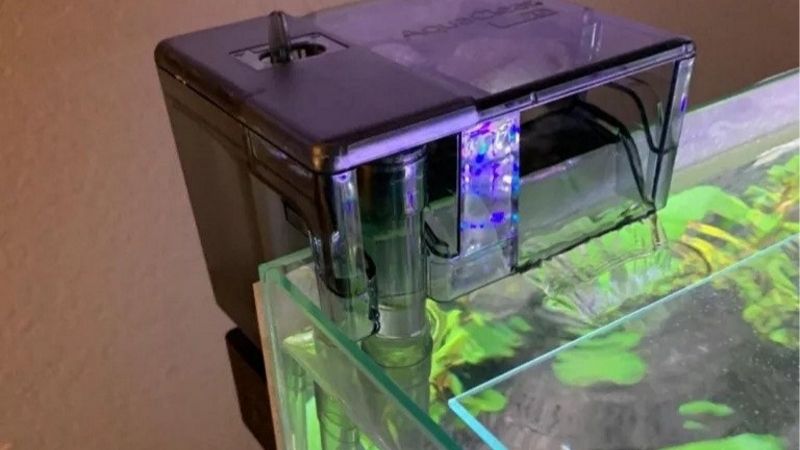
The Deciding Numbers: Real Volume, Turnover and Loaded Flow
Start with real volume. A 20 gallon (76 L) tank holds roughly 17-18 gallons (64-68 L) once substrate, hardscape and the surface gap are subtracted. Every calculation below uses that figure rather than the number printed on the box.
Turnover for community stocking is 4-6 times per hour, which puts this tank at roughly 70-110 GPH (265-416 LPH) of actual flow. Heavier bioloads such as a small group of cichlids push toward 8-10 times, or 140-180 GPH (530-681 LPH).
Then allow for loading. Printed GPH is measured with an empty housing and real flow drops 30-50% once media and tubing are in, so a unit rated 150-200 GPH (568-757 LPH) delivers the right amount for community stocking in service.
The Other Criteria: Footprint, Media System and Noise
Footprint decides flow distribution more than any best filter for 20 gallon aquarium specification does. A 20 gallon long measures about 30 x 12 x 12 in (76 x 30 x 30 cm), so a single outflow at one end leaves the far corner slow, while a 20 gallon high at 24 x 12 x 16 in (61 x 30 x 41 cm) circulates more readily from one point.
Media system decides the running cost across twelve months. Loose media lets you replace floss while keeping colonised biological media in place, and cartridge systems discard that colony every time the insert is swapped.
Media order is worth getting right and costs nothing. Water should pass through mechanical first, then biological, then chemical if used at all, because floss placed after the bio media lets debris clog the surfaces you were trying to protect.
Tank Size, Placement and Fit
Hang-on-back units need 4-6 in (10-15 cm) of clearance behind the glass, and a thick rim brace can stop one seating properly. The long footprint also means a single unit may need repositioning toward the middle rather than the corner.
Measure before you order: rear clearance against unit depth, cabinet interior height if you are considering a canister, and stand capacity against roughly 10 lb/gallon (about 1 kg/L). A filled 20 gallon tank runs around 225 lb (102 kg) with substrate.
The Options by Need
These five cover what works as a best filter for 20 gallon aquarium choice. Each is grouped by the tank it suits rather than ranked, because the best filter for 20 gallon aquarium use changes with stocking and with which footprint you bought.
For Standard Community Tanks: Hang-on-Back With Loose Media
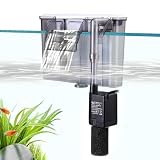
A hang-on-back rated 150-200 GPH (568-757 LPH) with a media basket is the default choice here, delivering roughly 70-110 GPH (265-416 LPH) once loaded. It handles mechanical and biological filtration and lets you choose every layer.
Who it suits: tetras, rasboras, corydoras and similar community stocking with rear clearance available. Who it does not: bettas without a baffle, tanks pushed flat against a wall, and anyone who lets the water level drop, since these units lose prime and can run dry.
For Planted and Aquascaped Tanks: Small Canister
A canister holds far more media, sits out of sight in the cabinet, and lets you place the inflow and outflow at opposite ends of a 20 gallon long. Flow is adjustable and noise is the lowest of any powered option.
Who it suits: planted tanks, long footprints and anyone wanting no equipment visible in the tank. Who it does not: beginners unwilling to handle hoses and priming, and nano keepers, since a canister is more machine than a lightly stocked tank of this size needs.
Check the cabinet before committing. A canister needs its own height plus room for the hose bend above it, and a stand designed as a display shelf frequently has less usable interior height than the outside dimensions suggest.
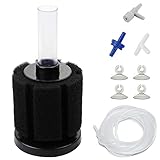
For Shrimp and Quarantine: Sponge Filter, Usually Paired
An air-driven sponge filter gives biological filtration with gentle flow and cannot draw in shrimplets. At 20 gallons it is usually run alongside another filter rather than alone, unless stocking is genuinely light.
Who it suits: shrimp tanks, breeding setups and as a second filter for redundancy. Who it does not: community tanks as a sole filter, since mechanical filtration is limited and the water stays visibly less polished than with a powered unit.
For Tanks Against a Wall: Internal Power Filter
An internal filter sits submerged, removing the rear clearance requirement and the prime-loss risk entirely. Models rated for 20 gallons are readily available and most have adjustable flow.
Who it suits: tanks in tight spaces, hooded tanks and anyone who has already had a hang-on-back run dry. Who it does not: aquascapers, since the housing occupies visible volume, and heavily stocked tanks, where media capacity is the limiting factor.
For Heavier Bioloads: Two Filters Instead of One
Running a hang-on-back plus a sponge filter, or two smaller hang-on-back units, spreads flow across a long footprint and means no single cleaning session or failure removes the whole bacterial colony.
Who it suits: 20 gallon long tanks, heavier stocking, and anyone who wants redundancy. Who it does not: people counting watts closely, since two units draw more power continuously, and anyone with limited rear clearance to work with.
Splitting flow has a maintenance benefit as well. Cleaning one unit this month and the other next month keeps a fully colonised filter running at all times, which removes the most common cause of mini-cycles in an established tank.
| Option | Rated flow needed | Suits | Recurring cost | Who it suits |
|---|---|---|---|---|
| HOB, loose media | 150-200 GPH (568-757 LPH) | Community stocking | Floss only | Most 20 gallon tanks |
| Small canister | 150-250 GPH (568-946 LPH) | Planted and long footprints | Floss, seals occasionally | Aquascapes, hidden equipment |
| Sponge filter | Gentle, air-driven | Light stocking or as a second unit | Air stone yearly | Shrimp, breeding, redundancy |
| Internal power filter | 150-200 GPH (568-757 LPH) | Tanks against a wall | Sponge and floss | Tight spaces, hooded tanks |
| Two filters combined | Split across units | 20 gallon long, heavier bioload | Floss plus air stone | Redundancy and even flow |
Direct Comparisons and Who Should Not Buy
One comparison dominates the best filter for 20 gallon aquarium question, one purchase is usually unnecessary, and a cheaper arrangement outperforms a single larger unit on a long tank.
Hang-on-Back Versus Small Canister
A hang-on-back is cheaper, simpler to maintain and easier to restart, at the cost of visible equipment, more noise and the risk of losing prime. A canister is quieter, holds more media and hides in the cabinet, at the cost of hoses, priming and a higher purchase price.
At 20 gallons either works. The deciding factors are usually the footprint and the cabinet: a 20 gallon long with a closed stand favours the canister, while a 20 gallon high on an open shelf favours the hang-on-back.
Who Should Not Buy a Canister at This Size
A canister rated for 55 gallons (208 L) on a 20 gallon tank is a common overbuy. Excess flow disturbs planting and stresses long-finned fish, and the extra media capacity does nothing biologically once the colony has sized itself to the waste available.
The maintenance load is also real. Canisters need periodic full teardowns, hose cleaning and re-priming, which is more involved than most people expect from a tank this size, and skipping it produces the gradual flow loss these units are known for.
The Cheaper Arrangement Worth Considering
A modest hang-on-back paired with an air-driven sponge filter costs less than one large canister, spreads flow across a long footprint, and gives you a colonised backup that survives any cleaning session or equipment failure.
Seeded media still beats hardware. A handful of biological media from an established tank shortens the three to eight week cycle more reliably than any filter choice, and it costs nothing when someone nearby has a running tank.
Plants contribute at this volume too. Fast-growing stems and floating species take up ammonium directly, supporting the filter rather than replacing it, and they cost less than the difference between two filter models.
Living With It: Failures and Twelve-Month Costs
Any best filter for 20 gallon aquarium choice runs for years, so failure modes and the recurring bill matter more than anything on the specification sheet.
Where Each Type Typically Fails
Hang-on-back units lose prime after a power interruption and can run dry silently. Intake tubes fall short as water evaporates, impellers wear and rattle, and lids warp over time until they overflow down the back of the tank.
Canisters leak at perished gaskets, lose flow gradually as hoses accumulate biofilm, and are awkward to re-prime after maintenance. Sponge filters clog into larger bubbles and reduced circulation, and air pump diaphragms stiffen across a few years of continuous use.
What It Costs to Keep Running
The recurring items are mechanical floss, occasional impellers and gaskets, air stones where relevant, and continuous electricity. Cartridge-based units add a fixed monthly purchase that none of the loose-media options require.
Prices change constantly, so check at the time of purchase. Compare the twelve-month running total rather than the shelf price, and include wattage, because a filter draws power every hour of every day for the life of the tank.
Warranty, Spares and Electrical Safety
Warranties generally separate the housing from moving parts, treating impellers, gaskets and suction cups as consumables. Check whether spares are sold individually, since a canister with available seals lasts many years longer than one without.
Electrical safety is a selection criterion rather than a footnote. Anything beside water should carry a UL or ETL mark, and every powered device belongs on a GFCI outlet with a drip loop in the cable.
Larger equipment is genuinely cheaper during the mid-year and late-November sale periods, and a canister is exactly the sort of purchase worth timing that way. It changes nothing biological, since the tank still needs three to eight weeks of cycling before fish go in.
Frequently Asked Questions
These four come up most often when someone is filtering a 20 gallon tank and the shop has offered both a hang-on-back unit and a canister.
What GPH do I actually need?
Roughly 70-110 GPH (265-416 LPH) of real flow for community stocking in the 17-18 gallons (64-68 L) this tank really holds. Buy a unit rated 150-200 GPH (568-757 LPH) to allow for the 30-50% loss once media is loaded.
Does a 20 gallon long need different filtration?
The volume is the same but the distribution is not. A 30 in (76 cm) footprint leaves a slow far corner with a single outflow, so either reposition the unit toward the middle, use a canister with separated inflow and outflow, or add a second filter.
Can I use one filter for a heavily stocked tank?
You can, if it is rated for the 8-10 times turnover heavier bioloads need, which is 140-180 GPH (530-681 LPH) of real flow. Two smaller units often distribute that better and protect you against a single failure.
How often should I clean it?
Rinse mechanical media monthly in a bucket of tank water, never under the tap, and clean only one part at a time. Chlorine and chloramine kill nitrifying bacteria on contact, which is the fastest way to trigger a mini-cycle.
See More:
The Bottom Line
The default best filter for 20 gallon aquarium use is a hang-on-back with a loose media basket, rated 150-200 GPH (568-757 LPH) so real flow lands in the 70-110 GPH (265-416 LPH) range those 17-18 gallons of water actually need. On a 20 gallon long, either reposition it toward the centre or add a second unit for the far corner. The lower-cost arrangement is a modest hang-on-back paired with an air-driven sponge filter, which costs less than a canister, spreads flow better and leaves you a colonised backup when something fails.
Product links and buying checks
As an Amazon Associate, we earn from qualifying purchases.
- AquaClear 30 power filter on Amazon — A hang-on-back example rated for 10–30 gallons. Confirm circulation, stocking and flow strength for your particular 20-gallon aquarium.
Prices, availability and included accessories can change. Review the current listing and the compatibility guidance above before purchasing.
Aquarium Filter Buying Guide for Beginners in 2026: What Actually Matters
Aquarium Filter 20 Gallon: Top Picks Compared in 2026