Last Updated: October 17, 2026
An arowana needs a very large tank: a single adult silver arowana is generally kept in at least 250 gallons (about 950 litres), with a long footprint (Seriously Fish gives a minimum length of 2 m), a heavy tight-fitting lid, warm soft-to-neutral water and a diet of live or meaty foods, and it is commonly quoted to live 10 to 15 years, with some sources reporting more. It is a surface-hunting predator that reaches roughly 80 to 90 cm (about 3 ft) and jumps readily, so it is not a fish for small or casual setups. The Asian arowana is a different case again, because it is protected under CITES and, in the United States, is listed as endangered, which in practice puts it out of reach of private keepers.
Quick answer: Our top pick in 2026 is the Adult size — our #1 rated choice. See the full ranked comparison, alternatives and buying advice below.
Arowana Quick Facts
| Trait | Silver arowana (Osteoglossum bicirrhosum) |
|---|---|
| Adult size | Roughly 80 to 90 cm (31 to 35 in): Seriously Fish gives 80 cm standard length, FishBase 90 cm total length |
| Minimum tank (adult) | About 250 gallons (950 L) is commonly advised, at least 2 m long per Seriously Fish; juveniles may start smaller, but plan for the adult tank |
| Tank shape | Long and wide; adults live in the top 30 cm (12 in) of water. Depth matters less than length and width |
| Temperature | About 24 to 30 C (75 to 86 F); sources range from 20 to 30 C |
| pH / hardness | Seriously Fish lists pH 5.0 to 7.5 and 2 to 15 dGH; other sources go up to about 8.0; soft, slightly acidic to neutral water is typical |
| Diet | Carnivore: insects, shrimp, fish pieces, earthworms, quality pellets |
| Lifespan | 10 to 15 years commonly cited; some sources report longer, and figures vary |
| Temperament | Peaceful to fish too big to swallow, predatory toward smaller fish; skittish and prone to jumping |
| Care level | Advanced (space, lid and cost of keeping a large predator) |
Which Arowana? Silver, Black and Asian
The word arowana covers several fish with different needs and legal status. Knowing which one is in the shop tank is the first decision.

A.D.P. Carnivorous Arowana Fish Food, 55% High Protein Floating Pellets with Astaxanthin & Spirulina, Tropical Fish Feed for Arowana, Oscar, Pleco & Catfish, Color Enhancing - 100 g
Included for 'Arowana Care Guide: Tank Size, Diet and Lifespan' because the listing specifies Tropical Fish Feed for Arowana and Oscar, details this guide uses to compare options.
View on Amazon
toyuto High Protein Floating Sticks Fish pellets for Arowana,Oscars,Flower Horns,Red Parrots Arowana pellets,1kg (2.2lb)
Included for 'Arowana Care Guide: Tank Size, Diet and Lifespan' because the listing specifies Oscars and Flower Horns, details this guide uses to compare options.
View on Amazon
Toyuto High Protein Floating Sticks Fish Pellets for Arowana, Oscars, Flower Horns, Red Parrots, 1kg (2.2lb)
Included for 'Arowana Care Guide: Tank Size, Diet and Lifespan' because the listing specifies Oscars and Flower Horns, details this guide uses to compare options.
View on Amazon
Xtreme Monster 9mm Pellets - Large Cichlid & Monster Fish Food (37oz)
Included for 'Arowana Care Guide: Tank Size, Diet and Lifespan' because the listing specifies Large Cichlid & Monster Fish Food (37oz), details this guide uses to compare options.
View on AmazonSilver arowana (Osteoglossum bicirrhosum)
The silver arowana is the species most commonly sold. It comes from the Amazon basin and neighbouring rivers in northern South America, has a long silvery body and two chin barbels. Juveniles are small and widely sold but grow quickly, with some guides describing a young fish doubling in length within about six months. Seriously Fish notes that juveniles are readily available but rarely reach adulthood in private aquariums. It is legal in most places and is the realistic choice for most keepers who have the space.
Black arowana (Osteoglossum ferreirai)
The black arowana is closely related to the silver. It comes from the Rio Negro basin. Juveniles have a dark body with a yellow stripe, and the markings fade as the fish grows, leaving a steel-grey to bluish adult. It reaches a similar length (most sources say about 90 cm) and has similar needs, though young fish are described as skittish and delicate. It also needs a 250-gallon-class tank or larger as an adult.
Asian arowana (Scleropages formosus)
Red, golden and green colour varieties of the Asian arowana are prized in some markets. The species has been listed on CITES Appendix I since 1975. Captive-bred fish from registered farms can be traded internationally with individual microchips and permits. In the United States the species is listed as endangered under the Endangered Species Act, which prohibits import, export and sale across state lines, and federal permits are generally limited to purposes such as science or species recovery rather than the pet trade, so CITES paperwork alone does not make a fish legal for a private keeper. Other countries have their own rules. Check national and local law before considering one, because buying an unpapered fish can mean seizure and fines.
| Species | Legal note | Notes |
|---|---|---|
| Silver arowana | Generally legal; check local rules | Most accessible; fast growth |
| Black arowana | Generally legal; check local rules | Similar size to silver |
| Asian arowana | CITES Appendix I; US Endangered Species Act listing, not available to private hobbyists in the US | Permits and microchips required in countries where trade is allowed |
| Australian species (Scleropages jardinii, S. leichardti) | Not on CITES Appendix I as far as the sources reviewed show; local rules still apply | Different species; check size and temperament before buying |
Tank Size, Footprint and Lid
Arowanas are surface cruisers. They spend most of their lives in the top foot of water and need length to turn without scraping their barbels or snout. A deep tank of the same volume is a poor substitute.
A simple sizing calculation
- Adult length is roughly 80 to 90 cm. As a rule of thumb, a fish should be able to turn around in the tank, so tank width should be at least about equal to the fish length, and tank length about 2.5 to 3 times the fish length.
- That points to a tank at least 240 cm (8 ft) long by 90 cm wide for a fully grown silver arowana, consistent with the 2 m minimum length given by Seriously Fish. Heights of 60 cm are enough because the fish stays near the top.
- Volume check: 240 x 90 x 60 cm is about 1,300 litres filled to the brim. Allowing for water level below the rim gives roughly 1,000 litres, in line with the 250-gallon minimum.
- Smaller aquariums, including 180-gallon tanks for juveniles, are only a stage. Rehousing a 60 cm fish at short notice is a common reason for stunted growth, damaged snouts and rehoming.
The lid
Arowanas jump, especially when startled or hunting insects. A heavy, tight cover with latches is not optional. Leave only small gaps for tubing and cables, and keep the water level several inches below the rim so the fish can not vault out. Many losses happen in the first weeks, when a new fish panics, and after dark when a light switches on.
Decor
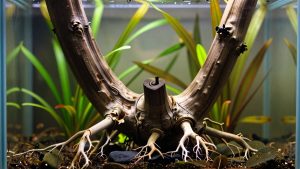
Keep the tank simple: sand or smooth fine gravel, a few large pieces of smooth driftwood and floating plants for cover. Leave the centre open. Avoid sharp objects. Dim lighting helps nervous fish settle, and a dark background reduces reflections that can cause the fish to bash the glass.
Water Parameters and Filtration
- Temperature: about 24 to 30 C. A heater with a guard prevents contact burns; a thermometer is essential.
- pH: sources give ranges from about 5.0 to 8.0 (Seriously Fish lists 5.0 to 7.5). Aim for a stable value somewhere between 6.0 and 7.5 rather than chasing a number.
- Hardness: soft to moderately hard; Seriously Fish lists 2 to 15 dGH.
- Ammonia and nitrite: zero. Nitrate low, kept down by large, frequent water changes.
A large predator produces a lot of waste. Use a filter system rated for well beyond the tank’s volume, such as a sump or large canister setup, with mechanical media that is cleaned regularly. Flow should be gentle at the surface, since the fish prefers calm water.
Feeding
Arowanas are carnivorous. In the wild they take fish and insects at and above the surface. In aquariums they accept a mix of foods:
- Large floating pellets or sticks made for carnivores as a staple.
- Insects such as crickets, locusts, mealworms and earthworms.
- Prawns, squid and strips of fish, offered in moderation.
- Small feeder fish are sometimes used, but they can carry disease and are not necessary. Keepers often avoid them for health reasons.
Young fish eat daily; adults are commonly fed a few times a week. Avoid mammal and bird meat, which Seriously Fish warns can cause organ damage, and excessive fatty foods. Remove uneaten food promptly.
Tank Mates
Silver and black arowanas are peaceful toward fish too large to swallow, but they will eat smaller ones and often shy at fast movement. Tank mates need to be big, robust and from similar water conditions, and they must not occupy the top layer.
| Group | Examples | Notes |
|---|---|---|
| Good | Large bottom-dwelling catfish such as pictus or large plecos, big silver dollars (with caution), large peaceful cichlids in a very large tank | Too large to eat and live in different water layers |
| Risky | Stingrays, large barbs, fast schoolers, aggressive cichlids | Stress or competition for food; nipping at the arowana’s fins or barbels |
| Avoid | Tetras, small catfish, small cichlids, smaller arowanas of the same species | Will be eaten, or will fight; multiple arowanas in the same tank often end in injury unless the tank is huge |
Many keepers choose to keep a single arowana alone to avoid damage and cost. Introductions should be done in a very large tank and watched carefully.
Behaviour, Jumping and Stress
Arowanas are shy of sudden movement and noise. Fast approaches to the tank, flash photography and bright lights at night can send them crashing into the glass or lid. Place the tank in a quiet area, dim the lights slowly and use a lid with a soft lining where possible. Some fish develop a habit of swimming into the front glass, which can cause “drop eye”, where one or both eyes sag downward. Causes discussed by keepers include tank height, light from above and diet, and the condition is difficult to reverse once developed.
Common Health Problems and Troubleshooting
| Symptom | Likely cause | Fix |
|---|---|---|
| Drooping eye | Low-set or overhead lighting, low food placement, genetic factor | Feed at the surface, dim overhead light, avoid glare; may not reverse |
| Snout scrapes, red nose | Hitting glass, panic, tank too small | Larger tank, dark background, reduce disturbance |
| White spots | Ich (Ichthyophthirius) | Treat with an arowana-safe medication; keep water stable. Large fish can be sensitive to some medications, so follow product guidance |
| Cloudy eyes, fin rot | Poor water quality, bacterial infection | Water changes, improved filtration, vet advice if persistent |
| Refusing food | Stress, new environment, disease | Offer live insects; check water; reduce disturbance |
| Fish found on the floor | Jumped | Fit a heavy lid; lower the water level; avoid sudden light changes |
Maintenance Schedule
- Daily: feed the correct portion, check temperature, check that the lid is secure, watch behaviour.
- Weekly: change roughly 25 to 50 percent of the water (Seriously Fish advises 30 to 50 percent); test ammonia, nitrite, nitrate and pH; wipe the glass.
- Monthly: clean mechanical filter media, inspect heaters and pumps, check lid hinges.
- Yearly: deep-clean the filter and check equipment; review whether the fish is still comfortable in the tank.
Common Mistakes
- Buying a cheap juvenile without a plan for the adult tank.
- Keeping the fish in a deep, narrow tank.
- Leaving gaps in the lid.
- Adding small fish as tank mates.
- Feeding mammal meat or only live feeders.
- Importing or buying an Asian arowana without checking legal status.
Is an Arowana Right for You?
| Pick an arowana if… | Skip it if… |
|---|---|
| You can house a 250-gallon-plus tank with a heavy lid | You live in a rental that cannot support the weight |
| You want a single showpiece predator and accept a long commitment | You want a community tank with many small fish |
| You can afford powerful filtration and regular large water changes | You cannot commit to 10 to 15 years of care |
| You will confirm species and legality first | You are tempted by a very cheap juvenile with no plan |
Frequently Asked Questions
How big a tank does an arowana need?
A silver arowana is generally given at least 250 gallons, ideally in a long footprint of around 240 cm by 90 cm (Seriously Fish gives a minimum length of 2 m). Juveniles may start in smaller tanks, but the fish grows quickly and the adult tank should be planned from the start.
How long do arowanas live?
Silver arowanas are commonly quoted at 10 to 15 years in captivity, and figures vary between sources. Good water, a proper tank and a safe lid contribute to a long life.
Do arowanas need a lid?
Yes. They are strong jumpers, especially when startled or hunting insects. A heavy lid with minimal gaps is essential.
Is the Asian arowana legal to own?
It depends on where you live. The species is on CITES Appendix I, and in the United States it is listed as endangered, with sale across state lines and import prohibited and permits generally limited to science or recovery. Where it is allowed, buyers need microchipped, documented fish. Check local law first.
What do arowanas eat?
They eat insects, shrimp, fish pieces, earthworms and carnivore pellets. Variety is better than a single food, and feeder fish are best avoided because of disease risk.
Can arowanas live with other fish?
Only with large, sturdy, non-aggressive fish that cannot be swallowed. Many are kept alone. Small fish will be eaten.
Why is my arowana’s eye drooping?
Drop eye is often linked to overhead lighting, food placement, tank height or stress. Feeding at the surface and keeping lighting soft may help, though the condition is difficult to reverse.
Ready to decide? Our #1 pick for 2026 is the Adult size.
Live price & availability on Amazon.
Related Reviews & Guides

Best Pond Aerators for Fish Health in 2026: Compared and Ranked
6 Best Fish Foods: Top Picks Reviewed and Compared (2026)