Last Updated: October 9, 2026

TL;DR
Bottom line: An aquarium phosphate remover — specifically granular ferric oxide (GFO) run in a media reactor — is the most reliable way to push phosphate below 0.03 ppm in a reef tank. Use it alongside a refugium or carbon dosing rather than as your sole export method. BRS ROX 0.8 GFO and Two Little Fishies PhosbanReactor 150 are the two products that appear in nearly every serious reefer’s sump.
As an Amazon Associate we earn from qualifying purchases at no extra cost to you.




Best Aquarium Phosphate Remover: GFO, Media Reactors & What Actually Works (2026)
High phosphate in a reef tank causes more frustration than almost any other parameter. Nuisance algae blooms, cyano outbreaks, and stunted coral growth all trace back to elevated phosphorus — yet chasing phosphate with the wrong method can drop it too fast, stress your corals, and cause a different kind of bleaching event. Understanding how aquarium phosphate removers actually work is the first step to using them correctly.
This guide covers GFO (granular ferric oxide), activated carbon combinations, zeolite systems, liquid phosphate binders, and the reactors that make each approach effective. We will also cover target phosphate levels for different tank types and the single biggest mistake hobbyists make when first starting GFO — running too much of it, too fast.
🛒 Best Price Today on Amazon
Prime members get fast, free shipping on everything above, plus member-only deals. New members get a 30-day free trial — cancel anytime.
Start 30-Day Prime Free Trial →See Today’s Amazon DealsTop 3 phosphate remover products




As an Amazon Associate we earn from qualifying purchases. Product prices and availability are accurate as of the date/time indicated.



As an Amazon Associate we earn from qualifying purchases. Product prices and availability are accurate as of the date/time indicated.


As an Amazon Associate we earn from qualifying purchases. Product prices and availability are accurate as of the date/time indicated.
GFO vs other phosphate removers: spec comparison
| Method | Removal speed | Precision | Cost / month | Best use case |
|---|---|---|---|---|
| GFO in reactor | Slow (days–weeks) | High | $5–15 | Reef maintenance below 0.05 ppm |
| Liquid binder (Lanthanum) | Fast (hours) | Low | $10–25 | Emergency knockdown only |
| Zeolite system | Moderate | Medium | $15–30 | Ultra-low nutrient SPS / Zeovit |
| Refugium (Chaeto) | Slow (weeks) | Low | ~$0 running | Baseline export, all tanks |
| Water changes | Immediate dilution | Proportional | Salt cost | Universal supplement to above |
How GFO works
Granular ferric oxide is an iron-based media that binds phosphate molecules through a process called ligand exchange — phosphate ions displace hydroxyl groups on the iron oxide surface and bond directly to the media. The reaction is essentially irreversible under normal aquarium conditions, which is why spent GFO should be discarded rather than regenerated.
The key variable is flow rate through the reactor. Too fast and water does not contact the media long enough for adsorption to occur. Too slow and the media tumbles aggressively, generating iron fines that cloud your water. The target is a gentle tumble — just enough movement to prevent channeling and media compaction, but not so vigorous that the media grinds itself down.
Standard dosing rate is roughly 250 ml of GFO per 100 gallons of system water for a tank running 0.05–0.1 ppm phosphate. Start at half that dose, test after one week, and increase only if phosphate remains elevated. This gradual approach prevents the rapid phosphate crash that can cause tissue necrosis in Acropora colonies that have acclimated to higher nutrient levels.
Setting up a media reactor for GFO
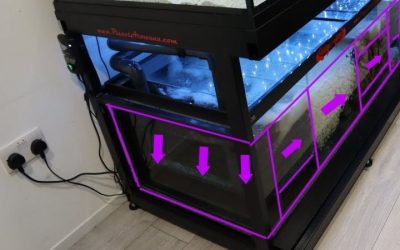
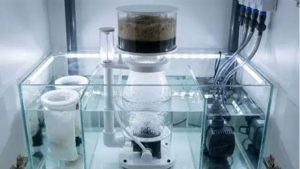
A dedicated media reactor produces far better results than running GFO in a mesh bag in your sump. Bag-based GFO sits in a low-flow zone, does not tumble, and exhausts unevenly — you end up with a phosphate-saturated shell around unused media inside. A reactor forces water through the bed consistently.
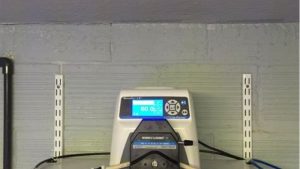
For tanks up to 75 gallons, a small reactor (100–150 ml capacity) fed by a dedicated return pump running 50–80 GPH is ideal. The output line from the reactor should return to the sump before the main pump — not directly into the display tank. This ensures any iron fines that escape the reactor (especially when first starting) settle in the sump rather than coating your corals.
For related filtration tools that complement phosphate removal, our guide on aquarium nitrate reactors covers sulfur-based nitrate reduction — often run alongside GFO reactors in the same sump. Also see our saltwater refugium setup guide for a more holistic nutrient export approach.
Target phosphate levels by tank type
Not every tank needs ultra-low phosphate. Chasing 0.00 ppm in a community fish tank is unnecessary effort. Here are practical targets: FOWLR tanks can tolerate 0.1–0.25 ppm without visible issues. Soft coral and LPS-dominant reefs perform well at 0.05–0.1 ppm. Mixed SPS reefs target 0.02–0.05 ppm. Ultra-low nutrient Acropora-dominated systems often run 0.01–0.03 ppm, but require very stable feeding and export balance to avoid starving corals of trace nutrients.
Test phosphate with a colorimetric test kit (Hannah Instruments ULR checker is the hobbyist standard) rather than the strip tests bundled with multi-parameter kits. Strip tests cannot resolve the 0.01–0.05 ppm range where reef chemistry decisions actually happen.
FAQ
How long does GFO last in an aquarium phosphate remover reactor?
Expect two to four weeks for a tank with moderate phosphate load (0.05–0.1 ppm). You will know GFO is exhausted when your phosphate begins climbing back up despite the reactor running. Some hobbyists test weekly and track the trend rather than changing on a fixed schedule — this approach wastes less media. Color change is not a reliable indicator for GFO; exhaustion is best confirmed by parameter testing.
Can I run GFO and activated carbon in the same reactor?
You can, but it is not ideal. GFO and carbon have different optimal flow rates — carbon needs slower flow to contact water effectively while GFO needs just enough tumble. Running them in separate reactors (or two chambers of a dual-chamber reactor) lets you optimize each independently. Many reefers run a single dedicated GFO reactor and a separate mesh sock of activated carbon changed monthly.
Is lanthanum chloride safe as an aquarium phosphate remover?
Lanthanum chloride works rapidly — it precipitates phosphate out of solution within hours. The risk is that the resulting precipitate can coat gill surfaces and irritate fish and corals if not removed quickly by efficient skimming or mechanical filtration. Use it only for emergency phosphate reduction (above 0.25 ppm in a reef) while your GFO reactor catches up. Never dose it directly into a tank with sensitive corals or inverts.
Does a refugium replace the need for a phosphate remover?
A well-maintained chaeto refugium under a strong grow light is an excellent baseline phosphate export — chaeto harvested weekly removes phosphorus directly from the system. In a lightly stocked tank with conservative feeding, a refugium alone may keep phosphate in range. In a heavily fed SPS tank or any system with a large bioload, GFO in a reactor is typically needed alongside the refugium to hit the 0.03–0.05 ppm target range.
What causes phosphate to spike in an established reef tank?
The three most common causes are overfeeding (uneaten food breaks down into phosphorus), a dead animal hidden in the rockwork, or a sudden reduction in export (skimmer offline, chaeto crash, GFO exhausted simultaneously). Before adding more media, check that your skimmer is pulling dark skimmate, do a headcount on livestock, and look for any dead matter in the rockwork. Fixing the source is always more effective than outpacing it with more GFO.
For a full filtration overview including mechanical and biological stages, see our aquarium overflow box and sump guide.
Frequently Asked Questions
What does GFO do and when do I need it?
Granular ferric oxide chemically binds phosphate as water flows over it, pulling levels down where water changes and skimming alone cannot. Use it when phosphate stays above roughly 0.1 ppm in a reef or is clearly driving nuisance algae. Do not use it to chase an absolute zero reading.
How much GFO should I run?
Start with about half the manufacturer recommendation and increase gradually. Dropping phosphate too quickly bleaches corals and shocks the system. Aim to lower it by no more than around 0.05 ppm per week, and test with a low-range colorimeter rather than a colour comparison card.
Reactor or media bag?
A fluidised reactor with gentle tumbling gives far better contact and uses less media, but excessive tumbling grinds granules into a dust that irritates corals. A passive bag placed in a high-flow section of the sump works too, just less efficiently. Never let GFO pack into a solid clump.
How often do I change it?
Typically every four to six weeks, or whenever phosphate stops falling between tests. Exhausted GFO is not harmful but is dead weight in the reactor, and there is some evidence it releases a little back once fully saturated. Track phosphate readings rather than following the calendar blindly.
Can I use GFO in freshwater?
It works chemically, but it is rarely appropriate. Planted tanks need phosphate as a nutrient, and stripping it stunts plants and often makes algae worse rather than better. In a freshwater fish-only tank, better feeding discipline and larger water changes solve high phosphate far more cheaply.
Ready to decide? Our #1 pick for 2026 is the GFO in reactor.
Live price & availability on Amazon.
Related Reviews & Guides

Best 75 Gallon Aquarium Kit for a Living Room: Top Compared
How to Choose Reef Protein Skimmer Size in 2026: What Actually Matters