Last Updated: September 25, 2026
Aquarium heater vs inline heater is usually presented as a question of appearance, when the real difference is dependency: an inline unit heats water only while the canister is running, and a submersible does not care what the filter is doing. That single distinction drives most of the comparison below.
As an Amazon Associate we earn from qualifying purchases.
As an Amazon Associate we earn from qualifying purchases at no extra cost to you. Prices and availability are accurate as of the date shown and are subject to change.

DaToo Aquarium External Heater in-Line Fish Tank External Heater 300W for Canister Filter
Selected for "Aquarium Heater vs Inline Heater: Which One Should You Pick": this listing is filtration (DaToo Aquarium External Heater in-Line Fish Tank External Heater 300W ), matching the equipment this article covers.
View on Amazon
Aquael Inline Flow Heater (300 Watt)
Selected for "Aquarium Heater vs Inline Heater: Which One Should You Pick": this listing is heating (Aquael Inline Flow Heater (300 Watt)), matching the equipment this article covers.
View on Amazon
ISTA I-H614 150W Inline External Heater
Selected for "Aquarium Heater vs Inline Heater: Which One Should You Pick": this listing is heating (ISTA I-H614 150W Inline External Heater), matching the equipment this article covers.
View on Amazon
300W/500W Inline External Heater for Aquarium Fish Tank in-Line Canister Filter with LCD Display Overheating Protection Adjustable (B:500W)
Selected for "Aquarium Heater vs Inline Heater: Which One Should You Pick": this listing is filtration (300W/500W Inline External Heater for Aquarium Fish Tank in-Line Canist), matching the equipment this article covers.
View on AmazonBy David Nguyen
Dependency, Accuracy and Where the Element Sits
Framing aquarium heater vs inline heater as a choice starts with what your filtration already is, because an inline unit is not an option at all without a canister. After that, the deciding figures are wattage, control accuracy and how the arrangement behaves when something stops.
The decisive numbers behind either choice
Wattage is calculated in exactly the same way for both formats. Multiply real water volume in US gallons by the temperature rise in degrees Fahrenheit, then by 0.4, which reflects the familiar baseline of 3–5 watts per gallon at a rise of about 10 °F (5.5 °C) above room temperature.
Accuracy differs between them more than wattage does. Budget submersibles commonly drift ±2–4 °F (1–2 °C) from the dial, while inline units are often paired with an external controller holding within roughly 1 °F (0.5 °C), which is why the comparison rarely comes down to heat output alone.
Visibility, installation and the dependency question
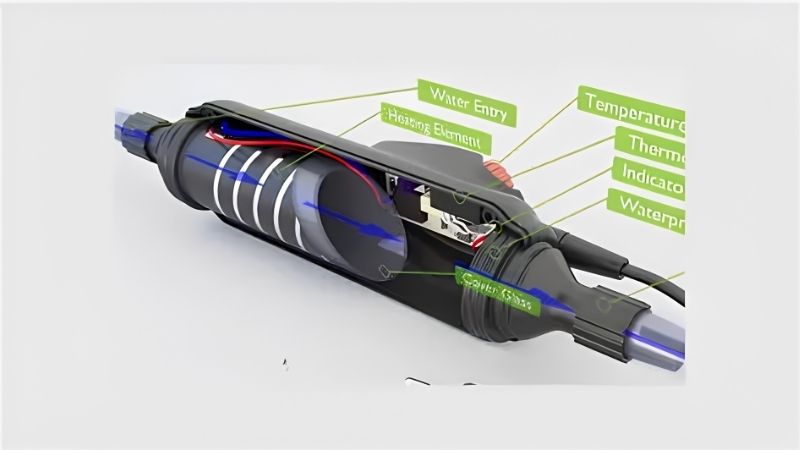
The aquarium heater vs inline heater split starts here. An inline heater sits on the canister return hose and keeps the display glass completely clear, which is the reason most people consider one. It also delivers heat already mixed into the returning flow, so gradients across a long tank tend to be smaller.
The trade is dependency and plumbing. If the canister stops, the heating stops with it, and installation adds two more hose connections inside a cabinet where a slow leak can go unnoticed for days. Hose diameter must match the unit exactly, which is worth confirming before ordering.
Tank size, placement and physical fit
Submersible units need depth above all: a 10 gallon (38 L) tank offers perhaps 10 inches (25 cm) of water while a 55 gallon (208 L) tank gives around 19 inches (48 cm), which decides whether a full-length unit stands vertically or has to be mounted horizontally near the substrate.
Inline units need cabinet space instead, with enough height for the body plus a hose bend radius that will not kink. A full tank runs near 10 lb per gallon (about 1 kg per L), so a 55 gallon (208 L) setup passes 600 lb (272 kg). Measure the cabinet interior with a tape before ordering.
| Option | Main number | Tank it suits | Recurring cost | Who it fits |
|---|---|---|---|---|
| Submersible in tank | Works with any filter | Any size, any filtration | Replace every few years | Most freshwater keepers |
| Inline on canister return | Needs canister flow | 40 gal (151 L) and up | Replaced with the canister | Aquascapers, planted tanks |
| Titanium plus controller | Often within 1 °F (0.5 °C) | Any, especially valuable stock | Probe cleaning over years | Discus and cichlid keepers |
| Two submersibles split | Half wattage at each end | Over 36 in (91 cm) long | Two units to replace | Anyone wanting redundancy |
| Inline with a HOB filter | Not compatible | None | Not applicable | Nobody, avoid this pairing |
The Options, Grouped by Who They Suit
Neither answer wins outright in the aquarium heater vs inline heater comparison, because the deciding factor is really the filtration you already run and how much the visible equipment bothers you. Each option below is tied to a group of keepers with its limitation stated plainly.
Submersible heaters, for most freshwater tanks
A submersible works with any filtration, costs less, installs in seconds and fails in ways that are easy to diagnose. For the great majority of community tanks it remains the sensible default, and pairing it with automatic shut-off covers the most common accident during water changes.
The limitations here are visibility and the glass body itself. The unit is visible in the display, and a glass body cracks if it runs while exposed above the water line, which is why switching it off before a water change matters more than any specification printed on the packaging.
Inline heaters, for canister-filtered aquascapes
An inline unit removes equipment from the display entirely, which is why planted tank keepers and anyone photographing their aquarium gravitate towards them. Heat enters already mixed with the return flow, so gradients along a long tank are usually smaller than with a single submersible.
The limitation is a total dependency on the canister filter. A stopped filter means no heating at all, a hose that kinks reduces both flow and heat delivery, and the two extra connections are a genuine leak path into a cabinet that often holds the electrics as well as the filter.
Titanium elements with external controllers, for valuable stock
Separating the element from the thermostat is available in both formats and gives the tightest control, commonly within about 1 °F (0.5 °C). For discus, large cichlids or anything difficult to replace, that accuracy is worth more than either the visibility or the price difference.
The drawback is an entirely new failure mode. An external probe that fouls with mineral scale or biofilm reports water cooler than it is, and the controller then overheats the tank rather than underheating it, so probes need periodic wiping and confirmation against a separate thermometer.
Two submersibles split, for long tanks and redundancy
Splitting the wattage between two submersibles at opposite ends is a third answer that neither format really offers on its own. It evens out the gradient along any footprint longer than 36 inches (91 cm) and it keeps working when one unit fails, which no single heater of any type can do.
The costs of that are two devices, two cables and two outlets to arrange, plus two positions that must stay clear of substrate and décor. It also doubles the number of items that can fail, although each individual failure then matters far less than a single unit failing alone would.
Direct Comparison and Who Should Not Buy
Set side by side, the aquarium heater vs inline heater decision really comes down to just three practical points, and to one question about whether the upgrade is warranted at all here. Most tanks are better served by improving placement than by changing the format of the heating.
Head to head on the deciding points
On reliability the submersible wins, because it works whatever the filter happens to be doing and because it has no plumbing at all to leak. On appearance and even heating the inline wins, since nothing sits in the display and warmed water arrives already distributed through the return.
On accuracy neither format is inherently better, since both are available with and without external controllers. The real differentiator is the thermostat, not the location, which means comparing two specific units matters far more than comparing the two categories in the abstract.
When an inline heater is the wrong purchase
If the tank runs a hang-on-back or a sponge filter, an inline unit is simply not compatible and no adapter changes that fact. It also makes little sense on tanks below roughly 40 gallons (151 L), where cabinet space is tight and the cost is disproportionate to the benefit gained.
Households that lose power regularly should think carefully about this too. A submersible resumes heating the moment power returns, whereas an inline unit only heats once the canister has re-primed, which turns a brief outage into a longer cold period than the interruption itself.
Cheaper approaches that genuinely work
Placement costs nothing at all and solves most complaints about uneven heating. Moving a submersible into the flow path near the filter intake or the outflow, with an inch (2.5 cm) of clearance from substrate and glass, usually removes the gradient people buy inline units to fix.
Two smaller submersibles at opposite ends are the other inexpensive answer on longer tanks. The total wattage stays exactly the same, distribution improves considerably, and the arrangement adds redundancy that neither a single submersible nor a single inline unit can offer on its own.
Operation, Failure Points and Twelve Month Ownership
Both formats run continuously right through the cold months, so the honest measure in aquarium heater vs inline heater terms is what each looks like after a year. Neither has consumables in the way a filter does, which puts the cost picture onto reliability and eventual replacement.
How each format fails
A submersible either fails on, fails off, or cracks when it is run exposed during a water change. Failing on is the dangerous case here, and it is why automatic shut-off and correct sizing both function as safety features rather than as conveniences added to the specification sheet.
An inline unit adds two failure modes that the submersible cannot have: a leak at a hose connection and a heater running with no flow through it because the canister has stopped. Most models include protection against the second, but the first remains a genuine risk inside a cabinet.
What wears out and what cannot be replaced
Thermostat calibration drifts across the years in both of these formats, so a unit holding 78 °F (26 °C) when new may sit two degrees away by its third winter without any visible sign. Submersible suction cups also harden and release, dropping the unit onto substrate where it can crack.
Inline units simply share the canister’s own maintenance cycle: hoses grow a biofilm that narrows the bore, and the connections need checking whenever the filter is opened up. Almost nothing is user-serviceable in either format, so warranty terms and spare part availability matter.
Certification, electrical safety and buying at the right time
Any powered device near water should carry recognised safety certification such as UL or ETL, run through a residual current device or GFCI outlet, and have a drip loop in the cable. For inline units this matters doubly, since the electrics sit in the cabinet alongside the plumbing.
Tank hardware discounts cluster into just a few events each year, with late November the deepest of them. Buying then is sensible, but it changes nothing biologically: a new tank still needs 3–8 weeks of cycling before fish go in, and prices move, so check at the time of purchase.
Frequently Asked Questions
These questions come up once people start looking past the appearance argument entirely, because the practical aquarium heater vs inline heater decision turns mainly on filtration type, cabinet space and what the tank does during the hours after a power cut or a stopped canister filter.
Is an inline heater safer than a submersible?
Not inherently safer, no. It removes the risk of a cracked glass body inside the tank, which is a real one, but it adds two hose connections that can leak into the cabinet and a complete dependence on filter flow. The safety comparison is a trade rather than a clear improvement either way.
Can I use an inline heater with a hang-on-back filter?
No. Inline units fit on a canister return hose and need continuous pumped flow through the body, which a hang-on-back does not provide. If you want equipment out of the display and run a hang-on-back, the practical options are a different filter or a discreetly placed submersible.
Do inline heaters heat more evenly?
Usually yes, because the heat enters already mixed with the return flow rather than from one fixed point. The same result is entirely achievable with a submersible placed correctly in the flow path, or with two smaller units at opposite ends of a tank longer than 36 inches (91 cm).
What happens if my canister stops with an inline heater fitted?
Heating stops along with it, and the tank then begins cooling steadily towards room temperature. Most units include protection against running dry, but the tank is unheated until the filter restarts, so households with frequent outages should weigh that against the tidier appearance.
See More:
Conclusion
For most freshwater tanks the answer to aquarium heater vs inline heater is a submersible placed in the flow path with automatic shut-off, since it works regardless of the filter. Choose inline only on a canister-filtered tank above roughly 40 gallons (151 L) where clear glass matters.
6 Best Aquarium Tank Chillers 2026
5 Best Aquarium Lights for Fish Tank (2026)