Last Updated: October 4, 2026
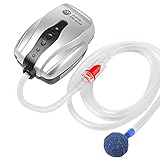
- Top Pick: AquaMiracle Aquarium Air Pump Fish Tank Bubbler Aerator, All-in-One Fish Tank Air Pump Kit, Quiet Small Aquarium Bubbler for 1-20 Gallon Aquariums
- Best Value: Pawfly 6 PCS Aquarium Check Valves for Common Air Pumps Red Plastic 1-Way Non-Return Valves Pump Protectors for Standard 3/16 Inch Airline Tubing Fish Tank Accessories for Aeration Setup
- Premium Choice: AQQA Aquarium Air Pump 10W 237GPH 4 Outlets Up to 600Gal
Shopping by the word “quiet” is one of the most common aquarium air pump mistakes. A pump can be advertised as quiet while transmitting vibration through a glass stand, rattling against a wall, or producing a low hum that is obvious in a bedroom. Another mistake is buying by gallons alone. Tank volume matters, but tubing length, air stones, water depth, outlet count, and back pressure also affect performance.
This aquarium air pump buying guide noise rating explains what specifications are useful, which claims need caution, and how to compare a compact bubbler with a multi-outlet pump. Noise ratings are helpful only when the testing distance and conditions are stated. If a listing gives no measurement method, treat “silent” as marketing language rather than a guarantee.
As an Amazon Associate we earn from qualifying purchases at no extra cost to you.


Decide These 3 Things First
- Tank and equipment load: Note the aquarium size, water depth, number of air stones, sponge filters, and approximate airline length. A 10-gallon tank with one small air stone has very different needs from a 75-gallon tank running four sponge filters.
- Where the pump will sit: A bedside aquarium, office tank, and fish room have different noise tolerances. A pump on a hollow cabinet usually sounds louder than the same pump on a dense rubber pad.
- How much control you need: Decide whether you need one outlet, several independently adjustable outlets, battery backup, or continuous operation. Extra capacity is useful, but an oversized pump may waste energy and require throttling.
Size and Air Capacity
Choose a pump based on usable airflow and pressure, not just the advertised gallon range. Compact pumps for approximately 1 to 20 gallons commonly use about 1 to 3 watts and have one outlet. They are suitable for a small air stone, gentle circulation, or a compact sponge filter when the water depth is modest.
For tanks from roughly 20 to 75 gallons, look for about 3 to 10 watts and either one high-output outlet or two to four outlets. Large systems may need 10 to 20 watts or more, especially when operating multiple air stones at depths above 18 inches. A listed figure such as 237 gallons per hour describes the pump’s maximum air movement under specific conditions; it does not mean every outlet will deliver that volume after tubing, valves, and air stones are connected.
Check outlet size before buying accessories. Standard aquarium airline tubing is typically 3/16 inch inside diameter. If a pump has four outlets, confirm whether the stated output is total airflow or airflow per outlet. A flow-control valve lets you reduce bubbles, while a splitter divides output but does not create more air.
Material and Heat Management
Most aquarium air pumps use an ABS or similar plastic housing, rubber feet, a diaphragm, and a metal or plastic internal armature. A plastic body is normal and keeps weight low; it is not automatically less durable than metal. More important details include heat-resistant construction, ventilation openings, and whether the pump remains stable while running.
Look for a housing with ventilation on the sides or top, but keep those openings away from splashing water. A pump should sit above the aquarium’s waterline whenever possible. If it must be positioned lower, install a check valve in every airline to help prevent back-siphoning during a power outage. The red and black six-packs of Pawfly check valves listed at about $4.99 are examples of inexpensive pump-protection accessories, although the valve’s arrow must point toward the aquarium.
Rubber feet matter because they isolate the motor from a hard shelf. Replaceable diaphragms are another useful feature on larger or more expensive pumps. They can extend service life when the pump weakens, rather than requiring replacement of the entire unit.
Construction and Vibration Control
Noise usually comes from vibration, not from bubbles themselves. A loose cover, worn diaphragm, unbalanced motor, or hard contact with the stand can turn a mild hum into a rattle. Inspect product photos for a firmly joined housing, non-slip feet, and a design that does not rock when placed on a flat surface.
A pump weighing about 6 to 12 ounces may be perfectly adequate for a nano tank, but it can move around if the feet are poor. Medium pumps often weigh 1 to 2 pounds; heavy-duty multi-outlet models may weigh 2 to 4 pounds. Greater weight does not guarantee quiet operation, but a stable base generally reduces movement.
Place the pump on a 1/4- to 1/2-inch silicone, rubber, or dense foam pad. Do not bury it in a towel, block ventilation, or suspend it where the housing can swing into a wall. Keep at least 2 to 3 inches of clearance around ventilation openings. If the sound changes when you gently press the pump or move it away from the cabinet, vibration isolation—not motor volume—is probably the main issue.
Comfort and Performance
For a bedroom or work area, a consistent low hum is generally less distracting than a clicking or rattling sound. Unfortunately, “quiet” product descriptions often omit a decibel number. When a rating is provided, check three details: the distance from the pump, whether the room was quiet, and whether the measurement included connected tubing and air stones.
A reading taken at 1 meter is not directly comparable with one taken at 10 inches. Background noise also matters: a room measuring 30 dB can make a small pump’s reading difficult to separate from ambient sound. Treat any rating without test conditions as a rough claim, not a laboratory comparison. Never assume a pump advertised as “silent” produces zero sound.
Performance should be judged by steady bubbles, adequate pressure at the tank’s depth, and the ability to run the intended filter. Fine-pore air stones create more back pressure than coarse stones. If bubbles stop when an air stone is attached, the pump may lack pressure even if its maximum airflow figure looks impressive. Keep spare air stones available, because mineral buildup can increase resistance over time.
Price Tiers and Running Cost
Budget pumps generally cost about $8 to $20. They are appropriate for small tanks, simple aeration, and buyers willing to replace a low-cost unit if the diaphragm wears. The AquaMiracle all-in-one bubbler kit, listed around $10, fits the compact end of this category and may be convenient for a 1- to 20-gallon setup. Check exactly what the kit includes before assuming it has a check valve or adjustable flow.
Midrange pumps usually cost $20 to $50 and often provide better feet, stronger pressure, multiple outlets, or more useful flow adjustment. A 10-watt, four-outlet AQQA pump listed around $30 is an example of a higher-capacity format for larger or more heavily filtered tanks. It is still important to divide total output among all connected lines rather than expecting each outlet to perform like a separate full-size pump.
Premium aquarium air pumps commonly cost $50 to $120 or more. The extra price may buy a better enclosure, quieter motor design, replaceable diaphragms, more consistent pressure, or longer support—not necessarily dramatically more airflow. Electricity is usually a minor part of ownership cost. A 10-watt pump running continuously uses about 0.24 kilowatt-hours per day, or approximately 7.2 kilowatt-hours per 30 days. Your local utility rate determines the actual cost.
Warranty and Replacement Parts
A warranty of 12 months is a reasonable baseline for a continuously running aquarium pump. Some brands offer 18 months, 2 years, or longer, but read the exclusions. Diaphragms, rubber feet, and air stones may be treated as wear items. A warranty is more valuable when the seller clearly explains how to obtain a replacement or refund.
Before buying, search the listing for replacement diaphragm availability, compatible tubing, and replacement power cords. A pump that costs $15 but has no service parts can be less economical than a $35 model with a $5 to $15 diaphragm kit. Keep the receipt, photograph the model label, and test the pump promptly rather than storing it unopened for months.
Delivery and Assembly
Most single-outlet pumps require only airline tubing, an air stone, and a check valve. Allow about 5 to 10 minutes for setup. Multi-outlet systems may require 15 to 30 minutes to cut tubing, attach a manifold, balance airflow, and secure each line. A six-pack of check valves at about $4.99 is inexpensive insurance for multiple lines, but confirm that the valves fit standard 3/16-inch tubing.
Inspect the package on arrival for cracked housings, bent outlet ports, missing suction cups, or crushed air stones. Run the pump for 10 to 15 minutes before placing it in its permanent position. Delivery packaging can damage plastic fittings, and a defect is easier to document before the equipment is wet. Assemble every connection firmly, but do not force tubing over a fitting so aggressively that the port cracks.
Spec Checklist
| Spec | Budget | Mid | Premium |
|---|---|---|---|
| Typical tank range | 1–20 gallons | 20–75 gallons | 50–150+ gallons, depending on outlets and depth |
| Power draw | 1–3 watts | 3–10 watts | 8–20+ watts |
| Outlets | 1 | 1–4 | 2–8, often adjustable |
| Typical weight | 6–12 ounces | 1–2 pounds | 2–4 pounds |
| Useful features | Rubber feet, basic flow control | Multiple outlets, stronger pressure, better isolation | Replaceable diaphragms, refined motor, long warranty |
| Price range | $8–$20 | $20–$50 | $50–$120+ |
Red Flags
- A “silent” claim with no decibel figure, test distance, or operating conditions.
- Maximum gallons listed without outlet count, pressure information, or water-depth guidance.
- A pump that becomes hot to the touch, smells like overheated plastic, or repeatedly trips its outlet.
- No check valve recommendation when the pump is shown below the aquarium.
- Very light construction that slides, rattles, or lacks rubber isolation feet.
- Missing information about voltage, replacement diaphragms, warranty length, or included accessories.
- Reviews describing inconsistent airflow, clicking, or a sharp electrical buzz rather than ordinary hum.
FAQ
What is a good noise rating for an aquarium air pump?
There is no universal “quiet” threshold because room acoustics and measurement methods vary. A published rating in the low-30-decibel range may sound quiet in a suitable test, but only compare it with another rating taken at the same distance and under similar conditions. Mechanical rattling is more concerning than a steady low hum.
Can a larger air pump be used on a small aquarium?
Yes, if its airflow can be reduced safely with a control valve or manifold. Avoid closing every outlet completely, since that can increase back pressure. A small pump matched to the tank is often simpler and quieter than an oversized unit running against excessive restriction.
Do I need a check valve?
Use one whenever the pump is below the aquarium’s water level, and consider one for every airline in a multi-outlet setup. It helps prevent water from flowing backward into the pump during a power failure. Check the arrow direction and replace a valve if it becomes clogged or stops opening freely.
How can I make an aquarium air pump quieter?
Set it on a 1/4- to 1/2-inch vibration-damping pad, keep it away from the wall, tighten loose fittings, replace clogged air stones, and maintain clear ventilation. Do not cover the pump or place it inside an airtight box. If noise persists after isolation, a worn diaphragm or failing motor may require repair or replacement.
Ready to decide? Our #1 pick for 2026 is the Typical tank range.
Live price & availability on Amazon.
Related Reviews & Guides




Best All In One 98 Gallon Aquarium For Living Room: Compared

Anubias Barteri Care: Light, Rhizomes and Algae