Last Updated: October 4, 2026
- Top Pick: Zigzagmars Reef Octopus 100 HOB w/Surface Skimmer
- Best Value: IOAOI Protein Skimmers for Saltwater Aquariums, Hang On Protein Skimmer for Fish Tanks up to 80 Gallons, DC Pinwheel Pump with Controller, Not for Rimmed Tank
- Premium Choice: AquaReady Hang On Back Protein Skimmer for Saltwater Aquariums HOB-1.5, Up to 75 Gallon Fish Tank Filtration, Hang On External, Adjustable, Ultra Quiet Pinwheel Pump
Choosing the right protein skimmer for a 75-gallon reef tank is less about finding a model labeled “75 gallons” and more about matching the skimmer to your aquarium’s actual bioload, sump space, water depth, and maintenance routine. A lightly stocked reef may run well on a compact skimmer, while a heavily stocked system with multiple fish, coral foods, and frequent feeding may need a unit rated for 100 to 150 gallons.
The Short Answer
For most 75-gallon reef aquariums, choose a protein skimmer rated for approximately 100 to 150 gallons of saltwater. That extra capacity gives the skimmer room to handle feeding spikes and livestock additions without operating at its maximum limit.
As an Amazon Associate we earn from qualifying purchases at no extra cost to you.


A practical target is a skimmer with a body diameter of about 4 to 6 inches, a total height of 18 to 24 inches for an in-sump model, or a hanging width of roughly 6 to 10 inches for a hang-on-back model. Many suitable units consume between 8 and 25 watts, although controllable DC models may use less or more depending on their pump setting.
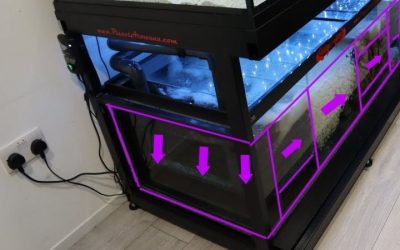
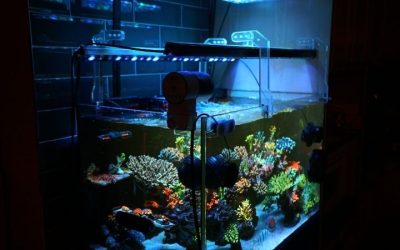
For a 75-gallon reef in a cabinet sump, an in-sump skimmer is usually the cleanest option. If the aquarium has no sump, a hang-on-back, or HOB, skimmer rated for at least 75 gallons—and preferably 100 gallons—can work. The most important measurements are not just the tank rating. Confirm the skimmer’s footprint, height, required water depth, clearance for removing the collection cup, and compatibility with a rimmed or rimless aquarium.
Standard Sizes
The table below gives realistic planning dimensions for the main skimmer sizes used on 75-gallon reef systems. Dimensions are shown in inches and centimeters; individual manufacturers can vary by pump, collection cup, outlet, and generation.
| Skimmer type | Typical tank rating | Planning dimensions in inches | Planning dimensions in centimeters | Typical wattage | Best fit |
|---|---|---|---|---|---|
| Compact in-sump | 50–100 gallons | 6 × 7 × 18 in | 15.2 × 17.8 × 45.7 cm | 8–15 W | Lightly stocked 75-gallon reef |
| Medium in-sump | 100–150 gallons | 8 × 9 × 21 in | 20.3 × 22.9 × 53.3 cm | 12–25 W | Most mixed reefs |
| Large in-sump | 150–200 gallons | 10 × 11 × 24 in | 25.4 × 27.9 × 61.0 cm | 20–40 W | Heavy bioload or future expansion |
| Compact HOB | 50–80 gallons | 6 × 8 × 18 in | 15.2 × 20.3 × 45.7 cm | 8–18 W | Smaller bioload without a sump |
| Large HOB | 75–150 gallons | 8 × 10 × 22 in | 20.3 × 25.4 × 55.9 cm | 15–35 W | Heavily stocked tank without a sump |
These are space-planning dimensions, not a promise that every model in a rating class will have the same measurements. A 75-gallon reef skimmer may need more than 20 inches of vertical clearance once the collection cup is installed. Measure the cabinet opening, not just the sump chamber.
HOB examples commonly considered for this size aquarium include the Zigzagmars Reef Octopus 100 HOB with surface skimmer, listed around $350, the IOAOI HOB model rated up to 80 gallons at about $100, and the AquaReady HOB-1.5 rated up to 75 gallons at about $300. The MagTool N130 Plus is an example of a controllable DC skimmer often considered for a medium saltwater system and is listed around $229. Prices can change, but these examples illustrate a broad buying range of approximately $100 to $340.
How to Measure Your Space
- Measure the available footprint. Record the sump chamber’s length and width at the waterline. Leave at least 1 inch, or 2.5 centimeters, around the skimmer when possible so the cup, drain, adjustment dial, and pump can be accessed.
- Measure usable height. Start at the bottom of the sump and measure to the lowest obstruction inside the cabinet. Include the cabinet’s top frame, plumbing, lights, and cross braces. Compare this number with the skimmer’s fully assembled height.
- Allow collection-cup clearance. A skimmer listed as 20 inches tall may require another 2 to 4 inches above the cup for removal. If the cup cannot be lifted straight up, routine cleaning becomes difficult.
- Check operating water depth. Many in-sump models work best in approximately 7 to 10 inches of water. If the sump runs deeper, use a stand or adjustable platform made from aquarium-safe material. Never guess at the water depth because an incorrect level can cause unstable foam.
- Measure the aquarium rim. For an HOB model, measure the back rim thickness, available glass width, and clearance between the aquarium and wall. Some units are designed only for rimless tanks, while others will not fit over thick framed rims.
- Map the plumbing and cords. Leave room for the drain outlet, air tubing, pump intake, and power cord. A skimmer that technically fits may block the return pump or make filter sock changes impossible.
- Confirm the actual water volume. A tank marketed as 75 gallons may hold closer to 60 to 65 gallons after rock, sand, equipment, and empty space are included. Size for the livestock and feeding level, not the label alone.
By Room or Use Case
75-Gallon Mixed Reef With a Sump
Choose a medium in-sump skimmer rated for 100 to 150 gallons. A footprint around 8 × 9 inches and height near 21 inches is a useful starting point. This size provides reasonable headroom for fish waste and coral feeding without taking over the entire sump.
75-Gallon Reef With a Heavy Fish Load
Use a stronger model rated for 150 gallons or more, particularly if the aquarium contains tangs, wrasses, anthias, or other active fish. Look for a larger reaction chamber and a controllable pump. Running a larger skimmer at a moderate setting is often easier than forcing a small unit to process a high nutrient load.
75-Gallon Lightly Stocked Coral Display
A compact skimmer rated for 75 to 100 gallons may be enough when the tank has a few small fish and modest feeding. Avoid choosing an oversized model solely because it has the highest rating. An excessively large skimmer may produce inconsistent foam when the system has little organic waste.
75-Gallon Aquarium Without a Sump
Select a HOB skimmer rated for at least 75 gallons, with 100 gallons being a more comfortable target. Measure the back of the tank carefully and verify whether the unit needs a rimless edge. HOB models save cabinet space, but they require clearance behind the aquarium and may add 18 to 24 inches of visible height.
Quiet Living Room or Bedroom Setup
Prioritize a controllable DC pinwheel pump, vibration isolation, and an adjustable air intake. Wattage does not directly determine noise, so do not assume the lowest-wattage model will be quietest. A stable platform, clean impeller, and properly sized air silencer can matter as much as the pump specification.
Common Sizing Mistakes
- Buying by gallon rating alone: Ratings are not standardized across brands. Compare body size, pump design, neck diameter, and expected bioload.
- Ignoring the sump’s operating level: A skimmer can fit physically but fail to perform if the water is too deep or too shallow.
- Forgetting maintenance clearance: Include room to remove the collection cup, clean the neck, and pull out the pump.
- Oversizing for a lightly stocked reef: A much larger skimmer may skim intermittently and require frequent adjustment.
- Undersizing a fish-heavy system: A skimmer rated exactly for 75 gallons may have little reserve capacity after rock displacement and livestock are added.
- Assuming every HOB fits every rim: Check maximum glass thickness and whether the model is compatible with a framed aquarium.
- Placing the skimmer in unstable water: Return sections that change level through evaporation can cause foam levels to rise and fall. Keep the skimmer in a constant-depth chamber or use an automatic top-off system.
FAQ
What size protein skimmer do I need for a 75-gallon reef?
Choose a skimmer rated for 100 to 150 gallons for most mixed reefs. A 75- to 100-gallon model can work for a lightly stocked aquarium, while a heavily stocked system may benefit from a 150-gallon rating or larger controllable unit.
Is an in-sump or HOB skimmer better for a 75-gallon tank?
An in-sump model is usually easier to hide and integrate with a reef filtration system, provided the sump has enough space and a stable water depth. An HOB model is the practical choice when there is no sump, but it needs rear clearance and careful rim compatibility.
How tall should a protein skimmer be?
Many suitable models are 18 to 24 inches tall. The correct height depends on the cabinet and sump. Leave an additional 2 to 4 inches above the collection cup unless the manufacturer specifies a different service clearance.
Can a protein skimmer be too big for a 75-gallon reef?
Yes. An oversized skimmer may remove organics inconsistently in a lightly stocked tank and can be harder to tune. For 2026, the best buying approach remains the same: match the rating to the bioload, then confirm the real footprint, operating depth, vertical clearance, and maintenance access before purchasing.
Ready to decide? Our #1 pick for 2026 is the Compact in-sump.
Live price & availability on Amazon.
Related Reviews & Guides
Best Auto Top Off System for a 55 Gallon Tank: Smart Picks
Best pH and ORP Monitor for a Reef Tank: Top Compared Guide