Last Updated: September 25, 2026
The practical answer to rodi vs distilled water for saltwater mixing is that both can serve as purified source water, and distilled is a perfectly acceptable starting point. Home RO/DI simply becomes more repeatable and cheaper once your volumes grow.
As an Amazon Associate we earn from qualifying purchases.
As an Amazon Associate we earn from qualifying purchases at no extra cost to you. Prices and availability are accurate as of the date shown and are subject to change.

Max Water 6 Stage 100 GPD (Gallon Per Day) RODI (Reverse Osmosis Deionization) Water Filtration System for Aquarium
Selected for "RODI vs Distilled Water for Saltwater Mixing: Best Guide": this listing is aquarium equipment (Max Water 6 Stage 100 GPD (Gallon Per Day) RODI (Reverse Osmosis Deion), matching the equipment this article covers.
View on Amazon
LiquaGen 5 Stage RO/DI Aquarium Reef Water Filter System 150 GPD – Reverse Osmosis Deionization Unit for Saltwater Marine Coral Fish Tank – TDS Meter & Pressure Gauge Included
Selected for "RODI vs Distilled Water for Saltwater Mixing: Best Guide": this listing is filtration (LiquaGen 5 Stage RO/DI Aquarium Reef Water Filter System 150 GPD – Rev), matching the equipment this article covers.
View on Amazon
ChemWorld Technical Grade Distilled Water - 5 Gallons
Selected for "RODI vs Distilled Water for Saltwater Mixing: Best Guide": this listing is lighting (ChemWorld Technical Grade Distilled Water - 5 Gallons), matching the equipment this article covers.
View on Amazon
LiquaGen- 5 Stage Reverse Osmosis & Deionization (RODI) | Aquarium Reef Water Filter System - 75 GPD | Water Purifier for Fish Tank with Filter's Included
Selected for "RODI vs Distilled Water for Saltwater Mixing: Best Guide": this listing is filtration (LiquaGen- 5 Stage Reverse Osmosis & Deionization (RODI) | Aquarium Ree), matching the equipment this article covers.
View on AmazonBy David Nguyen
Quick answer: For most people in 2026, the best rodi vs distilled water for saltwater mixing is the Source water TDS — our #1 rated choice. See the full ranked comparison, alternatives and buying advice below.
How RO/DI and Distillation Actually Work
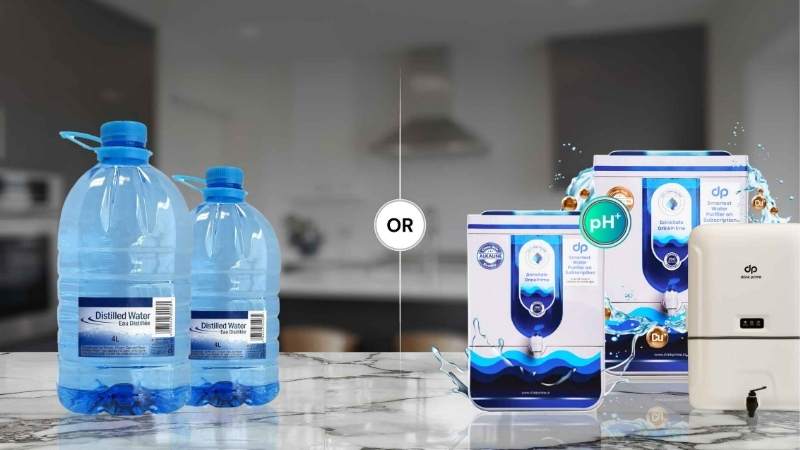
Both methods aim at the same outcome, water with essentially nothing dissolved in it, but RO/DI and distilled water get there differently. Understanding the mechanisms explains why one is measured and the other is described by process. That distinction shapes every practical comparison below.
What RO/DI Does
Reverse osmosis pushes water through a semi-permeable membrane that rejects most dissolved solids, then deionisation resin captures what remains. Reef practice targets an output of 0 TDS, which you confirm with a meter rather than assume. Multi-stage systems place sediment and carbon ahead of the membrane to protect it. Resin does the final polishing after the membrane has removed the bulk of dissolved solids.
That measurability is the real advantage. A common 75 GPD home system produces roughly 3.125 gallons per hour in theory, and an inline meter tells you on every run whether the membrane and resin are still doing their jobs. Distilled water offers no equivalent running check at the point of use. Two monitoring points separate membrane problems from exhausted resin.
What Distillation Does
Distillation boils water and condenses the vapour, leaving dissolved solids behind in the boiler. BRS guidance for 2026 treats distilled water as an acceptable purified starting source for salt mixing, which settles the safety question. Volatile compounds can carry over with the vapour, which is why process alone is not a complete description. Commercial distillation is energy intensive, which is reflected in the price per gallon.
The catch is verification. Distilled describes a process rather than a measured result, so a 0 TDS reading and a distilled label are not the same kind of claim, and bottled product TDS is not universally published. A handheld meter resolves that uncertainty in seconds if you already own one. Treat the label as a process description and your meter as the measurement.
Marine Salt Supplies the Ions
Neither source water contributes the chemistry your reef needs. Marine salt mixes are formulated to be dissolved into demineralised water, supplying calcium, magnesium, alkalinity and trace elements in balanced proportions. This is true whichever purified source you choose, so it is not a point of difference.
That is why remineralising before adding salt is unnecessary and counterproductive. Starting from water with dissolved solids already present means you cannot know the final composition, which defeats the purpose of purifying it. Salt manufacturers assume demineralised water in every published ratio. Tap water as a starting point introduces exactly the variability salt mixes are designed to avoid.
Follow the Brand-Specific Recipe
Dosing rates differ by manufacturer and by target salinity. Aquaforest Reef Salt specifies 390 grams per 10 litres of demineralised water for roughly 33 ppt, while Red Sea Salt lists 38.2 grams per litre for a 35 ppt example. Both figures come from the manufacturers themselves rather than a general guideline. Salinity targets themselves differ between reef keepers and salt lines.
Those figures are not interchangeable, since they target different salinities with different formulations. Mix to your salt maker’s instructions, then verify with a calibrated refractometer rather than trusting the arithmetic alone. Temperature affects refractometer readings, so calibrate at room temperature. Record which salt and ratio you used so batches stay consistent between changes.
What This Looks Like in Practice
Four common situations cover most reef keepers. The thresholds below frame the decision, though your own volume and storage space decide where the balance actually falls. Volume and storage space usually decide this more than chemistry does.
| Factor | Normal Range | Watch-out Threshold | What to Do |
|---|---|---|---|
| Source water TDS | 0 ppm at the tap | Any reading above 0 | Replace DI resin before mixing |
| Weekly volume | Small, occasional batches | Repeated large changes | Home RO/DI becomes more economical |
| Verification | Meter reading each run | Label only, no measurement | Spot-check distilled with a meter |
| Salt ratio | Per manufacturer instructions | Recipes copied between brands | Follow your own salt’s figures |
Routine Changes on a Large Reef
Once you are mixing regularly, home production wins on logistics and cost. A 75 GPD system fills a 20 gallon batch in roughly 6.4 hours at rated conditions, which fits comfortably into an overnight schedule. Reservoir capacity then decides how often that cycle needs supervising. Larger membranes shorten that further when demand justifies the upgrade.
Buying the same volume in jugs every week means transport, storage space and recurring expense that continues indefinitely. The break-even point arrives faster than most people expect once changes become routine rather than occasional. Fifty gallons a week in jugs becomes a chore long before it becomes unaffordable.
Emergency or Occasional Water Changes
Distilled shines when you need water now and your system is down, or when a rare large change exceeds your reservoir. Buying a few jugs is far cheaper than oversizing a system for an event that happens once or so a year. Availability at most supermarkets is part of the appeal.
Keep a few gallons on hand as insurance. A failed membrane or exhausted resin discovered on maintenance day is exactly the situation where store-bought purified water saves a schedule without compromising the tank. Store jugs somewhere cool and out of sunlight so they stay usable. Rotating stock keeps the supply fresh without waste.
Nano Reefs and Small Systems
For a nano tank, distilled can be the sensible long-term choice. Weekly changes of a few gallons do not justify the space, plumbing and maintenance a home system requires, especially in an apartment without a suitable drain. Apartment reefers in particular often find jugs simpler than plumbing a system.
Spot-check what you buy with a TDS meter anyway. Bottled distilled TDS is not universally published, and knowing your actual starting point costs very little once you already own a meter for tank testing. Consistency between batches matters more on a small volume, where errors concentrate quickly.
Automatic Top-Off Water
Top-off consumes more water than people estimate, since evaporation runs continuously while water changes are periodic. This is usually where jug logistics become tiresome first, well before water change volume does. A heavily lit open-top tank can evaporate several gallons a week.
Either source works chemically, as both supply purified water without adding dissolved solids to the display. The decision here is practical: whether you want to refill a reservoir by hand every few days or produce water on site. An automatic top-off unit needs a reservoir either way, so plan storage first. Reservoir size then dictates how often you refill by hand.
Frequently Asked Questions
Four questions decide most of these debates: whether distilled is a genuine substitute, whether to remineralise first, what source TDS should read, and how much salt a batch actually needs.
Can distilled water replace RO/DI?
Yes for salt mixing, since BRS guidance in 2026 treats it as an acceptable purified starting source. The difference is practical rather than a safety issue. Both routes supply water without the dissolved solids a reef reacts badly to.
What you lose is measurement and economics. RO/DI gives a verified 0 TDS reading on every run and costs less per gallon at volume, while distilled trades that for convenience and zero installation. Many reefers start with jugs and move to a system as the tank grows.
Should I remineralise before adding salt?
No. Marine salt mixes are formulated for demineralised water and already supply calcium, magnesium, alkalinity and trace elements in balance. Adding minerals separately duplicates what the salt already provides.
Adding minerals first makes the final composition unpredictable and can push individual parameters out of range. Start from purified water, follow the salt instructions, and adjust afterwards only if testing shows a genuine deficit. Test the mixed batch rather than the source if you want confirmation.
What should my source water read?
Zero TDS is the reef operational target, which is what a healthy RO/DI system delivers and what you should verify before every mixing session. Check it on the day you mix rather than relying on last month’s reading. Meters are inexpensive and take seconds to use.
Remember a TDS meter measures conductivity-derived dissolved solids, not every possible contaminant, so zero is a practical benchmark rather than proof of absolute purity. It remains the most useful single check available. A reading above zero before mixing means resin needs replacing first.
How much salt does a batch need?
Follow your specific product. Aquaforest at 390 grams per 10 litres means 780 grams for a 20 litre batch, while Red Sea at 38.2 grams per litre gives 764 grams for the same volume at its stated salinity. Weighing salt is far more repeatable than measuring by scoop.
Those totals look similar but target different salinities, so the recipes are not interchangeable between brands. Mix, circulate with heat for the time your salt maker recommends, then confirm with a calibrated refractometer. Salt mixes also vary in how long they need to clear before use. Give the batch time to circulate with heat before testing salinity.
Final Thoughts
In the rodi vs distilled water for saltwater mixing question, distilled is genuinely workable and sensible for nano tanks or emergencies. Home RO/DI earns its place through measurable 0 TDS output and lower cost per gallon once your changes and top-off demand grow.
Ready to decide? Our #1 pick for 2026 is the Source water TDS.
Live price & availability on Amazon.
Related Reviews & Guides




AI Prime 16 HD vs Kessil A80 Nano Reef Light Comparison

6 Best Saltwater Nano Aquarium Kits 2026