Last Updated: September 27, 2026
Coral placement arguments usually end with someone quoting a number without saying where it was measured. The par requirements for sps lps and softies break down into three working bands: roughly 50 to 100 for soft corals, 100 to 150 for LPS, and 200 to 350 or higher for SPS, always read at the coral itself.
As an Amazon Associate we earn from qualifying purchases.

Apogee Instruments-MQ-510/AM-330 - Underwater/Reef Tank, Full-Spectrum Quantum PAR Meter Bundled w/AM-330 Telescoping, Submersible Sensor Wand - Includes Apogee Instruments Neoprene Case
Included for 'PAR Requirements for SPS LPS and Softies: Expert Best Guide' because the listing specifies Underwater/Reef Tank and Full-Spectrum Quantum PAR Meter Bundled w/AM-330 Telescoping, details this guide uses to compare options.
View on Amazon
Apogee Instruments MQ-510 Full-Spectrum Quantum PAR Meter, for Underwater/Reef Tank Precision Light Measurement - All Light Sources Including LEDs
Included for 'PAR Requirements for SPS LPS and Softies: Expert Best Guide' because the listing specifies for Underwater/Reef Tank Precision Light Measurement and All Light Sources Including LEDs, details this guide uses to compare options.
View on Amazon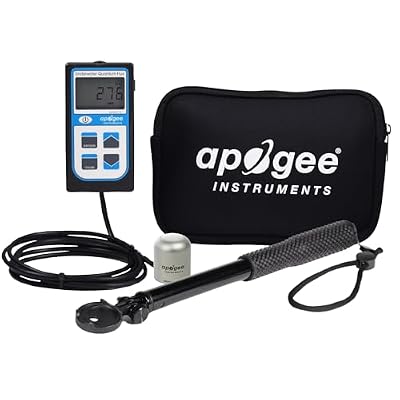
Apogee Instruments MQ-650/AM-330 Bundle - Underwater/Reef Tank ePAR Quantum Meter Bundled with AM-330 Telescoping, Submersible Sensor Wand - Includes Apogee Instruments Neoprene Case
Included for 'PAR Requirements for SPS LPS and Softies: Expert Best Guide' because the listing specifies Submersible Sensor Wand and Includes Apogee Instruments Neoprene Case, details this guide uses to compare options.
View on Amazon
PAR Meter 0-4000 µmol/m²/sec PPFD Range Quantum Meter, High-Precision Quantum Flux Sensor with IP68 Waterproof Sensor, Large LCD Display, Extension Rod for Indoor Growers, Greenhouse Farmers & Experts
Included for 'PAR Requirements for SPS LPS and Softies: Expert Best Guide' because the listing specifies Large LCD Display and Extension Rod for Indoor Growers, details this guide uses to compare options.
View on AmazonBy David Nguyen
Quick answer: For most people in 2026, the best par requirements for sps lps and softies is the Softies and mushrooms — our #1 rated choice. See the full ranked comparison, alternatives and buying advice below.
How Coral PAR Requirements Work
Those three bands are hobby consensus, not lab output, and they only mean something when you know where the reading was taken. Understanding what PAR measures, how it fades with distance, how photoperiod multiplies it, and how corals adapt turns a number into a placement decision. Each of the four carries a number you can measure tonight.
What PAR Actually Measures
PAR counts photons between 400 and 700 nanometers, the range corals photosynthesize with, which is why watts and lumens mislead so badly here. Two fixtures drawing 100 watts each can differ by more than 100 PAR at the same height depending on optics and diode mix. Lumens are worse still, since they weight green light the human eye favors.
The common error is quoting a fixture’s peak number as if it applied everywhere under the light. Peak readings occur directly beneath the housing at a stated distance, so a coral 8 inches off-center in a 20-inch-deep tank often sees half that figure or less. Manufacturer PAR maps state that distance, so read the fine print.
How Depth and Distance Cut the Number
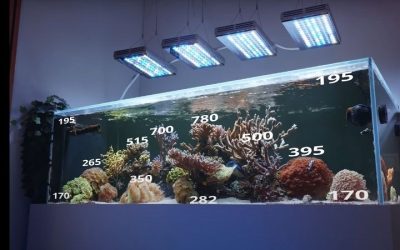
Light intensity falls sharply with distance through water, so a reading taken just under the surface bears little relation to one at the sandbed. In many reef tanks the bottom measures well under half the value recorded a few inches below the waterline. Reefers commonly log three readings per tank for that reason.
That is why a coral thriving at 250 on the upper rock can starve at the same fixture setting 14 inches lower. Measure at three heights, top rock, mid rock, and sand, before assuming your tank offers a single light level to every coral in it. A 10-inch difference in placement can move a coral a full band.
Photoperiod Multiplies Intensity
Total daily light equals intensity times hours, so 150 PAR across 9 hours delivers far more energy than 250 PAR across 4. Most reef tanks run 6 to 9 hours of peak light with ramped sunrise and sunset on either side of it. Ramps of 30 to 60 minutes on each end reduce the shock of lights snapping on at full output.
Raising both numbers at once is how tanks bleach, since a longer day at higher intensity compounds stress rather than adding to it linearly. Change one variable, hold it a week, and watch polyp extension before touching the other, especially on a tank that recently gained a new fixture. A common conservative pace is 5 to 10 percent per week.
Photoacclimation and Moving Targets
Corals adjust pigment over days to weeks, so a frag from a 60 PAR system will bleach at 250 even though the target band says SPS belongs there. A common starting point is 25 to 40 percent of the intended level, climbing over four to eight weeks while watching color. New diodes often read brighter than the ones they replace.
Fixture upgrades reset that clock for established corals too, since a new light can output more PAR at identical slider positions than the old one did. Treat any hardware change as a fresh acclimation and re-measure carefully, since manufacturers refresh diodes often and output can shift meaningfully between generations.
What It Looks Like in Practice
Turning the par requirements for sps lps and softies into placement means matching each coral group to a height on your rock. The table below sets the working bands and the warning signs, and the four scenarios after it show how the numbers play out in real tanks. Each row states where the reading is taken, which is at the coral.
| Factor | Normal Range | Watch-out Threshold | What to Do |
|---|---|---|---|
| Softies and mushrooms | 50 to 100 PAR | Above 150 | Move lower or shade |
| LPS | 100 to 150 PAR | Above 200 | Drop to mid or low rock |
| SPS | 200 to 350 PAR | Below 150 or sudden jumps | Raise placement, ramp slowly |
| Peak photoperiod | 6 to 9 hours | Over 10 hours | Shorten peak, keep ramps |
A Softie-Dominant Tank
Mushrooms, leathers, and most zoas color best between 50 and 100, which means a modest fixture run at partial output covers the whole tank. Pushing a softie system to 200 usually produces closed polyps and washed-out color that owners mistake for a flow or nutrient problem. Zoas are the exception, holding color up to about 150.
The practical advantage is cost, since a softie tank rarely needs the premium fixture tier or a second unit on a four-foot span. Money saved there is better spent on a test kit and stable alkalinity, which drive coral health more than extra intensity ever will. Alkalinity swinging past 1 dKH a day does more damage than 50 PAR ever will.
An LPS-Dominant Tank
Hammers, torches, and euphyllia sit comfortably from 100 to 150, low enough that placement on mid rock or open sand usually suffices. Sustained readings past 200 show up as retracted tissue during the day and a gradual loss of the fluorescence that made the coral appealing. Torches in particular show it first at the tentacle tips.
LPS also want gentler flow than SPS, so a bright, high-flow upper shelf is the wrong address on both counts. Check both variables together when a euphyllia sulks, since the fix is frequently a six-inch move rather than a new fixture or supplement. Moving a euphyllia 6 inches lower typically drops it 40 to 60 PAR.
An SPS-Dominant Tank
Acropora and similar stonies generally want 200 to 350 at the coral, with some tanks running higher on the top shelf under mature lighting. Anything under roughly 150 sustained produces brown, slow growth no additive corrects, because the coral is simply short of light. Tissue stays pale brown regardless of feeding at that level.
Depth decides whether your fixture can supply that band at all, which is where 24-inch-deep displays start needing the higher power classes. Verify with a meter at rock height instead of trusting a published footprint, and raise intensity gradually rather than in daily jumps. A common conservative pace is 5 to 10 percent per week.
A Mixed Reef with Zones
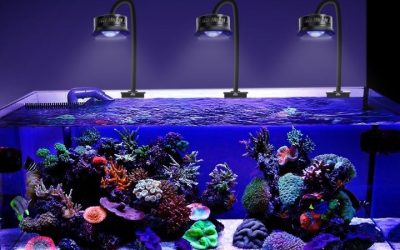
Mixed tanks work by treating the rock as a gradient: SPS on the top shelf near 250, LPS through the middle around 120, softies low or shaded under 100. One fixture then satisfies three very different demands without a single slider change. That gradient usually spans 100 to 150 PAR from top shelf to sand.
Building that gradient requires measuring before placing, not after a coral declines. Map readings at several heights, keep a note of what sits where, and re-measure after any fixture, mount height, or photoperiod change, since each of those shifts the whole map at once. Raising a fixture 2 inches can shift every reading by 20 or more.
Frequently Asked Questions
Reefers translating these bands into their own tanks tend to hit the same four practical problems, from measuring without owning a meter to reading blue-heavy settings. Each answer here ties back to a number you can verify rather than a rule of thumb you have to trust. Borrowed meters cost nothing but a week of your time.
How do I measure PAR without buying a meter?
Borrow one. Many local reef clubs lend an Apogee-class underwater sensor, and some retailers rent them by the week, which is enough time to map a tank at three heights. A single afternoon of readings is worth more than months of guessing from fixture specs. Record the height of each reading, since the number is meaningless without it.
If borrowing is impossible, use coral behavior as a proxy and place conservatively, starting corals lower than the target band and moving up over weeks. Manufacturer PAR maps help as a rough guide, though they assume a specific mounting height and clean optics. Those maps also assume a clean lens, and salt creep cuts output within months.
Can corals get too much PAR?
Yes, and it happens faster than the reverse. Softies above roughly 150 and LPS above 200 commonly pale, retract, or expel their algae, and a sudden doubling from a new fixture can bleach an established colony in a day or two. Recovery from a bleaching event takes months, while a light coral regains color in weeks.
Too little light is slower and more forgiving, showing as browning and stalled growth over weeks. Because recovery from overexposure is much harder, err low, hold the level several days, and raise only after color and polyp extension stay stable. Holding a level for five to seven days is the usual checkpoint.
Do blue-heavy settings change my readings?
They do, because sensors respond differently across the spectrum and many hobby meters read blue-weighted light differently than full-spectrum sunlight. Two tanks at the same displayed number can deliver noticeably different energy to coral if one runs 90 percent blue. Compare only readings taken with the same sensor and settings.
Keep your comparisons internal: measure your own tank with the same meter and the same settings each time. Chasing another reefer’s number recorded on different gear with a different spectrum is how people end up over-driving corals that looked fine last month. Photos posted online rarely state the meter or the mounting height used.
Does my target change as the tank matures?
Targets stay roughly the same, but your fixture’s real output drops as diodes age and salt creep films the optics, so a tank at 250 two years ago may sit closer to 200 now. Clean lenses and re-measure annually rather than assuming a static number. A tank at 250 two years ago can drift toward 200 without any setting change.
Coral growth also changes the map, since a colony that fills in shades everything beneath it. Re-check readings after any major growth or aquascape change, because shading from a maturing Acropora can drop a lower coral by 50 PAR or more. Re-map after any aquascape change, since one colony can shade three below it.
Final Thoughts
Treat the par requirements for sps lps and softies as three placement zones rather than three fixture settings: softies under 100, LPS near 100 to 150, SPS from 200 up. Measure at the coral, not the surface, ramp new arrivals over four to eight weeks, and re-check the map after every hardware or growth change.
Ready to decide? Our #1 pick for 2026 is the Softies and mushrooms.
Live price & availability on Amazon.
Related Reviews & Guides

Best Reef Lighting Bundle with Controller: Top Expert Picks
How Long Do RODI Filters Last Before Replacement: Best Guide