Last Updated: September 25, 2026
Nano reef tank setup means under 30 gallons (114 L), usually 10-20 gallons (38-76 L), and the defining problem is speed. Evaporation of 1-2% of volume a day moves salinity within hours, and alkalinity can shift a full dKH between one test and the next. Every equipment decision below follows from that single fact about volume.
As an Amazon Associate we earn from qualifying purchases.
As an Amazon Associate we earn from qualifying purchases at no extra cost to you. Prices and availability are accurate as of the date shown and are subject to change.
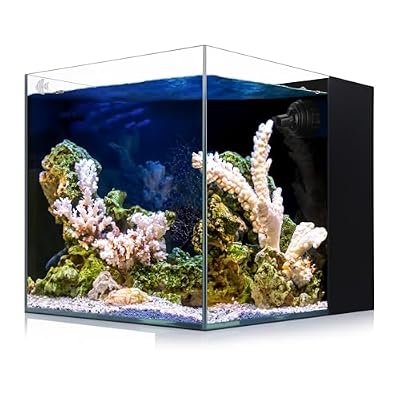
Coralland 8-Gallon Saltwater Aquarium - Ultra Clear Low Iron Glass, 45° Angled Joint Design, Crystal Clear Viewing, Perfect for Marine Fish & Reef Tanks & Freshwater
Selected for "Nano Reef Tank Setup: How It Works and What to Watch For": this listing is lighting (Coralland 8-Gallon Saltwater Aquarium - Ultra Clear Low Iron Glass, 45), matching the equipment this article covers.
View on Amazon
Coralife LED Biocube Aquarium Starter Kit, 16 Gallon Tank for Beginners
Selected for "Nano Reef Tank Setup: How It Works and What to Watch For": this listing is lighting (Coralife LED Biocube Aquarium Starter Kit, 16 Gallon Tank for Beginner), matching the equipment this article covers.
View on Amazon
8 Gallon Fish Tank (Black Marble, Tank with lid, Filter Media, Pump, Hose & Nozzle)
Selected for "Nano Reef Tank Setup: How It Works and What to Watch For": this listing is filtration (8 Gallon Fish Tank (Black Marble, Tank with lid, Filter Media, Pump, H), matching the equipment this article covers.
View on Amazon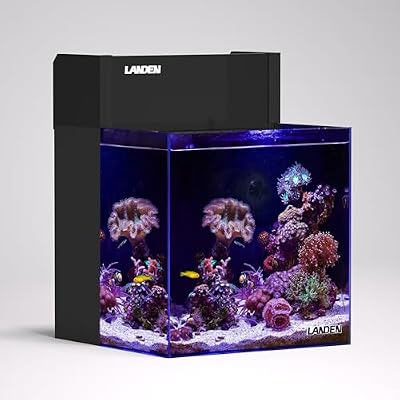
LANDEN EzCube 30 Saltwater AIO 6 Gallon Nano Reef Tank, Pump Included
Selected for "Nano Reef Tank Setup: How It Works and What to Watch For": this listing is pumps (LANDEN EzCube 30 Saltwater AIO 6 Gallon Nano Reef Tank, Pump Included), matching the equipment this article covers.
View on AmazonBy David Nguyen
Why Small Volume Changes Everything
A nano reef tank setup uses the same parameters as a larger reef, but every input arrives proportionally larger. That single fact drives the equipment list, the testing schedule and the coral selection, and it is the reason nano reefs fail differently.
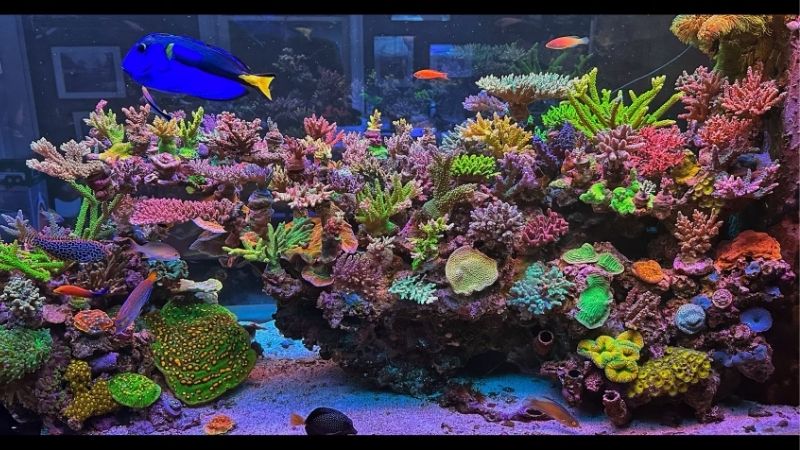
The Decision Numbers: Volume, Evaporation Rate and Swing Speed
A 20 gallon (76 L) all-in-one holds roughly 15-16 gallons (57-61 L) of actual water once rock, sand and the rear chamber are subtracted. Evaporation of 1-2% daily therefore removes a measurable fraction of the tank before anyone notices.
Salinity moves with it. Losing 2% of volume raises salinity by roughly 0.0005 SG per day, so three days without top-up shifts a tank from 1.025 to about 1.0265, which is outside the band corals hold well. That is why an automatic top-off is equipment rather than luxury.
Temperature behaves the same way. A nano tracks room temperature closely enough that a 6 °F (3 °C) daily room swing moves the tank several degrees, so the heater in a nano reef tank setup exists to hold a figure steady rather than to raise it.
Why Alkalinity Is the Hardest Parameter Here
Corals consume alkalinity continuously, and in 15 gallons (57 L) of water the same consumption produces a much larger change in concentration than it would in 75 gallons (284 L). A growing colony can pull a full dKH within a day.
Dosing that back accurately is harder at small volumes too, since the correcting dose is small enough that measurement error becomes significant. Frequent small water changes are usually the better route at this size than a dosing regime.
Target Ranges and Action Thresholds
The parameters below are the same as in any reef; the action thresholds are tighter because a small tank crosses them faster. Testing frequency is the column that differs most from a larger system, and it is the one people underestimate.
| Measurement | Target | Test frequency | Action threshold |
|---|---|---|---|
| Salinity | 1.025-1.026 SG (34-35 ppt) | Every 2-3 days | Drift over 0.0005 SG daily |
| Temperature | 76-78 °F (24-26 °C) | Daily glance | Swing over 2 °F (1 °C) |
| Alkalinity | 8-9 dKH, held steady | Twice weekly | Change over 0.5 dKH daily |
| Calcium | 400-450 ppm | Weekly | Below 380 ppm |
| Magnesium | 1250-1350 ppm | Monthly | Below 1200 ppm |
| Nitrate | 2-10 ppm | Weekly | Above 20 ppm or a flat 0 |
| Phosphate | 0.03-0.10 ppm | Weekly | Above 0.15 ppm |
| Evaporation top-up | Daily, RO/DI only | Automatic preferred | Any day missed |
Alkalinity is deliberately targeted at the lower end of the reef range here. A nano held at 8-9 dKH has further to fall before it leaves the safe band than one held at 11, which buys a margin the volume itself does not provide.
Building It in a Real Room
A nano reef tank setup is small enough to sit on a desk and demanding enough to need proper equipment behind it. This section covers placement, choosing between the common sizes, and what will actually fit inside a rear chamber.
Tank Size, Placement and Fit
Measure the rear chamber before ordering a heater or a skimmer, since most all-in-one nanos give 3-4 in (7.6-10 cm) of width and many nano skimmers do not fit. Check the return pump height against the chamber as well.
Placement matters more than at any larger size. A nano tracks room temperature closely, so a desk beside a window can add several degrees across an afternoon, and that same window drives algae in a system already short on nutrient buffering.
Leave space beside the tank for a top-off reservoir and a mixing container. A 20 gallon (76 L) nano on 15% weekly changes needs roughly 2-3 gallons (7.6-11 L) of mixed saltwater each week, which has to be prepared somewhere within reach.
How 10, 20 and 30 Gallon Nanos Differ
Ten gallons (38 L) is achievable and unforgiving, holding roughly 7-8 gallons (26-30 L) of actual water once rock and sand are in. Salinity and alkalinity both move fast enough at that volume that daily attention is genuinely required rather than merely advisable.
Twenty gallons (76 L) is the practical floor for most people and the most common nano size for good reason. Thirty gallons (114 L) sits at the boundary of nano and behaves noticeably more like a standard reef in how slowly it drifts.
Which Corals Suit the Volume
Soft corals at 50-100 µmol PAR are the right first stock: mushrooms, zoanthids and leathers tolerate the parameter movement a nano produces while you learn its rhythm. Most also stay small enough not to outgrow the footprint within the first year.
LPS at 100-200 µmol works from around month six if readings have been stable across consecutive tests. Treat SPS as a poor fit at this volume, since they demand the tightest alkalinity stability and a nano is the hardest place to provide it.
Growth rate is the second selection criterion here. Fast-spreading soft corals such as some mushrooms and leathers will cover a nano rock structure within a year, so plan placement with adult spread in mind rather than the size of the frag.
Myths Specific to Nano Reefs
Three claims cause most of the failures in a nano reef tank setup, and all three come from applying larger-tank thinking to a volume where the arithmetic works differently. Each is paired below with the figure that replaces it.
Myth: Small Reefs Are Cheaper to Run
The tank is cheaper; the system is not proportionally so. You still need a refractometer, an RO/DI unit, a full set of test kits, a quality light and an automatic top-off, and those costs barely scale down with volume at all.
What does scale down is salt mix and coral count. Budget the fixed equipment first, and treat the saving as coming from livestock and consumables rather than from the setup, which is where most nano cost estimates go wrong.
Myth: Water Changes Alone Hold Everything
At nano volumes, frequent small changes do carry most of the load, which is genuinely an advantage. The limit arrives when coral consumption of alkalinity outpaces what a 10-20% weekly change replaces, and it arrives sooner than people expect.
Watch the alkalinity trend rather than a single reading. Two consecutive tests showing a fall of 0.5 dKH or more between changes means the tank has passed that point and needs either smaller more frequent changes or careful dosing.
Myth: A Nano Is a Good First Marine Tank
Nano reefs are frequently marketed to beginners and are the least forgiving format in marine keeping. The chemistry is identical to a larger reef; only the reaction time is shorter, and reaction time is exactly what a first-time keeper needs.
Where a nano is the only option, the honest version is to start fish-only or with soft corals, fit an automatic top-off from day one, and test twice weekly for the first three months rather than settling into a weekly habit.
That is a workable path rather than a discouragement. Plenty of nano reef tank setup builds run for years, but they run on attention rather than on equipment, and the attention has to be daily rather than concentrated into one session a week.
Running a Nano Past the First Year
Nano reefs demand attention in short frequent doses rather than long occasional sessions. This section covers that routine, what degrades in a small system, and what the arrangement costs across twelve months.
The Routine That Holds It
Daily: check the top-off reservoir and glance at the temperature. Twice weekly: test alkalinity and salinity. Weekly: a 10-20% change with salt mixed to tank salinity and temperature, plus nitrate and phosphate.
Monthly: clean the return pump and any powerhead of calcium deposits, check the top-off float for salt creep, and test magnesium. Quarterly, check RO/DI output TDS with a meter, since an exhausted cartridge shows up nowhere else.
What Fails and What It Does
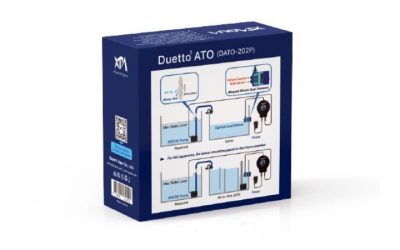
The top-off is the critical component in a nano. A stuck float either dumps fresh water and drops salinity within hours, or stops entirely and lets salinity climb, and both events happen faster here than in any larger tank.
Small heaters fail in both directions and a 20 gallon (76 L) tank responds within hours either way. Nano lights lose measurable PAR across two to three years, and rear chamber pumps clog with detritus that is easy to overlook.
The 12-Month Running Cost
Recurring spend is salt mix, RO/DI cartridges, test reagents, food and continuous electricity for a light, heater and pump. Test reagents are a larger share here than in a bigger tank, because the testing frequency is higher.
Salt mix use is lower than in a larger reef but reagent use is higher, since the testing schedule is roughly double. Those two roughly cancel, which is why nano running costs are closer to a mid-size reef than the volume suggests.
On timing, nano tanks, lights and top-off units see their deepest discounts in late June and again in late November. A sale changes nothing biological: the tank still needs three to eight weeks of cycling plus stable readings before corals, and prices move constantly.
Nano Reef Tank Setup Questions
These arrive while the tank is cycling but before corals are ordered. Every answer in this nano reef tank setup guide points at a measurement, because at this volume the readings move well before anything is visible.
What is the smallest workable nano reef?
Ten gallons (38 L) with soft corals, an automatic top-off and disciplined daily attention. Twenty gallons (76 L) is the practical floor for most people, since it roughly halves the rate at which salinity and alkalinity move.
Do I really need an automatic top-off?
At this volume, effectively yes. Losing 1-2% of the tank daily shifts salinity measurably within days, and manual top-up depends on being home every day. The unit protects the parameter that corals tolerate least well.
Can I skip the skimmer?
In a nano, often yes. Frequent small water changes export enough dissolved organics at this volume, and many nano skimmers fit rear chambers badly. Watch nitrate and phosphate and add export only if the readings demand it.
How many fish fit in a nano reef?
One or two small species in 20 gallons (76 L), chosen for adult size rather than shop size. Marine fish need more room per unit length than freshwater ones, and nitrate held at 2-10 ppm caps stocking well below expectations.
Why does my alkalinity keep falling?
Coral consumption, and it rises as the corals grow. Test twice weekly and track the trend rather than single readings. A fall of 0.5 dKH or more between water changes means consumption has outpaced what the change replaces.
See More:
Conclusion
A nano reef tank setup works when the volume is treated as the constraint it is: salinity 1.025-1.026 SG checked every two or three days, alkalinity held at 8-9 dKH and tested twice weekly, and evaporation replaced automatically every day.
Start at 20 gallons (76 L) rather than 10, fit the top-off before the first coral, stock soft corals for the first six months, and use frequent small water changes rather than dosing. Reaction time is what a nano lacks, so the routine has to supply it.
Reef Tank Setup for Beginners: What It Takes to Get Right
6 Best Chillers For Saltwater Aquarium 2026