Last Updated: September 25, 2026
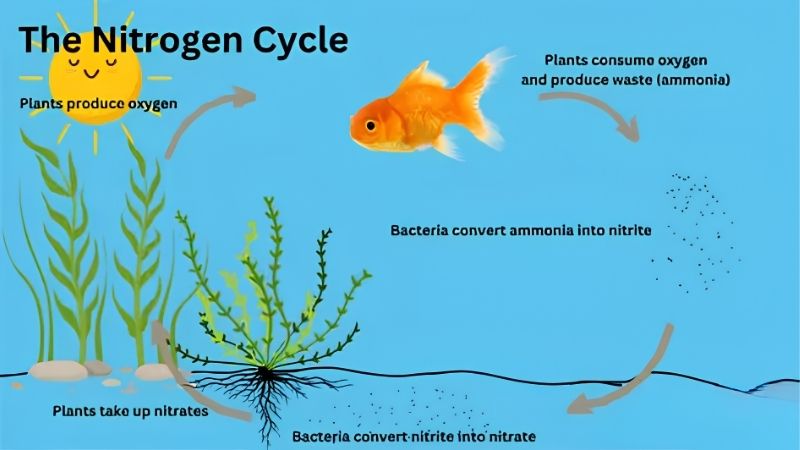
How to cycle a saltwater aquarium comes down to one test result repeated twice: ammonia dosed to 2 ppm clearing to 0 ppm along with nitrite within 24 hours, with nitrate present. Everything before that result is waiting rather than working, and it takes three to eight weeks depending on rock type and temperature.
As an Amazon Associate we earn from qualifying purchases.
As an Amazon Associate we earn from qualifying purchases at no extra cost to you. Prices and availability are accurate as of the date shown and are subject to change.

DrTim’s Aquatics Ammonium Chloride Solution One and Only Live Nitrifying Bacteria Aquarium Cycle Start Up Bundle for Saltwater Reef Aquarium (2oz Ammonium + 4oz One Only for 60 Gallon Tank)
Selected for "How to Cycle a Saltwater Aquarium: A Step by Step Method": this listing is tanks (DrTim’s Aquatics Ammonium Chloride Solution One and Only Live Nitrifyi), matching the equipment this article covers.
View on Amazon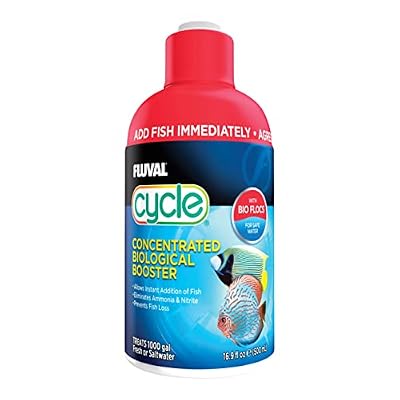
Fluval Cycle Biological Enhancer, Aquarium Water Treatment, 16.9 Oz., A8351
Selected for "How to Cycle a Saltwater Aquarium: A Step by Step Method": this listing is aquarium equipment (Fluval Cycle Biological Enhancer, Aquarium Water Treatment, 16.9 Oz., ), matching the equipment this article covers.
View on Amazon
API Quick Start Freshwater and Saltwater Aquarium Nitrifying Bacteria 4-Ounce Bottle
Selected for "How to Cycle a Saltwater Aquarium: A Step by Step Method": this listing is aquarium equipment (API Quick Start Freshwater and Saltwater Aquarium Nitrifying Bacteria ), matching the equipment this article covers.
View on Amazon
TLC Products StartSmart Complete Saltwater Aquarium Cycle Starter
Selected for "How to Cycle a Saltwater Aquarium: A Step by Step Method": this listing is aquarium equipment (TLC Products StartSmart Complete Saltwater Aquarium Cycle Starter), matching the equipment this article covers.
View on AmazonBy David Nguyen
Measure First, Then Decide What Stage You Are At
Working out how to cycle a saltwater aquarium starts with knowing which stage the tank is currently at. Three readings place it on the timeline, and most cycling questions are really questions about which stage the readings describe.
The Numbers to Take Before Changing Anything
When working out how to cycle a saltwater aquarium, test ammonia, nitrite and nitrate together, every time. Ammonia rising with nitrite at zero means the first bacterial population is still establishing; ammonia falling with nitrite rising means the second has not caught up yet.
Add salinity and temperature to every check. Bacteria establish faster at 78-80 °F (26-27 °C) than at 74 °F (23 °C), and salinity outside 1.024-1.026 SG slows the process while telling you nothing useful about the colony itself.
Reading the Numbers: What Each Pattern Means
The table below places a set of readings on the cycling timeline and gives the first action for each. Work from the numbers rather than from elapsed time, since rock type and temperature change the schedule considerably.
| What you see | Stage | Likely cause | First action |
|---|---|---|---|
| Ammonia high, nitrite 0, nitrate 0 | Week 1-2 | First colony still establishing | Wait, keep temperature at 78-80 °F |
| Ammonia falling, nitrite rising | Week 2-4 | First colony working, second behind | Wait, do not add more ammonia yet |
| Ammonia 0, nitrite high, nitrate rising | Week 3-6 | Second colony establishing | Wait, resist water changes |
| Ammonia 0, nitrite 0, nitrate present | Complete, pending confirmation | Both colonies established | Dose ammonia again and retest at 24 hours |
| No movement after 3 weeks | Stalled | Temperature, salinity or no ammonia source | Check all three before adding anything |
| Ammonia climbing above 5 ppm | Overdosed | Too much ammonia added | Water change to bring it under 3 ppm |
| Nitrite stuck for weeks | Slow second stage | Normal, or ammonia dosed too high | Stop dosing, wait, keep the heater on |
When It Is Not a Cycling Problem
If ammonia and nitrite both read zero, nitrate is present and the tank still looks wrong, cycling is finished and something else is happening. Diatom films, cyanobacteria and hair algae are all normal in the weeks after a cycle completes.
Those films are a nutrient and light matter rather than a bacterial one. Reduce the photoperiod, verify RO/DI output TDS with a meter, and let the tank mature rather than reacting with treatments that will disturb the colony you just built.
The Steps, In Order
Once the readings place the tank on the timeline, the sequence below carries it through to completion. Learning how to cycle a saltwater aquarium properly is mostly a matter of not intervening between the steps once they are underway.
Step 1: Build the System and Mix the Water
Assemble the tank, rock, sand, heater and circulation first, then mix saltwater to 1.024-1.026 SG using RO/DI water verified at 0 ppm TDS. Run the system for two or three days to confirm temperature holds at 78-80 °F (26-27 °C).
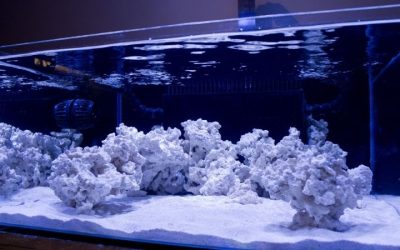
Aim for rock at 1-1.5 lb per gallon (0.45-0.7 kg per 3.8 L), built on the bottom glass rather than on sand. That rock is the surface the colony will grow on, so its quantity matters more to cycling speed than any additive does.
Step 2: Add an Ammonia Source and Test Daily
Dose pure ammonia to 2 ppm and record the date. Two parts per million is enough to grow a colony sized for a stocked tank without pushing nitrite so high that the second stage stalls, which is the usual result of dosing to 4 ppm or beyond.
Test ammonia and nitrite daily, and nitrate twice a week. Do not add more ammonia while either reading is elevated, and do not change water at all, since both actions remove the food that the bacterial colony is currently growing on.
Step 3: Confirm Completion, Then Check Placement and Fit
When ammonia and nitrite both read 0 ppm, dose ammonia back to 2 ppm and test again 24 hours later. Both clearing to zero within that window, with nitrate present, is completion. Repeat once more before trusting it.
Measure the rear chamber or sump against your skimmer and heater before ordering either, since a unit that does not fit means running the tank without it. Do a large water change at this point to bring nitrate down before the first fish.
What Not to Do During a Cycle
Three habits stall or reset a cycle, and all three come from a reasonable instinct to help the tank along. Each one shows up as a timeline that stretches from a few weeks into several months without any obvious cause.
Never Change Water Mid-Cycle
A water change during cycling removes ammonia and nitrite, which are the food the bacteria are growing on. The readings improve immediately and the colony stops expanding, so the tank looks better and is further from finished than before.
The one exception is ammonia above roughly 5 ppm, which inhibits the second bacterial stage rather than feeding it. In that case, change enough water to bring the reading under 3 ppm and then leave the tank alone again.
Never Add Fish to Speed It Up
Cycling a saltwater aquarium with fish in it uses the animal as the ammonia source, exposing it to concentrations that damage gill and skin tissue over weeks. It is slower than a fishless cycle as well, since a fish produces far less ammonia than a controlled dose.
Use pure ammonia instead and keep the tank empty. The colony that results is sized for the stocking you plan rather than for one small fish, which means the tank can take its full stock sooner rather than in stages.
Never Treat the Tank During Cycling
Any product that kills bacteria will kill the colony you are growing, and anything containing copper makes the tank unusable for invertebrates afterwards, since residue persists in silicone and plastics for a long time.
Films and algae during cycling are normal and resolve as the tank matures. Reduce light hours, verify source water, and wait. A tank treated during cycling frequently has to start the process again from the beginning.
Preventing a Stall and What Comes Next
Most stalled attempts at how to cycle a saltwater aquarium have one of four causes, and all four are checkable in an afternoon. This section covers those checks, the equipment that removes uncertainty, and what the first weeks after completion actually look like.
The Four Checks for a Stalled Cycle
Temperature first: below 74 °F (23 °C) the process slows markedly, so hold 78-80 °F (26-27 °C) throughout. Salinity second: outside 1.024-1.026 SG the colony establishes more slowly and the readings mislead you about progress.
Ammonia source third, since a tank with no ammonia has nothing to cycle on and will read zero across the board indefinitely. Test kit accuracy fourth, because an expired kit reporting zero ammonia looks exactly like a finished cycle.
Equipment That Removes the Guesswork
A liquid test kit for ammonia, nitrite and nitrate is the minimum, replaced on schedule rather than when results look odd. A refractometer calibrated against a 35 ppt standard confirms salinity, since hydrometers drift with salt build-up.
A TDS meter checks RO/DI output, which matters during cycling because phosphate and silicate carried in from source water feed the algae films that follow. None of these are optional in a marine tank; they are the instruments the method depends on.
The First Weeks After Completion
Do a large water change to bring nitrate down, then add one or two small fish rather than a full stock. The colony is sized for the ammonia you dosed, but distribution across the rock takes further weeks to even out.
Expect diatom films within the first month and hair algae shortly after. Both are stages a maturing marine tank passes through, and both fade as the rock matures, provided light hours are moderate and source water is clean.
How to Cycle a Saltwater Aquarium: Questions
These arrive during the wait, which is precisely when most mistakes happen. Every answer about how to cycle a saltwater aquarium points back to a reading, since elapsed time on its own tells you very little about the colony.
How long does it take?
Three to eight weeks. Live rock shortens it toward the lower end because it arrives carrying bacteria; dry rock pushes it toward the upper end. Temperature and a steady ammonia source matter more than either for the middle stages.
Do bottled bacteria work?
They can shorten the first stage by seeding the colony, and they do not replace the process. Treat any product as a possible head start rather than an instant cycle, and confirm completion with the same ammonia test regardless.
Should I run a skimmer while cycling?
It makes little difference either way, since there is nothing to skim in an unstocked tank. Run it if it is installed, and use the period to learn its adjustment before livestock arrives and mistakes start to matter.
Can I use fish food instead of pure ammonia?
You can, but the dose is uncontrolled and the decaying food adds phosphate that feeds algae for months afterwards. Pure ammonia gives a measurable 2 ppm dose and leaves nothing behind, which makes the readings meaningful.
See More:
Conclusion
How to cycle a saltwater aquarium reduces to a single method: build the system, mix saltwater to 1.024-1.026 SG and hold 78-80 °F (26-27 °C), dose ammonia to 2 ppm, then test daily without changing water or adding any livestock.
Completion is ammonia and nitrite both clearing to 0 ppm within 24 hours of a fresh dose, with nitrate present, repeated twice. That takes three to eight weeks, and no product shortens the biology enough to skip the confirmation test.
Best Kessil LED Light for Reef Tank: How to Pick by Size
6 Best Aquarium Kit Saltwaters 2026