Last Updated: October 4, 2026
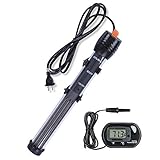
- Top Pick: hygger Small Aquarium Betta Heater, Submersible Fish Tank Heater 10W/25W/50W/100W with LED Digital Display, Suitable for Marine Saltwater and Freshwater up to 5/10/16/26 Gallon
- Best Value: Orlushy Submersible Aquarium Heater,500W Fish Tahk Heater with Adjust Knob Thermostat 2 Suction Cups and Free Thermometer Suitable for Marine Saltwater and Freshwater (500W)
- Premium Choice: hygger Small Aquarium Betta Heater, Submersible Fish Tank Heater 10W/25W/50W/100W with LED Digital Display, Suitable for Marine Saltwater and Freshwater up to 5/10/16/26 Gallon
Choosing aquarium heater wattage sounds simple: match the heater to the tank’s gallon capacity and plug it in. That shortcut is responsible for many temperature swings, overheated tanks, and prematurely failed heaters. A heater rated for “up to 10 gallons” may perform very differently in a covered 10-gallon aquarium inside a warm room than in an open tank near a cold window. Tank shape, room temperature, water movement, and heater quality all matter.
The goal is not to buy the largest heater available. An oversized heater can raise the temperature too quickly if its thermostat sticks, while an undersized model may run continuously without maintaining a stable temperature. This guide explains how to choose aquarium heater wattage in 2026, using practical numbers, safety margins, and features that matter more than flashy displays.
As an Amazon Associate we earn from qualifying purchases at no extra cost to you.


Decide These 3 Things First
- Your actual water volume: A tank sold as 10 gallons may hold closer to 8 gallons after gravel, decorations, plants, and empty space. Use the manufacturer’s stated capacity as a starting point, then allow for displacement.
- The temperature difference: Subtract your room’s lowest typical temperature from your target water temperature. Tropical fish commonly need water around 75°F to 80°F, while some species require a narrower range. A 78°F target in a 72°F room requires less heating than the same target in a 64°F basement.
- How much control you need: A small betta aquarium may need a compact preset or adjustable heater. A large community, turtle, or saltwater tank may need a stronger adjustable model, multiple heaters, or a controller for safer, more even heating.
A useful starting rule is approximately 3 to 5 watts per gallon when the room is about 5°F to 10°F cooler than the desired aquarium temperature. For a 5-gallon tank, that usually means 15 to 25 watts; for a 10-gallon tank, 25 to 50 watts; and for a 20-gallon tank, roughly 50 to 100 watts. In a very cold room, use the upper end of the range, improve insulation, or divide the load between two heaters rather than automatically choosing one oversized unit.
Tank Size and Wattage
Tank volume is the first filter, but it should not be the only one. Small aquariums lose heat quickly because they have a high surface-area-to-volume ratio. A 10-watt heater can be appropriate for a tiny betta tank, while a 25-watt unit may be more suitable for a 5-gallon aquarium in a cool room.
As a general buying guide:
- 1 to 3 gallons: 5 to 15 watts, depending on room temperature and species.
- 5 gallons: 15 to 25 watts in a moderate room; up to 50 watts in a chilly location.
- 10 gallons: 25 to 50 watts.
- 20 gallons: 50 to 100 watts.
- 29 to 40 gallons: 100 to 200 watts.
- 55 gallons: 150 to 300 watts, often split between two heaters.
- 75 gallons and larger: 200 to 400 watts or more, preferably divided across multiple units.
These are starting ranges, not guarantees. Check the product’s stated tank-size rating and follow the lower limit if your room is warm. A 500-watt heater, such as the Orlushy model listed for reference, is generally excessive for a small home aquarium and should be considered only for a much larger setup with appropriate safeguards.
Room Temperature and Heat Loss
The colder the room, the more work the heater must do. Measure the room overnight, not just during the warmest part of the day. If your room drops to 65°F and your fish need 78°F, the 13-degree difference calls for more capacity than a room that stays at 73°F.
Location matters, too. Tanks beside exterior doors, drafty windows, air-conditioning vents, or unheated floors lose heat faster. A fitted lid can reduce evaporation and heat loss, while placing the aquarium on a stable stand away from drafts improves consistency. Do not bury a heater in gravel or allow it to touch the tank wall unless the instructions specifically permit that installation.
If you need the upper end of the wattage range, two smaller heaters are often safer than one large heater. For example, a 55-gallon aquarium could use two 150-watt units positioned at opposite ends. Each heater can maintain part of the temperature, and one failed unit is less likely to create a rapid temperature change.
Heater Material and Construction
Most submersible aquarium heaters use a glass or plastic housing around a heating element. Standard glass is affordable and works well when handled carefully, but sudden temperature changes or a knock from a decoration can crack it. Shatter-resistant or reinforced housings cost more and may be worthwhile in aquariums with turtles, large fish, or heavy decorations.
Look for a fully submersible design with clear minimum and maximum water-depth markings. A heater that is too long for the tank may need to be installed diagonally, but it must remain covered to the specified level. Compact 10W, 25W, 50W, and 100W heaters are common for small tanks; larger 200W and 300W models require more space and stronger water circulation.
Construction details also affect safety. Favor models with protected heating areas, secure suction cups or mounting brackets, a visible power indicator, and a power cord long enough to form a drip loop. A drip loop is a low point in the cord below the outlet, preventing water from running directly into the receptacle.
Temperature Control and Performance
An adjustable thermostat is usually more useful than a heater with a fixed setting. It lets you match the needs of tropical fish, shrimp, turtles, and other aquatic animals, although the dial is not necessarily precise. A built-in display can make checking the setting easier, but it does not replace a separate aquarium thermometer.
Choose a heater with a thermostat range that includes your target temperature, commonly about 68°F to 93°F. Look for overheat protection or automatic shutoff when the unit is removed from water, but never assume those features eliminate the need for supervision. Water should circulate around the heater so warm water does not remain trapped in one corner. Install it near filter flow while keeping the unit fully submerged.
After installation, wait until the heater is completely submerged before plugging it in. When removing it, unplug it and allow it to cool for at least 15 minutes before lifting it from the aquarium. Check the actual water temperature with a separate thermometer daily during the first week and after water changes. A difference of more than 2°F from the setting deserves investigation.
Price Tiers and What You Get
Budget aquarium heaters generally cost about $12 to $25. Examples in this category include adjustable 25W to 300W models with suction cups, simple dials, or an included thermometer. A low price can be perfectly acceptable for a basic freshwater setup, but inspect the cord, seal, mounting hardware, and return policy carefully.
Midrange heaters typically cost $25 to $60. They may offer clearer digital controls, sturdier housings, better mounting systems, and more consistent thermostat adjustment. Small digital-display heaters in the 10W to 100W range often fall into or near this range depending on size and included accessories.
Premium systems usually cost $60 to $150 or more, particularly when they include an external controller, advanced temperature protection, titanium construction, or a separate monitoring probe. Premium pricing does not guarantee perfect accuracy, so prioritize a reliable warranty and independently verify the water temperature.
Warranty and Replacement Support
For a basic heater, look for at least a 12-month warranty. A two-year warranty is more reassuring for a larger or higher-priced unit. Confirm whether the warranty covers the heating element, thermostat, and water damage, since terms can exclude misuse, dry operation, or cracked glass.
Keep the receipt, packaging, model number, and installation instructions. Aquarium heaters are consumable electrical components, so replacing an older unit before it fails can be sensible, especially if the thermostat becomes inconsistent or the housing shows discoloration, cracks, or corrosion. A dependable seller should make replacement parts or a replacement unit easy to obtain.
Delivery, Installation, and Ongoing Care
Before ordering, measure the aquarium’s usable height and the distance to the outlet. A heater may be rated for the right wattage but too long for a nano tank. Delivery packaging matters because glass heaters can be damaged in transit. Inspect the unit before placing it in water and return anything with a crack, loose end cap, damaged cord, or missing suction cup.
Installation usually takes less than 10 minutes, but allow a full 15 minutes for the heater to cool before handling it later. Mount it vertically or diagonally according to the instructions, maintain water circulation, and keep the cord’s drip loop below the outlet. Clean algae and mineral buildup from the housing during routine maintenance without scraping the heating element.
Spec Checklist
| Spec | Budget | Mid | Premium |
|---|---|---|---|
| Typical price | $12–$25 | $25–$60 | $60–$150+ |
| Common wattage | 10W–300W | 25W–300W | 50W–500W systems |
| Control | Dial or preset | Adjustable dial or digital display | External controller or probe |
| Housing | Standard glass or plastic | Reinforced glass or protected element | Titanium or heavy-duty shatter-resistant housing |
| Tank coverage | About 1–40 gallons | About 5–75 gallons | About 20 gallons and larger |
| Warranty target | At least 12 months | 12–24 months | 24 months or more |
Red Flags
- A wattage claim without a recommended tank-size range.
- No minimum water level or submersion instructions.
- A thermostat dial with no temperature scale or unclear operating range.
- Cracked glass, loose end caps, brittle suction cups, or a damaged cord.
- A heater that turns on and off rapidly, remains hot after reaching temperature, or causes a temperature change greater than 2°F in a few hours.
- Using one 300W or 500W heater in a small aquarium simply because it is inexpensive.
- Operating any heater outside the water or plugging it in immediately after removal.
- Relying on the heater’s display without a separate thermometer.
FAQ
How many watts do I need for a 10-gallon aquarium?
Most 10-gallon aquariums need 25W to 50W when the room is 5°F to 10°F cooler than the target water temperature. Choose closer to 25W for a warm room and closer to 50W for a cool or drafty location. Verify the actual temperature with a separate thermometer.
Is a higher-wattage aquarium heater better?
Not automatically. A higher-wattage heater can raise temperature faster, but it may be less forgiving if the thermostat fails. Match wattage to tank size and room conditions, and use two appropriately sized heaters for a large aquarium when practical.
Can I use a 50W heater in a 5-gallon tank?
You can if the manufacturer permits it and the room is cold, but 25W is often sufficient in a moderate room. A 50W unit should have a reliable thermostat, strong water circulation, and frequent temperature checks during setup.
Do aquarium heaters need to be fully submerged?
Most submersible heaters do. Keep the water above the marked minimum line and follow the manufacturer’s orientation instructions. Unplug the heater before lowering the water, cleaning the tank, or removing the unit.
Ready to decide? Our #1 pick for 2026 is the Typical price.
Live price & availability on Amazon.
Related Reviews & Guides
Are Aquarium Sponge Filters Worth It? An Honest Answer (2026)
6 Best Water Air Pumps For Aquarium 2026