Last Updated: October 4, 2026
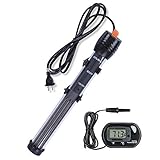
- Top Pick: Orlushy Submersible Aquarium Heater,500W Fish Tahk Heater with Adjust Knob Thermostat 2 Suction Cups and Free Thermometer Suitable for Marine Saltwater and Freshwater (500W)
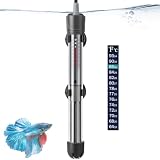
- Best Value: HITOP 100W Adjustable Aquarium Heater, Submersible Fish Tank Heater Thermostat with Suction Cups for 12-30Gal
- Premium Choice: Inkbird Aquarium Heater with Probe Thermostat Fish Ornamental Shrimp Reef Tanks 24 Hours Double Time with Day Night Automatic Temperature Controller
Aquarium heater thermostat accuracy is easy to underestimate. Many buyers compare wattage and price, then assume every adjustable heater holds the selected temperature equally well. In practice, the dial may be approximate, the built-in sensor may react slowly, and room temperature, water movement, tank size, and heater placement can all affect the result.
The safest approach in 2026 is to treat the heater’s thermostat as a control, not a laboratory-grade thermometer. Choose the correct wattage, verify the water with a separate thermometer, and look for safety features that prevent overheating if the thermostat sticks. A $16 heater can work well in a small, stable tank, while a controller with an external probe may be worth paying for in a reef aquarium, shrimp setup, or room with large temperature swings.
As an Amazon Associate we earn from qualifying purchases at no extra cost to you.


Decide These 3 Things First
- Tank volume and room temperature: A 10-gallon aquarium in a warm room needs far less heating capacity than a 30-gallon tank in a cold basement.
- Required temperature stability: Hardy community fish may tolerate modest variation, while shrimp, tropical species, fry, and reef inhabitants benefit from tighter control.
- Your monitoring routine: If you check temperature daily, a simple adjustable heater may be sufficient. If the aquarium is unattended for days, prioritize an external probe, over-temperature protection, and an alarm or visible display.
Most tropical aquariums are set somewhere around 75–80°F, but always follow the care requirements for the species rather than choosing a temperature by habit. The thermostat’s accuracy matters most when the actual water temperature stays meaningfully above or below your target.
Size and Wattage
Wattage determines how quickly a heater can add heat; it does not automatically determine thermostat accuracy. A common starting point is approximately 3–5 watts per gallon, but that range changes with room temperature, tank cover, water circulation, and desired temperature.
- 5–10 gallons: Usually 25–50 watts, depending on the room.
- 10–20 gallons: Typically 50–100 watts.
- 20–30 gallons: Often 100–150 watts.
- 40–55 gallons: Commonly 150–250 watts.
- 75 gallons and larger: Consider two lower-wattage heaters or a controlled system rather than one oversized unit.
Do not buy a 500-watt heater simply because it reaches temperature quickly. An oversized heater can raise water temperature rapidly if its thermostat fails, leaving less time to notice a problem. The Orlushy 500W example is intended for much larger aquariums than a typical betta tank; it should not be used as a one-size-fits-all choice.
For large tanks, two heaters placed at opposite ends can provide more even heating and partial backup. Each heater should still be appropriately sized, and both should be connected to reliable temperature monitoring.
Material and Sensor Design
Heater construction affects durability, heat distribution, and how quickly the thermostat senses a change. Glass-bodied heaters are common and often affordable, but they can crack if exposed to a sudden temperature change or knocked against décor. Shatter-resistant plastic or polymer housings can be a practical choice in tanks with large fish, turtles, or active decorations.
Look for a fully submersible design with a clearly stated minimum water level. The heater should remain covered whenever it is powered. A heater that runs partly out of water can overheat its housing and may fail when returned to the aquarium.
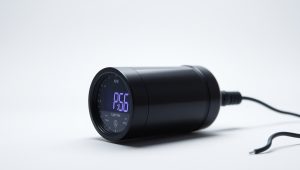
The location of the sensor also matters. A heater with an internal thermostat measures temperature near its own body, not necessarily across the aquarium. Strong water circulation helps distribute heat and reduces local hot spots. External-probe models, such as the Inkbird-style controller example, measure from a separate probe that can be positioned away from the heating element. That arrangement can improve control, provided the probe remains submerged, clean, and securely mounted.
For a glass heater, check for a protective guard if fish, snails, or decorations may contact it. A guard does not make the heater indestructible, but it can reduce impact damage.
Construction and Safety Features
Thermostat accuracy is only one part of safe heating. A good heater should include a readable temperature scale, an adjustment mechanism that does not move easily, suction cups or a mounting bracket, and a power indicator. Digital displays are convenient, but the displayed setting is not proof of the actual water temperature.
Prioritize these features:
- Overheat protection: Shuts the element down if internal temperature rises abnormally.
- Thermal cutoff: Adds a second layer of protection if the primary thermostat sticks.
- Water-level or dry-run protection: Helps prevent damage if the heater becomes exposed.
- External probe: Useful when you want the sensor positioned in a representative area of the tank.
- Secure mounting: Two or more attachment points are preferable for longer heaters.
Never operate a heater outside its instructions. Unplug it before removing it from the water, and let it cool for at least 15 minutes before handling. The heater should be near water flow but not pressed against the substrate or wedged tightly between decorations.
Comfort and Temperature Performance
For aquarium heaters, “comfort” means stable conditions for fish and convenient operation for the owner. An adjustment knob is simple and inexpensive, but the printed scale may have wide increments. A digital display is easier to read, while a separate controller can offer day-and-night settings, alarms, or more flexible calibration.
Use a separate thermometer regardless of heater type. Place it at the opposite end of the tank, ideally at mid-water level and away from direct heater output. Let the aquarium stabilize for 24 hours after installation, then compare the thermometer reading with the heater’s setting. If the water is consistently off target, make small adjustments—about 1°F at a time—and wait several hours before changing it again.
Do not chase every brief fluctuation. A heater may cycle on and off as the element and water respond at different speeds. The goal is a stable average temperature, not a display that never changes. A difference of roughly 1–2°F between the set point and an independent thermometer can be normal for basic equipment; larger or inconsistent differences deserve closer investigation, recalibration if supported, or replacement.
Small tanks need special care because a few watts can produce a noticeable temperature change. A 10W, 25W, or 50W compact heater—such as the hygger small-tank category—may be more appropriate for a betta aquarium than a full-size 100W model. Follow the manufacturer’s gallon rating and provide water movement without creating excessive current.
Price Tiers
Price is a useful guide to features, but not a guarantee of thermostat accuracy.
- Budget: $15–$25: Usually an internal thermostat, adjustment knob, suction cups, and sometimes a free thermometer or basic display. The HITOP 100W example falls in this general category, as does a compact heater priced around $17. Best for small or medium freshwater tanks that are checked regularly.
- Midrange: $25–$60: May add a digital readout, stronger housing, improved mounting, external sensing, or better control options. An external controller such as the approximately $35 Inkbird example can be attractive when monitoring and temperature limits matter more than simplicity.
- Premium: $60–$150 or more: Often includes a separate controller, probe redundancy, alarms, robust guards, replaceable components, or a system designed for larger aquariums. Confirm what is actually included before assuming a higher price means tighter accuracy.
Budget for a separate thermometer, usually $5–$20, and possibly a replacement set of suction cups. That small addition often improves confidence more than moving from one basic heater to another.
Warranty and Replacement Support
Check the warranty period, return window, and whether the manufacturer provides replacement probes, suction cups, controllers, or glass components. A one-year warranty is common for entry-level equipment; longer coverage can be valuable for a heater that operates continuously.
Read the exclusions. Damage caused by running the unit dry, incorrect installation, impact, or water intrusion may not be covered. Keep the receipt and packaging until the heater has operated reliably for at least several weeks. For a valuable reef or breeding setup, buying a spare heater or using two smaller units may be more practical than relying on warranty service during an emergency.
Delivery and Installation
Heaters do not require furniture-style assembly, but delivery and setup still matter. Inspect the glass, cord, suction cups, probe, and controller immediately after arrival. Do not install a cracked heater or one with a loose seal.
Before plugging it in, place the heater in the tank and wait 15–30 minutes so its materials reach the water temperature. Position it vertically or according to the instructions, keep it fully submerged, and allow water to circulate around it. After installation, wait for the tank to reach temperature and confirm the reading with an independent thermometer.
Use a drip loop in the power cord, and connect the aquarium to a ground-fault circuit interrupter outlet where appropriate. Avoid extension cords that are not rated for the electrical load and wet environment.
Spec Checklist
| Spec | Budget | Mid | Premium |
|---|---|---|---|
| Typical price | $15–$25 | $25–$60 | $60–$150+ |
| Best tank range | 5–30 gallons | 10–75 gallons | 40 gallons and larger, or sensitive systems |
| Common wattage | 10–150W | 50–300W | 100–500W, often split between units |
| Temperature control | Internal knob or basic digital setting | Improved digital control or external probe | Controller, probe, alarms, and calibration options |
| Recommended monitoring | Separate thermometer | Separate thermometer and periodic checks | Independent thermometer plus alarm or backup monitoring |
| Typical body length | 6–12 inches | 8–16 inches | 10–20 inches, depending on wattage |
Red Flags
- No stated gallon range, wattage guidance, or minimum water level.
- A temperature dial with no readable increments or a control that turns accidentally.
- Claims of exact accuracy without explaining tolerance, sensor location, or testing conditions.
- No dry-run, overheat, or thermal cutoff information.
- A high-wattage heater marketed for a very small tank.
- Cracked glass, cloudy seals, damaged cords, or missing suction cups on arrival.
- A digital display that shows only the selected setting and not the measured water temperature.
- Instructions that do not clearly explain submersion, placement, cooling, and cleaning.
FAQ
How accurate should an aquarium heater thermostat be?
For many home aquariums, keeping the actual water temperature within about 1–2°F of the target is a reasonable practical standard. Verify performance with a separate thermometer because manufacturers may describe accuracy differently, and the reading can vary with placement and water flow.
Is an external temperature controller better than a built-in thermostat?
It can be. An external controller lets the probe measure water away from the heating element and may provide alarms or a second temperature limit. However, it adds more components that must remain dry and correctly positioned. It is most useful for sensitive livestock, larger tanks, or rooms with significant temperature changes.
Should I use one large heater or two smaller heaters?
Two smaller heaters can distribute heat more evenly and provide limited backup if one fails, especially in tanks over about 40 gallons. Size each unit conservatively for the aquarium rather than installing two oversized heaters. Always use an independent thermometer and suitable over-temperature protection.
How often should I check the heater?
Check the temperature daily during the first week, after water changes, and whenever the room temperature changes sharply. Once the system is stable, inspect the heater, cord, mounting, and thermometer at least weekly. Remove mineral or algae buildup according to the instructions, and replace equipment that shows cracks, erratic cycling, or unexplained temperature changes.
Ready to decide? Our #1 pick for 2026 is the Typical price.
Live price & availability on Amazon.
Related Reviews & Guides
Aquarium Heater Length for a Ten Gallon Size Guide With Measurements (2026)
How to Choose an Aquarium Light: Complete Buying Guide (2026)