Last Updated: October 9, 2026
Quick answer: Our top pick in 2026 is the 5 gallon — our #1 rated choice. See the full ranked comparison, alternatives and buying advice below.
The Short Answer
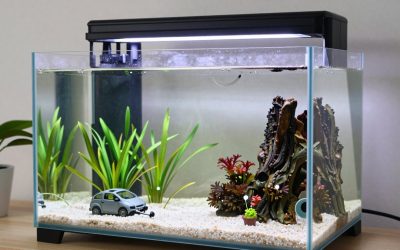
For most aquariums, aquarium substrate should be 1 to 2 inches deep (2.5 to 5 cm). That range provides enough coverage to protect the tank bottom and support decorations without making cleaning unnecessarily difficult.
Use about 1 inch (2.5 cm) for a bare-bottom look, quarantine tank, hospital tank, or aquarium with only a few ornaments. Choose 1.5 to 2 inches (3.8 to 5 cm) for a typical freshwater community aquarium. A planted aquarium usually needs 2 to 3 inches (5 to 7.6 cm), especially when growing rooted plants.
As an Amazon Associate we earn from qualifying purchases at no extra cost to you.

Deep substrate is not automatically better. Layers thicker than 3 inches can develop compacted, low-oxygen areas if the material is too fine or water cannot circulate through it. Deeper beds can work for specialized planted layouts, but they require careful material selection and maintenance.
As a practical buying guide, plan on approximately 1 pound of gravel or coarse substrate per gallon for a 1-inch layer. Fine sand is often heavier and more compact, so calculate by volume whenever possible. A level 1-inch layer in a 20-gallon tank typically requires about 20 pounds of gravel, while a 2-inch layer may require approximately 40 pounds. Sloped layouts use more.
Standard Sizes
The table below shows common aquarium footprints and useful substrate depths. These are planning measurements, not exact bag requirements. Interior tank dimensions, curved fronts, rockwork, and slopes can change the final amount.
| Common tank size | Typical footprint | Footprint in cm | 1-inch layer | 2-inch layer | Recommended use |
|---|---|---|---|---|---|
| 5 gallon | 16.0 × 8.0 in | 40.6 × 20.3 cm | About 5 lb | About 10 lb | Small fish, shrimp, or plants |
| 10 gallon | 20.0 × 10.0 in | 50.8 × 25.4 cm | About 8–10 lb | About 16–20 lb | Beginner freshwater setup |
| 20 gallon long | 30.0 × 12.0 in | 76.2 × 30.5 cm | About 20 lb | About 40 lb | Community fish or planted layout |
| 29 gallon | 30.0 × 12.0 in | 76.2 × 30.5 cm | About 20 lb | About 40 lb | Tall freshwater aquarium |
| 40 gallon breeder | 36.0 × 18.0 in | 91.4 × 45.7 cm | About 35–40 lb | About 70–80 lb | Large planted or community tank |
| 55 gallon | 48.0 × 13.0 in | 121.9 × 33.0 cm | About 35–40 lb | About 70–80 lb | Long freshwater display |
| 75 gallon | 48.0 × 18.0 in | 121.9 × 45.7 cm | About 50–60 lb | About 100–120 lb | Deep planted or aquascaped tank |
For a sloped aquascape, use the table’s 2-inch estimate as a starting point and add 25% to 50%. A front depth of 1 inch and rear depth of 3 to 4 inches creates height while using less material than a flat 3-inch bed.
Substrate grain size also affects depth. Gravel measuring approximately 2 to 5 mm stays relatively open and is easy to vacuum. Fine sand can form a dense layer, so 1 to 2 inches is usually sufficient unless the aquarium is specifically designed for a deep sand bed. Avoid burying large amounts of decomposing material beneath ordinary aquarium sand.
How to Measure Your Space
- Measure the inside length and width. Use the bottom interior dimensions rather than the manufacturer’s outside measurements. Measure in inches, and record the numbers to the nearest half inch.
- Choose the target depth. Select 1 inch for minimal coverage, 2 inches for most aquariums, or 2 to 3 inches for rooted plants. If you want a slope, record both the front and rear depths.
- Calculate the volume. Multiply length by width by average depth. Divide the result by 231 to find the volume in U.S. gallons. For example, a 30 × 12-inch tank with a 2-inch layer contains 720 cubic inches, or about 3.1 gallons of substrate volume.
- Convert volume to weight. Check the product packaging for coverage. If no coverage information is available, use approximately 1 pound per gallon of tank capacity for a 1-inch gravel layer, then adjust for the material’s density. Sand usually needs a weight-based estimate from the package because it settles more tightly.
- Subtract areas occupied by hardscape. Large rocks, caves, and ornaments displace substrate. However, do not reduce your purchase too aggressively; uneven ground and a rear slope usually require extra material.
- Rinse and place the substrate. Rinse dusty gravel or sand according to the product instructions, then add it gradually. Smooth it with a clean ruler or plastic card and check the depth at several points.
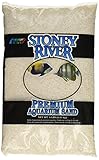
Bag size varies widely. For example, a 7.7-pound bag of Seachem Fluorite Onyx Sand is suitable for a small aquarium or as part of a layered setup, but the exact coverage depends on the tank footprint and desired depth. A 5-pound bag of Stoney River White Aquatic Sand may cover a shallow nano tank or serve as a top-off layer. Prices for aquarium substrate commonly range from about $10 to $25 for a 5- to 8-pound bag, with larger 15- to 20-pound bags often ranging from $20 to $45.
By Room or Use Case
Freshwater community aquarium
Choose 1.5 to 2 inches (3.8 to 5 cm). This depth gives a finished appearance, anchors modest decorations, and leaves enough room for rooted plants without creating a difficult-to-clean trench. Medium gravel is a forgiving choice for beginners because waste remains visible on the surface and can be removed with a gravel vacuum.
Planted aquarium
Use 2 to 3 inches (5 to 7.6 cm), with the deeper end toward the back. Plants with substantial root systems benefit from more room, while foreground plants often need only 1 to 2 inches. A nutrient-rich base layer, capped with gravel or sand, should follow the manufacturer’s depth instructions rather than being improvised.
Shrimp or nano aquarium
About 1 to 1.5 inches (2.5 to 3.8 cm) is usually enough. A shallow layer preserves swimming space and makes it easier to see and remove debris in a small tank. Fine sand can be attractive, but avoid creating deep, compacted pockets in a tank with limited water movement.
Marine aquarium
For a standard decorative sand bed, use approximately 1 to 2 inches (2.5 to 5 cm). A deeper marine sand bed is a specialized system and may require specific grain size, circulation, and maintenance. Do not assume that simply adding more sand creates the benefits of a designed deep-bed filtration system.
Quarantine or hospital tank
Use no substrate or a thin layer of about 0.5 to 1 inch (1.3 to 2.5 cm). Bare bottoms are easier to inspect and sanitize, while a thin layer can reduce glare and make fish feel more secure. Remove decorative substrate if medication instructions require a bare tank.
Betta or desktop aquarium
Use 1 to 2 inches (2.5 to 5 cm), depending on the tank’s footprint and plants. In a small desktop tank, a thick bed can take up significant water volume. Keep the front area shallow enough for routine cleaning and avoid burying the filter intake.
Common Sizing Mistakes
- Using tank gallons as the only measurement. Two tanks with the same water capacity can have different footprints and require different amounts of substrate.
- Filling to the rim. Leave space above the substrate for water circulation, cleaning, and a natural visual border.
- Ignoring hardscape displacement. A large rock pile can replace several pounds of material, but it also needs a stable base that will not shift under fish activity.
- Making fine sand too deep. Deep, compact sand can trap debris and become difficult to stir or vacuum safely.
- Forgetting slopes. A rear wall that is 4 inches deep uses substantially more substrate than a flat 2-inch layer.
- Covering filter intakes. Keep substrate below the intake’s recommended clearance and check that small grains cannot be pulled into the motor.
- Adding all substrate without checking the stand. Substrate, water, glass, rocks, and equipment are heavy. A large aquarium can add hundreds of pounds to a floor or cabinet.
FAQ
How deep should aquarium substrate be for live plants?
Most planted aquariums work well with 2 to 3 inches (5 to 7.6 cm). Use about 2 inches for small or shallow-rooted plants and closer to 3 inches for larger rooted species. Build a slope rather than filling the entire tank to 3 inches if you want height at the back.
Is 3 inches of aquarium substrate too deep?
Not necessarily, but it is deeper than many tanks need. Three inches can be appropriate for planted displays or a sloped aquascape. Use compatible grain sizes, avoid tight compaction, and maintain the surface so waste does not accumulate.
How many pounds of substrate do I need?
A rough estimate is 1 pound per gallon of tank capacity for a 1-inch gravel layer. A 20-gallon aquarium therefore needs about 20 pounds for 1 inch or 40 pounds for 2 inches. Always compare that estimate with the product’s stated coverage because sand and specialty substrates vary in density.
Can aquarium substrate be too shallow?
Yes. A layer under 0.5 inch can look patchy, expose the tank bottom, and allow decorations to shift easily. It can still be suitable for a bare-bottom-style setup or a quarantine tank, but most display aquariums look and function better with at least 1 inch.
Ready to decide? Our #1 pick for 2026 is the 5 gallon.
Live price & availability on Amazon.
Related Reviews & Guides
Best 125 Gallon Aquarium Kit For Large Fish: Top Compared
6 Best Aquarium Sump Pumps 2026