Last Updated: October 4, 2026
Choosing the best titanium heater for saltwater aquariums is really two decisions: which heating element goes in the water, and which controller decides when it runs. Titanium survives salt far better than glass, but the controller is what prevents a stuck-on disaster.
As an Amazon Associate we earn from qualifying purchases.
As an Amazon Associate we earn from qualifying purchases at no extra cost to you. Prices and availability are accurate as of the date shown and are subject to change.
By David Nguyen
Quick answer: For most people in 2026, the best titanium heater for saltwater aquariums is the BRS 300W Titanium System WiFi — our #1 rated choice. See the full ranked comparison, alternatives and buying advice below.
How to Choose a Titanium Heater
Heater wattage follows your temperature gap rather than tank volume alone, and the element is only half the system. Work through required watts, element versus bundled controller, the electrical load your controller can switch, and the safety layers you want behind it. A heater sized from a volume chart alone is the most common mistake in this category.
Size Wattage to Heat Loss, Not Gallons
Manufacturer tank guidelines assume a temperature gap they rarely state. BRS suggests its 300W titanium system for tanks up to 100 gallons, and Innovative Marine charts the Helio 350W at 50 to 100 gallons, yet both figures depend on how far the room sits below your setpoint.
A display in a 72F room needs far less wattage than the same tank in a 60F basement. Measure how quickly the system drops overnight with heating off, then size for that measured loss rather than trusting a volume band printed on a chart. Splitting the load across two smaller heaters also gives you partial heating if one fails mid-winter.
Element Only or Complete System
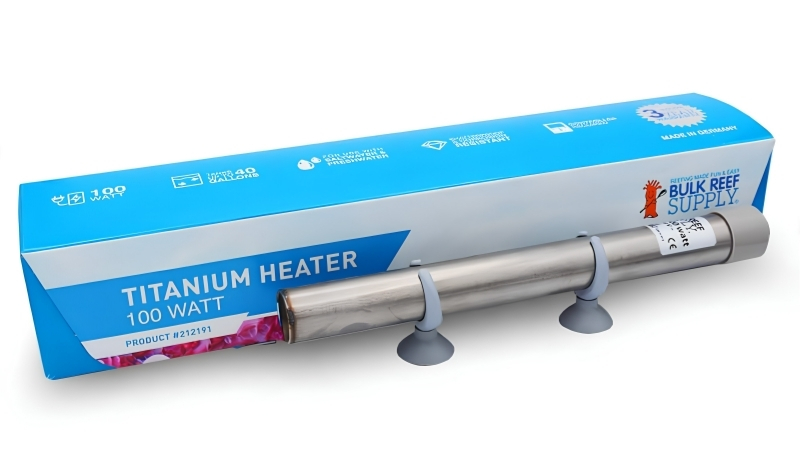
BRS sells both: a bare 300W titanium element near under $80 that requires a controller purchased separately, and a complete 300W Titanium Heater System with WiFi near under $150 that includes the controller and a 68 to 95F range.
The bundle costs roughly $55 more, about 73.3% above the bare element, which is usually less than buying a quality controller separately. Choose the element alone only if you already run a controller with a spare heating output and a probe you trust. Check whether the controller in a bundle can also drive a chiller later, since that decides whether you buy a second controller later.
Check the Controller’s Electrical Ceiling
Two different current figures appear in these listings and they mean different things. The BRS 300W element draws 2.5A at 120VAC as a resistive load, which cross-checks cleanly as 120V times 2.5A equals 300W. The controller’s maximum is 10A at 120VAC.
That 10A ceiling is the controller’s switching limit, not an invitation to load it fully. Add the draw of everything you plug into it, leave margin, and remember a resistive heater behaves predictably where a compressor does not. Titanium elements are resistive loads, so their draw stays predictable across the whole heating cycle.
Build in Safety Layers
Titanium will not shatter like glass, which is its main advantage in a saltwater system, but it can still fail stuck on. That failure mode is what cooks a tank, and the element material does nothing to prevent it. Salt creep and mineral scale can also build on any element, which is worth wiping during water changes.
Run a controller with an independent probe, consider a second smaller heater rather than one oversized unit, and plug everything through a GFCI outlet. Aquarium heaters are among the most frequently recalled aquatic devices, so check current recall listings by model and year with the CPSC.
Top Picks
Three products plus one buying decision cover this category. Each entry lists manufacturer specifications, a relative price position as of 09/2026, and one real drawback worth weighing before you order.
| Product | Best For | Key Spec | Watch Out For |
|---|---|---|---|
| BRS 300W Titanium System WiFi | Best overall | 300W; 2.5A at 120VAC; 68-95F; 10A controller | Tank guideline assumes a modest gap |
| BRS 300W Element | Best value | Titanium, fully submersible; controller separate | Unsafe to run without a controller |
| IM Helio 350W | Best accuracy and warranty | 350W; 59-95F; plus/minus 1F; 5-year warranty | Most expensive by a wide margin |
| System vs element | Choosing your path | Bundle costs about $55 more | Separate controllers often cost more |
BRS 300W Titanium Heater System WiFi: Best Overall
At roughly $125 as of 09/2026, this bundle pairs a 300W titanium element drawing 2.5A at 120VAC with a controller rated to 10A at 120VAC and a 68 to 95F range. The element measures 10.25 by 1 inch, and BRS suggests it for tanks up to 100 gallons.
That 100 gallon guideline depends entirely on your temperature gap, so a cold room narrows it considerably. The WiFi element of the system also depends on your network staying up, which makes it a monitoring convenience rather than a guaranteed safety layer. BRS supports its own ecosystem well, and replacement probes and elements are sold separately, which keeps the system repairable.
BRS 300W Titanium Element: Best Value
The bare element at about $75 as of 09/2026 sits roughly 42.3% below the complete system. It is fully submersible titanium with the same 300W rating, which suits anyone already running a controller with a free heating output.
Running it without a controller is genuinely unsafe, since the element has no thermostat of its own. Factor the cost of a quality dual-stage controller into any comparison, because that addition often exceeds the $55 bundle premium. Keeping a spare element on the shelf is cheap insurance, since a failed heater in winter gives you very little reaction time.
Innovative Marine Helio 350W: Best Accuracy and Warranty
The Helio 350W covers a charted 50 to 100 gallon range with a 59 to 95F set range, quoted accuracy of plus or minus 1F, a 15.25 inch element and a five-year warranty. It runs near $237 as of 09/2026.
It costs about 82.3% above the BRS system, a gap near under $150, and the extra 50W does not translate into a proportional performance gain. Buy it for the accuracy figure, the long warranty and the build, not for the wattage difference alone. The five-year warranty is genuinely unusual in this category, where one or two years is more typical, and that coverage offsets part of the price gap over time.
Complete System or Element Plus Your Own Controller
If you are starting fresh, the bundled system is usually the cheaper route once a controller is priced in. If you already run a reef controller with spare outputs and calibrated probes, the bare element slots into that ecosystem without duplicating hardware.
Consider where you want to end up. Replacing a heater often becomes a controller ecosystem decision, since probes, apps and alert systems rarely interoperate between brands, and committing to one platform shapes future purchases more than the heater itself does. Reef electronics tend to discount hardest around Prime Day and Black Friday, which is useful timing when buying an element and controller together.
Frequently Asked Questions
Four questions come up repeatedly: whether titanium can fail, how many watts a hundred-gallon system needs, whether a controller is truly mandatory, and what the Helio’s temperature range means in practice.
Can a titanium heater still fail?
Yes. Titanium resists shattering and corrosion in saltwater, which is why it is preferred over glass, but the failure that harms livestock is a thermostat or relay sticking on, and material choice does not prevent that.
Protect against it with an independent controller and probe, and check recall listings by model and year with the CPSC before installing. Recall lists change month to month, so treat any check as current rather than permanent. Position the probe away from the heater outflow so the controller reads tank temperature rather than the warm water leaving the element.
How many watts does a 100 gallon tank need?
It depends on the gap between room and setpoint. BRS suggests 300W up to 100 gallons and Innovative Marine charts 350W across 50 to 100 gallons, but neither figure states the ambient temperature behind it.
Measure your overnight drop with heating off, then size for that loss. In a warm room 300W may be generous; in a cold basement the same tank can need more heating capacity or a second element sharing the load. Lids, room heating and tank placement all change the answer more than a 50W difference between models does.
Do I really need a separate controller?
For a bare element, yes, because it has no thermostat at all. Even for heaters with built-in thermostats, an external controller adds a second independent layer that cuts power if the internal one sticks.
That redundancy is the point. A controller with its own probe is one of the cheapest forms of insurance on a reef system, costing far less than the livestock it protects from a single stuck relay.
What does the Helio’s 59 to 95F range mean?
It describes the span you can set as a target, not what the heater will achieve in any room. Reaching the lower end simply means the heater stays off; reaching the upper end depends on wattage against your heat loss.
Practical saltwater setpoints sit far inside that span, typically in the high seventies. The useful number alongside it is the quoted plus or minus 1F accuracy, which tells you how tightly the system holds whatever value you choose. Verify readings against a calibrated thermometer in the display, since sensor drift shifts accuracy over a year of continuous running.
Final Thoughts
The best titanium heater for saltwater aquariums pairs an element sized to your measured heat loss with a controller you trust and a second safety layer behind it. The BRS 300W system near under $150 covers most tanks, while the Helio 350W buys tighter accuracy and a five-year warranty at a premium.
Ready to decide? Our #1 pick for 2026 is the BRS 300W Titanium System WiFi.
Live price & availability on Amazon.
Related Reviews & Guides





Best LED Mounting Arm for Reef Lights: How to Choose It
RO DI System for Reef Tank: Stages, TDS and Cartridge Life