Last Updated: October 4, 2026
On a small reef, a pump’s lowest usable setting matters more than its headline flow. The best adjustable powerhead for nano reef tanks publishes a real minimum as well as a maximum, offers genuine controller modes, and fits the tank size and glass you actually have.
As an Amazon Associate we earn from qualifying purchases.
By David Nguyen
How to Choose Flow for a Nano Reef
Nano reefs are easy to overpower, so control matters as much as capacity. The specs that decide a good match are a published minimum flow, an honest reading of what maximum GPH means, the tank and glass range, and the control modes on offer. These four keep flow tunable rather than brute force.
Published Minimum Flow Matters
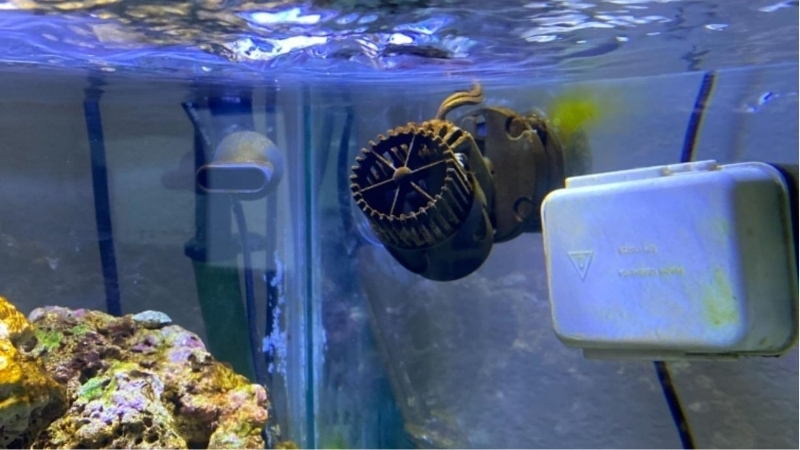
A pump you can turn down is worth more on a nano than one that only lists a big top number. TUNZE publishes the 6040 HUB’s full range as 53 to 1,190 GPH with its controller (TUNZE, 2026), so you know the low end, not just the ceiling, before you buy.
That span is about 22.5 times from bottom to top, which is a range, not a promise of even steps. Many pumps advertise only maximum flow, leaving you guessing whether they dial low enough for a small tank. A stated minimum is the cleanest signal that a powerhead can suit a nano reef.
Max GPH Is Not Coral Impact
Headline flow is a lab number, not the current your corals feel. A pump rated 2,000 or 2,500 GPH does not push that through the tank; flow geometry, placement and obstructions all change what actually reaches the rock. So do not translate a percentage setting directly into coral flow performance.
Read max GPH as a capacity ceiling and judge real flow by watching detritus lift and coral movement in the tank. Two pumps with similar top numbers can feel very different depending on how they spread water, which is why placement and tuning matter more than the spec on the box.
Tank Size and Glass Thickness
Match the pump to both the volume and the glass. The AI Nero 3 covers 2.5 to 60-plus gallons in a 2.25 by 2.25 by 1.4-inch body (AI, 2026), while the EcoTech MP10mQD lists a maximum glass thickness of 0.375 inch (EcoTech, 2026) because its motor sits outside the tank.
Glass thickness only matters for external-magnet pumps like the MP10, which will not couple through glass thicker than rated. In-tank powerheads avoid that limit but put a motor and cord inside the display. Confirm your tank’s glass and whether you want hardware in or out of the water.
Controller Modes
Modes are how you turn raw flow into a natural pattern. The AI Nero 3 offers constant, pulse and random modes (AI, 2026), while the hygger HG222 provides six intensity settings from 10 to 100 percent plus three wave modes (hygger, 2026), enough to shape flow without a premium controller.
Pulse and wave modes create gentle back-and-forth movement that corals often prefer to a constant jet. Random modes reduce dead spots over time. Pick the level of programmability you will actually use, since a simple six-step pump can serve a nano as well as a fully app-driven one.
Best Adjustable Nano Reef Powerheads
These four span verified low-end control, budget value, compact app control and an external-motor design. They are separated by minimum flow, modes and mounting, not by their biggest GPH number. Prices move and some specs vary by variant or generation, so confirm the exact model before buying.
| Product | Best For | Key Spec | Watch Out For |
|---|---|---|---|
| TUNZE 6040 HUB | Best overall | 53–1,190 GPH; 5.3–132 gal | Premium; needs controller |
| hygger HG222 | Best value | Six steps; 660–790 GPH | Flow locked to variant |
| AI Nero 3 | Compact app control | 2,000 GPH; 2.25 in body | Rated wattage conflicts |
| EcoTech MP10mQD | No in-tank cord | 2,500 GPH; ≤0.375 in glass | Priciest; glass limit |
TUNZE 6040 HUB
The TUNZE 6040 HUB earns the top slot because its adjustable range is fully published: 53 to 1,190 GPH with the controller, a 5.3 to 132-gallon range, and 1.5 to 13W draw (TUNZE, 2026). That stated minimum is exactly what a nano needs, and it is the cleanest match on the defining axis.
At around $225 from TUNZE USA as of 09/2026, it is premium and relies on its controller to unlock the low end. The compact pump body measures 2.36 by 1.69 by 2.68 inches without the deflector and magnet. For a nano reef that needs to dial flow down, it is the safest overall pick.
hygger HG222
The hygger HG222 is the value choice, with six intensity steps from 10 to 100 percent and three wave modes (hygger, 2026). Flow is locked to the variant: the 9W model does 660 GPH for 5 to 10 gallons, and the 12W model does 790 GPH for 10 to 20 gallons, so pick the SKU by tank size.
At roughly $45 to under $50 on the official site as of 09/2026, it delivers real adjustability for a fraction of the premium pumps. It lacks app control and the published low-end precision of the TUNZE, but for a straightforward nano on a budget, the six steps and wave modes are plenty.
AI Nero 3
The AI Nero 3 is the compact app-controlled option, with a 2,000 GPH maximum, a 2.5 to 60-plus gallon range, and constant, pulse and random modes in a small 2.25 by 2.25 by 1.4-inch body (AI, 2026). At about $200 at BRS as of 09/2026, it undercuts the TUNZE by roughly 13%.
The app control and small footprint suit tidy nano builds. One caveat: AI’s official page conflicts on rated power, listing 20W in one place and 30W in another, so treat wattage as unverified. Judge it on modes and size rather than a power figure, and confirm the current spec before buying.
EcoTech MP10mQD
The EcoTech MP10mQD keeps the motor outside the tank, so there is no in-tank power cord cluttering the display. The current mQD rates 2,500 GPH, a 2.5 to 50-plus gallon range, 8 to 19W, and a maximum glass thickness of 0.375 inch (EcoTech, 2026). It runs about $400 at BRS as of 09/2026.
It is the priciest here and the glass limit is a real constraint, since it couples magnetically through the wall. Note the generation: the current mQD does 2,500 GPH, while older MP10QD listings can show 1,500, so confirm you are buying the current model. For a clean in-tank look, it is the standout.
Frequently Asked Questions
Nano reefers tend to ask the same things: how much flow a small reef needs, whether a bigger maximum is better, how glass thickness limits choices, and whether one pump can cover a tank. Short answers first, then the practical caveats.
How much flow does a nano reef need?
It depends on the corals, so treat any turnover figure as a starting point rather than a rule. Soft corals and LPS generally want gentler flow than SPS, and the goal is enough movement to keep detritus suspended without blasting the animals. A tunable pump lets you find that by observation.
Because real flow depends on placement and tank shape, start low and increase gradually while watching coral response and detritus. A pump with a published minimum, like the TUNZE, makes this easier because you can begin genuinely gentle and work up rather than starting too strong.
Is a higher maximum GPH always better?
No. A bigger top number only helps if you can turn it down, and on a nano an unnecessarily high maximum with a high floor can be worse than a smaller, more adjustable pump. What matters is whether the low end suits your tank, not how large the ceiling is on paper.
Headline GPH also does not equal coral impact, since flow geometry changes what reaches the rock. Prioritize a usable minimum and good modes over a large maximum, and judge the result by how the tank actually behaves rather than by the number printed on the box.
Does glass thickness limit powerhead choice?
Only for external-magnet pumps. The EcoTech MP10mQD lists a 0.375-inch maximum glass thickness (EcoTech, 2026) because its motor mounts outside and couples through the wall; too-thick glass weakens that coupling. In-tank powerheads like the TUNZE or hygger avoid the limit entirely.
If your rimless nano has thick glass, either choose an in-tank pump or confirm the external model supports your wall thickness. It is an easy spec to overlook, and a mismatch shows up as a weak or noisy mount rather than an obvious failure at purchase.
Can one powerhead cover a whole nano reef?
Often yes on a small tank, though placement matters more than count. A single well-placed, tunable pump can circulate a nano and reach most of the rock, especially with a pulse or wave mode that spreads flow over time and reduces the dead spots a constant jet leaves behind.
Larger or heavily aquascaped nanos may still develop stagnant corners that a second small pump fixes. Start with one, watch for detritus buildup, and add flow only where the tank actually needs it rather than defaulting to two pumps from the outset.
Final Thoughts
The best adjustable powerhead for nano reef tanks is the one you can genuinely turn down, with a published minimum, real modes, and a fit for your tank and glass. The TUNZE 6040 HUB leads on verified low-end control, the hygger HG222 is the value pick, and the Nero 3 and MP10mQD suit compact and external-motor builds. Match the low end to your corals first.
As an Amazon Associate we earn from qualifying purchases at no extra cost to you. Prices and availability are accurate as of the date shown and are subject to change.
Best Macro Ring Lights for Coral and Macro Shots
Best Reef Octopus VarioS Pump for Return Flow: Top Picks