Last Updated: October 21, 2026
LPS keepers are told to chase big PAR numbers, but the figure that matters is what reaches the coral where it sits. The best reef led light for lps corals is the one with enough measured PAR at coral depth, honest test conditions, and dimming for acclimation, not the highest peak on a marketing slide.
As an Amazon Associate we earn from qualifying purchases.
By David Nguyen
How to Choose an LED Light for LPS Corals
LPS lighting comes down to species-specific PAR at the coral location, read under conditions you can compare, with enough control to acclimate slowly. Wattage and peak output are poor proxies, so anchor the decision to PAR at depth, matching test setups, placement, and dimming rather than one headline number.
Start With the PAR Target of the Actual LPS Species
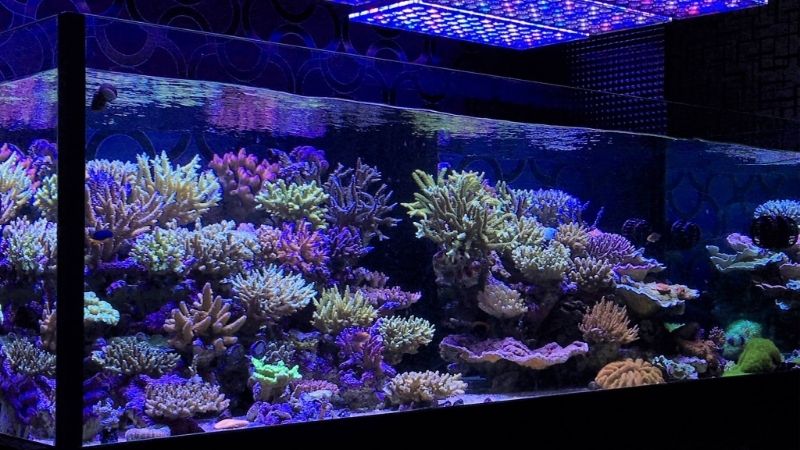
LPS is a broad group, so the target moves with the species. One Bulk Reef Supply guide places LPS around 150-250 PAR, while another groups soft and LPS corals together at 75-150 PAR, which tells you these are planning references from different educational contexts rather than a universal requirement you can lock in.
Pick a target for the specific corals you keep, then verify it in the tank. Euphyllia and many hammers sit lower than acan or chalice placements, and acclimation history matters, so a mid-output fixture set conservatively often beats a stronger light run high before the coral has adjusted over several weeks.
Compare PAR Only Under Matching Conditions
Published PAR numbers are not interchangeable. Red Sea’s ReefLED G2 60 lists 100 PAR at 20 inches from an underwater cube test, while the Hydra Edge 44HD publishes 60-125 PAR across 24 inches from a height-based map. Those are different measurement environments, so a direct one-to-one comparison is not valid.
Treat each map as internal to its own test. The AI Prime 16HD lists about 100 PAR at 24 inches but does not state the full geometry with that figure, so it is condition-limited. When maps use different setups, use them to understand a fixture on its own terms instead of ranking two lights by a single shared number.
Account for Tank Depth and Coral Placement
Depth changes everything a fixture delivers. In Red Sea’s own cube the ReefLED G2 60 drops from 500 PAR at the surface to 100 PAR at 20 inches, an 80% fall between those two test points, and that is specific to that test rather than a formula you can apply to a deeper or shallower tank.
Place LPS with that falloff in mind. A coral high on the rock in a shallow cube sees very different light than one low in a deep tank under the same fixture, so plan placement and mounting height together, and re-check PAR after any rescape rather than assuming the number holds across the whole footprint.
Prioritize Dimming and Acclimation
LPS respond badly to sudden intensity jumps, so fine control is a real buying criterion. App-driven fixtures such as the Prime 16HD and ReefLED G2 60 let you ramp up over weeks, while the Kessil A360XE offers intensity and color-density control through its own dials for a gradual, watchable acclimation path.
Reef brands refresh controllers and firmware fairly often, so confirm the current generation and active app support before buying, since acclimation features live in that software. Starting new frags well below target and stepping up slowly protects color and tissue better than a fixture’s peak output will.
Top Reef LED Lights for LPS Corals
Because published PAR data uses different environments, no one fixture is an outright winner for every LPS tank. The four below each hold a clear role by footprint and control style, and the right choice depends on your coral list, tank depth, and how carefully you plan to acclimate rather than on peak wattage.
| Product | Best For | Key Spec | Watch Out For |
|---|---|---|---|
| Red Sea ReefLED G2 60 | Documented PAR on a 20-inch cube | 500 surface / 100 PAR at 20 in; 20×20 in | Underwater test; not comparable to height maps |
| AI Prime 16HD | Compact acclimation control | ~100 PAR at 24 in; up to 24×24 in spread | Full geometry not stated; 55W vs 59W spec |
| Hydra Edge 44HD | Wider footprint coverage | 95 W; 60-125 PAR across 24 in; up to 30×30 | Height-based map; different test than Red Sea |
| Kessil A360XE | Point-source over a 24-inch tank | 90 W; 24×24 in mixed-reef coverage | Coverage is use-case rated, not PAR-mapped |
Red Sea ReefLED G2 60 – Documented PAR for a 20-Inch Cube
This is the pick for an LPS keeper on a 20-inch cube who wants numbers tied to a stated test. Red Sea publishes 500 PAR at the surface and 100 PAR at 20 inches with 20-by-20-inch coverage, measured 7 inches above center. It sits around $289 for the fixture as of 09/2026, with the arm separate.
The strength is condition-stated PAR that makes placement planning honest, plus app ramping for acclimation. The trade-off is that its data is underwater-referenced, so it should not be cross-compared to height-based maps, and the mount and app step add a little to the cost and first setup versus a plug-in light.
AI Prime 16HD – Compact Acclimation Control
The Prime 16HD suits an LPS nano or frag tank where fine control matters more than raw coverage. It lists roughly 100 PAR at 24 inches and up to a 24-by-24-inch spread on a 59 W technical spec, and runs around $275 at Bulk Reef Supply, with a flex arm near under $50 for the example install.
Its app makes slow, staged acclimation easy, which LPS reward. Two cautions: the geometry behind that 100 PAR figure is not fully stated, so treat it as condition-limited, and the official copy shows both 55 W and 59 W. Over a wider tank, watch the corners rather than assuming even PAR across the full published spread.
Hydra Edge 44HD – Wider Footprint Coverage
The Edge 44HD is aimed at an LPS keeper lighting a longer or wider tank. It draws 95 W and publishes 60-125 PAR across a 24-inch span with an up-to-30-by-30-inch spread, mapped at 24 inches of height. Its direct price of about $475 as of 09/2026 sits above the roughly $400 seen at Bulk Reef Supply.
The appeal is broader, more even coverage for a bigger LPS layout. The catch is that its PAR is a height-based map, so those numbers are not comparable to Red Sea’s underwater figures, and pricing varies by retailer, with the direct listing about 20% above the BRS example, so check the source before buying.
Kessil A360XE – Point-Source Over a 24-Inch Tank
The A360XE fits an LPS keeper who likes shimmer and a compact point-source look over a 24-inch tank. Kessil rates it at 90 W with a 24-by-24-inch mixed-reef coverage figure, and its dials give straightforward intensity and color control. It sits in the mid-premium price tier for a single-puck reef fixture.
The draw is that dense point-source shimmer many reefers prefer, with easy manual acclimation. The limitation is data: coverage is a manufacturer use-case rating rather than a full PAR map, so you should verify PAR at your corals with a meter, and a single puck can leave edge falloff on a wide LPS footprint.
Frequently Asked Questions
LPS keepers ask the same handful of things when a fixture list gets long. Each answer opens with the direct call and then names the condition that would change it, so you can carry the reasoning to your own species, tank depth, and acclimation plan instead of copying a single number from someone else’s build.
How Much PAR Do LPS Corals Need?
It depends on the species and the guide you read. One Bulk Reef Supply reference puts LPS near 150-250 PAR, while another groups soft and LPS at 75-150 PAR, so there is no single hard minimum. Choose a target for your specific corals and confirm it at their exact placement with a meter.
Placement and history matter as much as the band. A freshly imported acan wants far less than an established colony, so start low and step up over weeks. Treat published ranges as planning references, not requirements, and let the coral’s color and expansion guide the final setting rather than a chart figure.
Can I Compare Two Lights by Their PAR Numbers?
Only if the tests match, which they often do not. Red Sea’s underwater cube figures and the Edge 44HD’s height-based map are measured in different environments, so lining them up one-to-one is misleading. Compare each fixture against its own stated conditions and your tank depth instead of against each other’s peaks.
When you need a real cross-check, a PAR meter in your own water is the only fair comparison. Borrow or rent one, read at coral height, and use the manufacturer maps to understand ramp behavior and falloff for that unit rather than to rank two lights that never shared a test setup in the first place.
Is a Higher-Wattage Light Always Better for LPS?
No. The Kessil A80 covers an 18-by-18-inch soft or lower-light LPS footprint on just 15 W, while a 95 W Edge 44HD serves a much larger span, so wattage tracks size and design more than coral suitability. An oversized light run high is a faster way to bleach LPS corals than to grow them out.
Match output to footprint and to a PAR target you can dim into. For most LPS tanks, a controllable fixture set below its ceiling gives steadier color than a stronger light pushed hard, and it leaves headroom if you later add higher-light corals without swapping the whole system out.
Do I Need to Measure PAR Myself?
For LPS it is worth it. Manufacturer maps use fixed test tanks that rarely match your depth, rock height, or coral placement, so a reading at the exact spot a coral sits is the only number that truly applies. A single measurement session can save weeks of guessing after a rescape.
If buying a meter is not practical, many reef clubs and local shops lend one. Take readings at several placements, note the fixture height, and adjust intensity from there, treating the published 100 or 125 PAR figures as a starting frame rather than proof of what your corals actually receive today.
Final Thoughts
Pin down the specific LPS species you want and the depth they will sit at, then read every fixture’s PAR only against its own stated test. The best reef led light for lps corals is the controllable unit that hits your species’ target at that depth with room to dim, so verify with a meter and acclimate new frags slowly.
What Size Protein Skimmer for 100 Gallons? Size Guide With Measurements (2026)
6 Best LED Lighting For Reef Tank 2026