Last Updated: October 4, 2026
The best temperature controller for chiller and heater duty has to do something a single-stage unit cannot: switch two opposing devices from one probe without letting them fight, while protecting a compressor from rapid restarts that shorten its life.
As an Amazon Associate we earn from qualifying purchases.
As an Amazon Associate we earn from qualifying purchases at no extra cost to you. Prices and availability are accurate as of the date shown and are subject to change.
By David Nguyen
Quick answer: For most people in 2026, the best temperature controller for chiller and heater is the Inkbird ITC-308S — our #1 rated choice. See the full ranked comparison, alternatives and buying advice below.
How to Choose a Dual-Stage Temperature Controller
Four things separate a controller that runs a chiller safely from one that merely holds a heater steady: genuine dual-stage switching, honest electrical limits, compressor restart protection, and how much monitoring you actually want. Get those wrong and you either trip a limit or shorten the life of the most expensive device on the system.
Insist on True Dual-Stage Switching
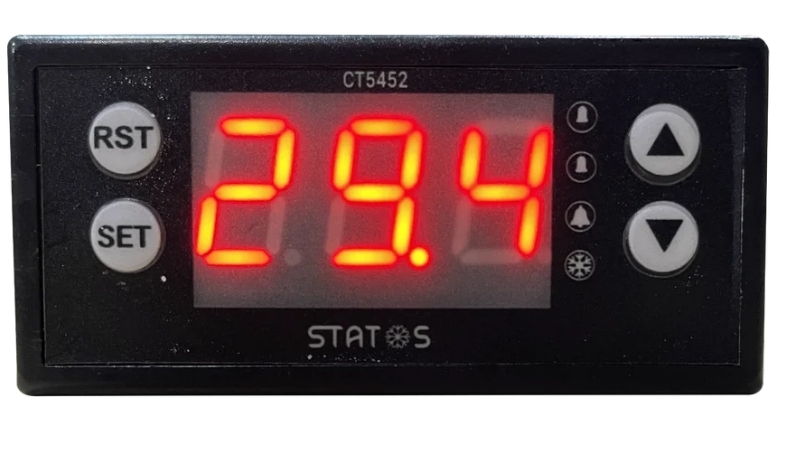
A dual-stage controller has separate heating and cooling outputs governed by one setpoint and a differential band. The Inkbird ITC-308S provides both outputs, as does the ITC-308-WIFI, which is the baseline requirement for running a chiller and heater together. Both models also let you set the differential band that keeps the two outputs from overlapping.
A heater-only controller cannot do this job. Wiring a chiller into a heating output inverts the logic, so the unit cools when it should warm, and no amount of careful setpoint tuning fixes that mismatch. Some single-stage units advertise cooling mode but only invert the display logic, so read the output description rather than the marketing line.
Read the Electrical Limits Correctly
This is where most buyers misread the spec. The ITC-308S carries a 10A maximum, and that figure is the controller’s total ceiling rather than 10A available at each outlet. Inkbird also lists a 1100 to 2400W load figure that varies by voltage variant. Check which variant you are buying, since the load figure shifts with supply voltage.
At 110V, 10A works out to 1100VA, which lines up numerically with the resistive load label. That arithmetic holds for heaters, but it does not transfer cleanly to a compressor, whose real power draw and startup inrush behave differently from a resistive element. Startup inrush on a compressor can briefly exceed its running draw by a wide margin, which is exactly when a relay contact fails.
Compressor Delay Is Not Optional
Compressors fail early when they restart too soon after shutting down, because pressure has not equalised. Both Inkbird models include a compressor delay, which holds the cooling output off for a set period before allowing a restart. Typical delay settings run a few minutes, and the right value comes from the chiller manufacturer rather than a general rule.
Set that delay according to your chiller manual rather than the shortest available option, and pair it with a sensible differential so the controller is not switching every few minutes. Short cycling is the single most common way to shorten a chiller’s service life.
Decide How Much Monitoring You Need
The ITC-308S uses a replaceable NTC probe on a 2 metre lead with quoted accuracy of plus or minus 1F across a wide range. The ITC-308-WIFI adds app-based remote monitoring and alerts for roughly $14 more.
Remote alerts matter most when a tank sits somewhere you do not visit daily, or when livestock is valuable. A replaceable probe matters more for long-term ownership, since probes drift and fail more often than the controller itself does. Keep a spare probe on hand, since a failed sensor takes both heating and cooling offline at once.
Top Picks
Two controllers cover most setups, plus two situations worth understanding before you buy. Each entry lists manufacturer specifications, a relative price position as of 09/2026, and one genuine drawback.
| Product | Best For | Key Spec | Watch Out For |
|---|---|---|---|
| Inkbird ITC-308S | Best overall value | Dual-stage; 10A max total; replaceable NTC probe | 10A is the total, not per outlet |
| Inkbird ITC-308-WIFI | Best remote monitoring | Dual-stage; 1100W at 110V; app alerts | WiFi adds convenience, not capacity |
| Heater-only controllers | Understanding the trap | Single output, heating logic only | Cannot invert to drive a chiller |
| High-draw chillers | When neither is enough | Large compressors exceed 10A switching | Needs a relay or contactor |
Inkbird ITC-308S: Best Overall Value
At roughly $35 as of 09/2026 the ITC-308S is the budget entry, about 28.0% below the WiFi version. It offers true dual-stage outputs, a 10A controller maximum, a load rating of 1100 to 2400W depending on voltage variant, compressor delay and a replaceable 2 metre NTC probe. That combination covers a heater plus a modest chiller on most home systems.
Accuracy is quoted at plus or minus 1F across a wide range. The main limitation is monitoring: without network connectivity you only see a problem when you are standing in front of the display, which matters if the tank sits in a basement or another building. Inkbird sells replacement probes separately, which keeps long-term ownership cost low compared with controllers using sealed sensors.
Inkbird ITC-308-WIFI: Best Remote Monitoring
For about $50 as of 09/2026, roughly 38.9% above the 308S, this version adds WiFi with app monitoring and alerts while keeping dual-stage heating and cooling, compressor delay, and a 1100W rating at 110V in the US configuration.
That $14 gap buys notification, not switching capacity. The controller still carries the same practical electrical ceiling, so do not treat the WiFi model as a step up in what it can safely run; the probe architecture and load limits remain the deciding factors. App-based alerts also depend on your network staying up, so treat them as a useful layer rather than a guaranteed safety net.
Why a Heater-Only Controller Is the Wrong Tool
Single-stage heating controllers are cheaper and widely sold, which tempts people running one device now and planning a chiller later. The logic only works in one direction, so the cooling device ends up switched at exactly the wrong times.
Buying dual-stage from the start costs little more and avoids replacing the controller when summer arrives. It also lets you set a proper differential between the heating and cooling points so the two devices do not chase each other around a narrow band. Controllers are inexpensive relative to livestock, making this one of the cheapest points of redundancy in a temperature-controlled system.
When Neither Controller Is Enough
Larger compressors can exceed what a 10A controller should switch directly, and startup inrush current is higher than steady running draw. Published inrush figures for specific chillers are often unavailable, which makes this a real limit rather than a theoretical one.
In that case, use the controller to drive an appropriately rated relay or contactor that handles the compressor load. Check your chiller’s electrical documentation first, and treat any unknown inrush figure as a reason for caution rather than an assumption of safety. An external relay also isolates the controller from compressor inrush, which extends the life of both components.
Frequently Asked Questions
Four questions decide most purchases here: whether both devices can run at once, what the load rating really covers, why compressor delay matters, and whether the WiFi upgrade is worth the difference.
Can it run a heater and chiller at the same time?
It runs both from one probe, but not simultaneously. A dual-stage controller switches the heating output below your setpoint and the cooling output above it, with a differential band in between where neither runs. That band is what stops the two devices from fighting each other across a single degree.
Set that band wide enough to avoid rapid alternation. Too narrow a differential makes the controller flip between heating and cooling repeatedly, which wastes power and puts unnecessary cycles on the compressor.
Does 10A mean 10A per outlet?
No. The 10A figure is the controller’s total maximum, not an allowance for each socket, so you cannot connect a 10A heater and a 10A chiller and expect 20A of capacity. Inkbird states it as a controller maximum, and exceeding it risks the internal relay rather than tripping a household breaker first.
Add the draw of both devices and keep the total comfortably under the ceiling. Remember the 1100W at 110V label describes a resistive load, which does not map directly onto a compressor’s real consumption. Plug both devices through a GFCI outlet, and avoid daisy-chaining power strips behind the cabinet.
Why does compressor delay matter so much?
Restarting a compressor before internal pressure equalises places heavy strain on the motor and can cause premature failure. The delay function holds the cooling output off until it is safe to restart.
Follow the chiller manufacturer’s recommended delay rather than the minimum setting. Pairing an adequate delay with a wider differential dramatically reduces the number of start events over a hot week, which is what actually wears the unit.
Is the WiFi version worth $14 more?
It is if the tank sits where you cannot check it daily, since remote alerts let you react to a failed heater or chiller before temperature drifts far enough to harm livestock. Alerts also help during power interruptions, when a tank can drift for hours before anyone notices.
If the tank is in a room you walk past constantly, that money does more elsewhere, on a spare probe or a backup heater. The WiFi model does not increase switching capacity or improve probe accuracy. Controllers and other reef electronics discount around Prime Day and Black Friday, which can close that gap entirely.
Final Thoughts
The best temperature controller for chiller and heater duty combines true dual-stage outputs, an electrical ceiling your devices stay under, a compressor delay set from the manual, and a probe you can replace. The Inkbird ITC-308S near under $40 covers most systems, with WiFi worth roughly $14 more when remote alerts matter.
Ready to decide? Our #1 pick for 2026 is the Inkbird ITC-308S.
Live price & availability on Amazon.
Related Reviews & Guides


Aquarium UV Sterilizer Guide: Watts, Flow and Dwell Time

Best Dosing Pump for a 125 Gallon Tank: Top Buying Guide