Last Updated: October 4, 2026
Shopping for the best combined heater and chiller for small tanks exposes an awkward gap in the market: the options are either inexpensive marketplace units with thin documentation, or full compressor systems costing well over a thousand dollars, with very little in between.
As an Amazon Associate we earn from qualifying purchases.
As an Amazon Associate we earn from qualifying purchases at no extra cost to you. Prices and availability are accurate as of the date shown and are subject to change.
By David Nguyen
Quick answer: For most people in 2026, the best combined heater and chiller for small tanks is the Fixartoo chiller/heater — our #1 rated choice. See the full ranked comparison, alternatives and buying advice below.
How to Choose a Combined Heater and Chiller
Because combo units span two very different classes of hardware, the usual spec comparison breaks down. Focus instead on whether the unit genuinely does both jobs, what capacity claim it makes and who made that claim, the flow it needs, and how good the documentation is. Those four checks matter more here than any headline wattage figure.
Verify It Truly Heats and Cools
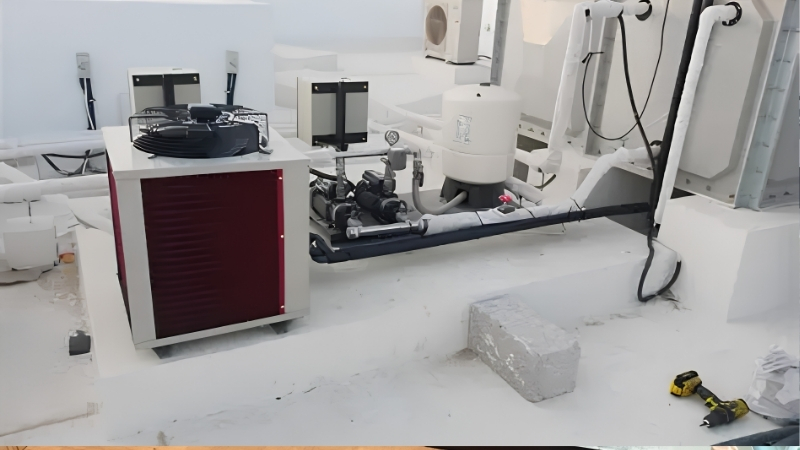
Plenty of listings advertise temperature control while only cooling, or only heating with a separate accessory. The Fixartoo unit lists a 10 to 40C operating range from a 100W device, and the TECO TK-500H pairs a built-in heater with a 1/6 HP compressor and a 41 to 95F set range. One thermostat governing both modes is what separates a true combo from a bundle of parts.
Check that a combo has both functions built in and controlled by one thermostat before buying. A device that cools well but relies on a second heater still leaves you managing two controllers and two failure points in a small tank.
Treat Capacity Claims by Their Source
Who published the number matters as much as the number. Fixartoo’s listing states up to 30 litres, roughly 7.93 gallons, which is seller-supplied capacity rather than tested engineering data. TECO lists the TK-500H up to 120 gallons, a manufacturer band that still depends on heat load.
Neither figure survives a hot room unchanged. Measure how far your tank drifts across a full day before trusting any capacity claim, and treat a seller-supplied range with more caution than a manufacturer band with stated conditions. Ambient temperature is the missing variable in almost every capacity claim at this end of the market.
Match the Required Flow
Both classes need water moving through them. The Fixartoo unit lists flow up to 3 litres per minute, while the TECO TK-500H requires 106 to 211 GPH through its exchanger, which is a completely different scale of plumbing. Litres per minute and GPH are different units, so convert before comparing anything.
Size the feed pump after head loss from lift, hose and fittings, because published pump ratings assume zero head. On the nano unit especially, a small powerhead can overshoot or undershoot that narrow window without you noticing. Put a valve in the line if your pump overshoots, and verify delivered flow at the unit’s inlet.
Judge the Documentation Itself
Documentation quality is a safety feature in any combo that puts a heating element in the water path. The Fixartoo listing quotes 35 to 45 dB without stating a measurement method, and publishes no BTU per hour figure or standardized pull-down data.
TECO publishes consistent specifications across its range, including power consumption at 225W and a defined set range. When a device will run unattended beside livestock, thin paperwork is a genuine risk rather than a minor inconvenience. Check whether replacement parts, seals and controllers are sold separately, because a sealed marketplace unit usually becomes disposable once it fails.
Top Picks
These four entries reflect a split market honestly: one affordable nano unit, one full compressor combo, an explanation of the gap between them, and the case for running separate devices instead.
| Product | Best For | Key Spec | Watch Out For |
|---|---|---|---|
| Fixartoo chiller/heater | Best budget nano option | 100W; up to 30 L (7.93 gal); 10-40C | Seller-supplied capacity, no BTU data |
| TECO TK-500H | Best true combo performance | 1/6 HP; built-in heater; 106-211 GPH; 225W | Costs over $1,400 more |
| The market gap | Understanding your options | Nothing mainstream sits between these classes | Avoid assuming a midpoint exists |
| Separate heater and chiller | Best for most small tanks | Size each device to its own job | Two controllers and more cabinet space |
Fixartoo Chiller and Heater: Best Budget Nano Option
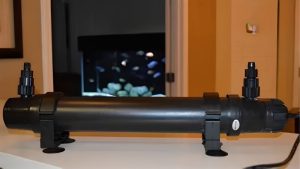
At roughly $100 as of 09/2026 this compact unit measures 4.41 by 4.41 by 7.56 inches, draws 100W, and covers a 10 to 40C range with flow up to 3 litres per minute. For a small desktop tank needing modest correction in both directions, it is the accessible entry point.
The drawback is evidence. Capacity comes from the seller, the 35 to 45 dB noise claim has no stated method, and there is no published BTU per hour or pull-down data, so you cannot predict how far it will pull a tank down in a warm room. Warranty terms and spare-part availability are equally thin on marketplace listings, so treat the purchase as a low-cost experiment rather than a long-term fixture.
TECO TK-500H: Best True Combo Performance
The TK-500H is a proper compressor system with a built-in heater, rated up to 120 gallons on 1/6 HP, requiring 106 to 211 GPH, drawing 225W and covering a 41 to 95F set range. It is the serious option when a small tank sits in a genuinely hot room.
At about $1,500 as of 09/2026 it costs roughly $1,400 more than the Fixartoo, and it is not a nano-sized device physically or in cost. For an eight-gallon desktop tank it is substantial overkill unless conditions are extreme. It also exhausts real heat into the room and needs ventilation clearance, which a small cabinet rarely provides.
Why the Middle of This Market Is Empty
The price gap is enormous because the two products solve the problem with different physics. Compressor systems scale down poorly and cost far more to build, while low-wattage units cannot match their pull-down, so manufacturers rarely target the space between.
That also explains why performance cannot be compared across the gap. A 100W device rating and a 225W power consumption figure describe different things, so calculating performance per watt between these two classes produces a meaningless number. Judge each combo against its own class and stated conditions rather than against the other.
When Separate Devices Make More Sense
For most small tanks, a reliable heater plus a small dedicated chiller or even a cooling fan costs less and performs more predictably than a single combo unit. Each device can be sized to its actual job and replaced independently when it fails.
The trade-off is two controllers, more cabinet space and more cords. Use a controller with separate heat and cool outputs and an adequate differential setting, so the two devices do not fight each other across a narrow temperature band. Separate devices also fail separately, so one dead component does not leave the tank without both heating and cooling at once.
Frequently Asked Questions
Small-tank owners ask four practical questions here: whether a combo works under ten gallons, what the smallest real compressor combo is, whether other TECO platforms offer heating, and how much weight to put on a seller’s capacity claim.
Is a combo unit worth it under 10 gallons?
Sometimes, though it depends on how far your tank drifts. The Fixartoo unit targets up to about 7.93 gallons and handles modest correction in both directions, which suits a desktop tank in a moderately stable room.
If your tank swings several degrees on hot afternoons, a device with no published BTU rating is a gamble. Measure the daily rise first, and consider whether improving room conditions solves the problem more cheaply than any single appliance. A lid, lower lighting hours and a cooler room location often cut the swing enough to avoid the purchase entirely.
What is the smallest real compressor combo?
Among current mainstream options, the TECO TK-500H at 1/6 HP is the entry point, rated up to 120 gallons with a built-in heater. There is no mainstream compressor combo sized specifically for nano tanks.
That means a small tank buying into compressor performance pays for capacity it will rarely use. Consider whether a separate small chiller and a quality heater cover the same need at a fraction of roughly $1,500.
Does the smaller TECO platform offer a heater?
The smaller TK-150 platform has no heater option and appears in discontinued documentation, so it is not a path to a compact combo. Availability and parts support for discontinued platforms are worth checking before any purchase.
Model lines in this category change frequently, so confirm the current generation, firmware where applicable, and whether the unit is still sold before ordering. A discontinued platform can leave you without replacement parts. Ask the retailer directly about current stock and parts before committing to any older platform.
How much should I trust a seller capacity claim?
Treat it as a starting point, not a specification. A seller-supplied figure such as up to 30 litres carries no stated ambient temperature, heat load or test method, which are exactly the conditions that determine real performance.
Look for published BTU per hour, a stated pull-down at a given room temperature, and a defined flow requirement. Where those are missing, assume the claim describes ideal conditions and size conservatively for your own room. Electrical safety certification is worth confirming too, since a heating element and water share the same housing in these units.
Final Thoughts
The best combined heater and chiller for small tanks depends on which end of a split market fits your situation. The Fixartoo unit near under $100 is the accessible option with thin documentation, while the TECO TK-500H delivers real compressor performance at a price most small tanks cannot justify.
Ready to decide? Our #1 pick for 2026 is the Fixartoo chiller/heater.
Live price & availability on Amazon.
Related Reviews & Guides



Best DIY Alternative to an Aquarium Stand: Top Expert Guide

9 Best Aquarium Gravels: Top Picks for Every Tank in 2026