Last Updated: October 21, 2026
Best tank size for betta fish has a short answer: 5 gallons (19 L) is the working minimum and 10 gallons (38 L) is the better buy. The chart below gives real water volumes, heater wattage and footprints so you can check a specific tank rather than guessing from the box. Check yours against the chart below.
As an Amazon Associate we earn from qualifying purchases.
As an Amazon Associate we earn from qualifying purchases at no extra cost to you. Prices and availability are accurate as of the date shown and are subject to change.
By David Nguyen
The Tank Size Chart and How to Read It
The best tank size for betta fish is decided by water volume and footprint together, not by volume alone. Volume dilutes ammonia and holds temperature; footprint gives a horizontal swimmer somewhere to go. This first table covers the sizes commonly sold for a single betta. Read across the row, not down the column.
| Rated size | Real water volume | Typical footprint | Heater needed | Verdict for one betta |
|---|---|---|---|---|
| 1 gal (3.8 L) bowl | 0.8-1 gal (3-3.8 L) | 6 in (15 cm) round | None fits safely | Not viable, no stable heating |
| 2.5 gal (9.5 L) | 2-2.2 gal (7.6-8.3 L) | 12 x 6 in (30 x 15 cm) | 15-25 W | Below minimum, swings fast |
| 5 gal (19 L) | 4-4.5 gal (15-17 L) | 16 x 8 in (40 x 20 cm) | 25 W | Working minimum, weekly changes |
| 10 gal (38 L) | 8.5-9 gal (32-34 L) | 20 x 10 in (50 x 25 cm) | 50 W | Recommended, room for tankmates |
| 20 gal long (76 L) | 17-18 gal (64-68 L) | 30 x 12 in (76 x 30 cm) | 75-100 W | Very stable, community capable |
| 29 gal (110 L) | 25-26 gal (95-98 L) | 30 x 12 in (76 x 30 cm) | 100-150 W | Tall, less useful footprint gain |
The Deciding Number: 5 Gallons Is the Floor, 10 Is Better
Five gallons (19 L) is the point at which a heater fits safely, a cycle stays stable between weekly changes, and ammonia from a single fish is diluted enough to stay near zero. Below that, every variable moves faster than a weekly maintenance routine can correct. Five gallons is a floor, not a target.
Ten gallons (38 L) is the size most keepers wish they had bought first. It roughly doubles the buffer, allows snails or a small group of pygmy corydoras, and gives enough planted space that the fish has cover without the tank feeling crowded to look at. Most keepers upgrade within a year.
The Rule Behind the Number
Two mechanisms set the floor. Ammonia produced by one adult betta is diluted by volume, so a tank holding 4 gallons (15 L) of real water reaches a given concentration roughly twice as fast as one holding 8.5 gallons (32 L) with identical feeding. Dilution is the entire mechanism at work here.
The second is thermal mass. A small volume tracks room temperature closely, and swings of several degrees across a day stress a fish that needs 78-82 F (25-28 C). More water simply changes temperature more slowly, which is why heaters hold a larger tank more accurately. Thermal mass does the work.
How to Read the Table: Units, Real Volume and Tolerances
Rated capacity is the volume to the rim with nothing inside. Subtract 10-15 percent for substrate, hardscape and the gap below the rim, which is why a 5-gallon tank holds around 4-4.5 gallons (15-17 L) and why dosing by the rating overshoots every time. Always dose against measured volume rather than the rating.
Heater wattage in the table assumes roughly 3-5 watts per gallon at a 10 F (5.5 C) difference between room and target temperature. A colder room needs the upper end, and cheap heaters commonly run 2-4 F (1-2 C) away from the dial setting regardless. Verify with a separate thermometer.
Adjusting the Number for Your Situation
The chart above covers a single betta. Adding anything else changes the answer, and the second table sets out how much. As a rule the betta needs its 5 gallons (19 L) first, and tankmates are added on top rather than sharing the same allowance. Add the space, rather than dividing what is there.
| Setup | Minimum tank | Recommended | Why |
|---|---|---|---|
| Betta alone | 5 gal (19 L) | 10 gal (38 L) | Dilution and heater stability |
| Betta plus 1-2 nerite snails | 5 gal (19 L) | 10 gal (38 L) | Small added bioload, no aggression |
| Betta plus amano shrimp | 10 gal (38 L) | 10-20 gal (38-76 L) | Shrimp need cover and hiding space |
| Betta plus 6 pygmy corydoras | 15 gal (57 L) | 20 gal long (76 L) | Shoal needs floor area, not height |
| Heavily planted, CO2 injected | 10 gal (38 L) | 20 gal (76 L) | Plants and hardscape displace water |
| Several female bettas together | Not recommended | Separate tanks | Aggression risk regardless of size |
Adjusting for Tankmates and Bioload
Bioload scales with the species rather than with inches of fish, so the old one inch per gallon rule is useless here. Six pygmy corydoras add far less waste than one goldfish of the same combined length, but they need floor area a tall tank does not provide. Footprint decides shoaling species.
Temperament sets a second limit. Tankmates must tolerate 78-82 F (25-28 C) and avoid long fins or bright colours that trigger a betta’s territorial response, and any combination needs an escape route, which in practice means plants, wood and a footprint over 20 in (50 cm). Escape routes matter as much as volume.
Adjusting for Plants, Substrate and Layout
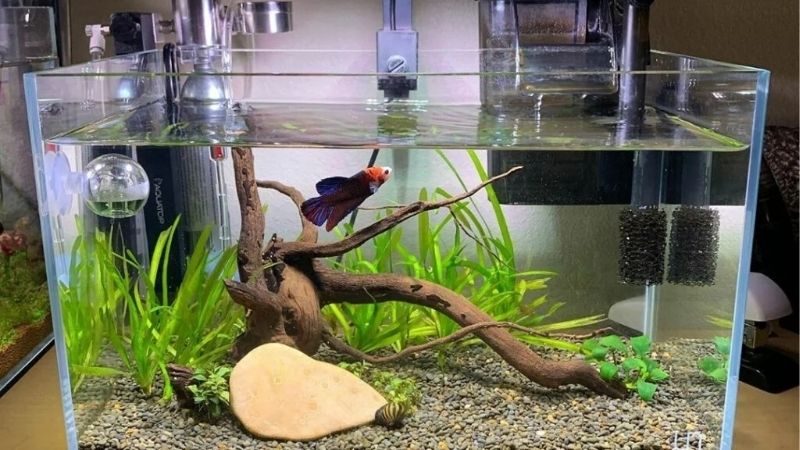
A 3 in (7.6 cm) substrate bed and a piece of driftwood remove a meaningful share of a small tank’s water. In a 5-gallon (19 L) tank that can take real volume down toward 3.5 gallons (13 L), which moves the setup back below the working minimum. Measure the water it actually holds, not the label.
Floating plants add another consideration for this species. Bettas breathe atmospheric air, so leave at least a third of the surface clear, and keep a lid gap of 1-2 in (2.5-5 cm) so the air above the water stays humid enough for the labyrinth organ. Leave a third of the surface clear.
Tank Size, Placement and Fit
A filled 5-gallon tank weighs roughly 55-60 lb (25-27 kg) and a 10-gallon around 100-110 lb (45-50 kg), which most furniture handles but few narrow shelves do. Check the footprint against the surface, allowing 4-6 in (10-15 cm) behind the tank for a hang-on filter. Weight is easy to underestimate.
Placement affects heating more than people expect: a tank beside a window or an exterior door tracks outdoor temperature. Measure the real numbers before you order: shelf length against tank length, heater length against water depth, and socket position for a drip loop. All three take about a minute.
Limits of This Number
Every chart has boundaries, and the best tank size for betta fish is no exception. The figures above assume one adult fish, weekly water changes and a cycled filter, and each of those assumptions can fail in ways the table cannot show you. It is worth knowing where the numbers stop working.
When the Formula Fails
The one inch per gallon rule fails immediately, because it ignores waste output per species, footprint and territorial behaviour. A 3 in (7.5 cm) betta is not a three-gallon fish, and applying that rule is how people end up buying a 2.5-gallon (9.5 L) tank. The rule ignores what matters.
Volume rules also fail on tall tanks. A 29-gallon (110 L) tank has the same footprint as a 20-gallon long while adding height a surface-breathing fish does not use, so the extra volume buys stability but very little additional usable swimming area. A long tank beats a tall one for this fish every time.
Variables the Chart Cannot Capture
Individual temperament varies widely. Some bettas tolerate tankmates in a 10-gallon (38 L) tank and others attack anything that moves regardless of space, which is why every community setup needs a backup plan and somewhere to move the fish at short notice. Temperament is unpredictable.
Finnage type matters too. Heavily finned varieties tire in current that a plakat handles easily, so a large tank with strong filtration can be worse for one fish than a smaller tank with a sponge filter running gently at the same temperature. Match the flow to the finnage you actually have.
When to Ignore the Chart and Measure
Quarantine and hospital tanks are deliberate exceptions, often 2.5-5 gallons (9.5-19 L) bare-bottomed for easier dosing and daily changes over a short period. That is a temporary medical setup with its own routine, not a housing recommendation for the fish long term. Different purpose, different numbers.
Breeding setups also depart from the chart, using shallow water for nest tending. In both cases the numbers come from the purpose rather than from a size guide, and both demand daily monitoring that a normal display tank does not require of its keeper. Purpose sets the size there.
Verification and How Often to Recheck
Numbers on a box are a starting point, and the value of the best tank size for betta fish chart depends on verifying a few of them yourself. Three inexpensive tools cover almost everything that matters here. None of them costs much, and each answers a question the packaging cannot.
Tools to Verify and Their Accuracy
A separate thermometer is the most useful, because heater dials commonly sit 2-4 F (1-2 C) away from actual water temperature. Glass or digital both work, and placing it at the opposite end of the tank from the heater gives a more representative reading. Check it weekly, not monthly.
A liquid test kit beats strips for ammonia and nitrite, which are the readings that matter most in a small tank. Reagents expire, so replace them roughly annually, and shake the second nitrate bottle hard for a full minute or the result reads falsely low. Shake it harder than feels necessary.
How Often to Re-measure
Test weekly for the first two months after setup, then monthly once readings hold steady at 0 ppm ammonia and 0 ppm nitrite. Re-measure whenever you add livestock, change filter media, or notice the fish behaving differently for more than a day or two. Behaviour change is a prompt to test.
Re-check real water volume whenever the layout changes substantially. Adding a large piece of wood or deepening the substrate by an inch changes dosing, and in a 5-gallon (19 L) tank that shift is proportionally large enough to matter for medication amounts. Recalculate after any rescape.
Equipment Drift Over Time
Heaters wander as thermostats age, filters lose flow as impellers wear, and lights lose measurable output over several years. Each change is gradual, which is why they get attributed to the fish rather than the equipment until someone measures with an independent tool. Drift is gradual and quiet.
Electrical safety belongs in the same routine. Run every cord as a drip loop below the socket and use a GFCI outlet, and check the heater’s seal and the filter intake at the same time you replace test reagents once a year. Make it a single annual check covering reagents, seals and flow together.
Frequently Asked Questions
These come up when someone already owns a tank and wants to know whether it will do. The answers stick to volume, footprint and temperature rather than opinions about what looks appropriate on a desk. Most best tank size for betta fish questions are really about whether a tank someone already owns will do.
Is a 3 gallon tank enough for a betta?
It is below the working minimum. A 3-gallon (11 L) tank holds roughly 2.5 gallons (9.5 L) of real water, which swings in temperature and accumulates ammonia faster than a weekly routine handles. It can work with twice-weekly changes, but 5 gallons (19 L) is easier. Twice-weekly changes are a real commitment.
What is the best tank size for betta fish with tankmates?
Twenty gallons long (76 L) covers most combinations, since it provides a 30 x 12 in (76 x 30 cm) footprint for a shoal to use and enough volume to absorb the extra bioload. Ten gallons (38 L) works for snails or a few amano shrimp. Scale the tank up before adding any shoaling species.
Do bettas prefer tall or long tanks?
Long. They swim horizontally and surface to breathe, so a 20-gallon long gives more usable space than a taller tank of the same volume. Height above roughly 16 in (40 cm) adds little for this species and makes surfacing a longer trip for the fish. Choose the long tank over the tall one.
Can I keep a betta in a bowl if I change the water daily?
Daily changes address ammonia but not temperature, and no bowl takes a heater safely. A fish held below 76 F (24 C) has a suppressed immune system regardless of how clean the water is, which is why the heater requirement drives the size floor. Temperature, not cleanliness, sets the minimum.
See More:
Conclusion
The best tank size for betta fish is 5 gallons (19 L) as a floor and 10 gallons (38 L) as a sensible purchase, with 20 gallons long (76 L) once tankmates enter the picture. Footprint matters as much as volume for a horizontal swimmer. The best tank size for betta fish is a pairing, not a single number.
Subtract 10-15 percent from any rated capacity for real water volume, size the heater at 3-5 watts per gallon, and verify temperature with a separate thermometer. Those three checks turn a number on a box into something you can rely on, and any best tank size for betta fish chart is only as good as the checks behind it.
Best 29 Gallon Aquarium: Best Proven Well-Researched Guide
Glass Canopy vs Hood Which Is Better: Top Compared Setup Guide