Last Updated: October 4, 2026
Salinity drives every other reef parameter, so the tool you trust it to matters. The best refractometer for saltwater aquarium use reads on a seawater scale, publishes its accuracy, and handles temperature properly, rather than a generic brine device that can misread real tank water by a meaningful margin.
As an Amazon Associate we earn from qualifying purchases.
By David Nguyen
What Makes a Reef Refractometer Suitable
A refractometer infers salinity from how seawater bends light, so calibration, scale and temperature handling decide accuracy. The things that matter are a seawater scale rather than a table-salt one, a published accuracy figure, an ATC temperature window, and clean calibration habits. These four separate a reliable tool from a rough guess.
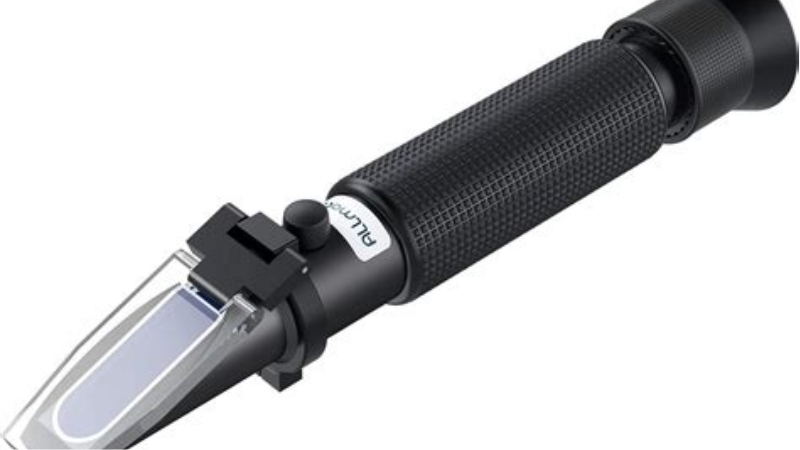
Seawater Scale, Not Generic NaCl Brine
Seawater is not just salt water, so a device calibrated for table-salt brine can misread it. Red Sea warns that NaCl-brine calibration can deviate up to about 1.5 ppt from real seawater, which is a large error for a reef. A seawater-specific scale, like the VEE GEE STX-3’s, avoids that mismatch.
Look for a refractometer built and calibrated for seawater or one you calibrate with proper reference solution. The ionic makeup of tank water differs from a simple salt mix, and a tool tuned for the wrong medium can read plausibly while being off by enough to stress corals over time.
Published Accuracy
An accuracy figure tells you how far a reading can stray from reference. The VEE GEE STX-3 publishes ±1 ppt, while the Milwaukee MA887 and Hanna HI96822 each publish ±2 ppt (VEE GEE, 2026; Milwaukee, 2026; Hanna, 2026). Tighter accuracy matters because small salinity errors ripple through the whole tank.
Do not confuse resolution with accuracy: resolution is how finely a device displays a value, while accuracy is how close it is to the true figure. A digital readout can show 0.1 ppt steps yet still carry a ±2 ppt accuracy, so read both numbers rather than trusting a precise-looking display.
ATC Has a Temperature Window
Automatic temperature compensation corrects for sample temperature, but only within a stated range. The STX-3 compensates across 10–30°C to a 20°C reference, while the Hanna HI96822 handles 10–40°C automatically (VEE GEE, 2026; Hanna, 2026). Outside that window, readings drift, so let samples reach a normal temperature.
ATC also does not mean you never calibrate. It corrects for temperature, not for calibration drift, so the device still needs periodic checking against reference fluid. Treat ATC as a convenience that keeps readings stable across normal room temperatures, not as a substitute for maintaining calibration.
Calibration and a Clean Prism
Accuracy depends on habit as much as hardware. Calibrate with proper reference solution rather than plain tap or table-salt water, and wipe the prism clean and dry between readings, since residue and stray droplets shift results. A well-calibrated cheaper tool can outperform a neglected expensive one.
Build a routine: calibrate on a schedule, rinse and dry the prism after each use, and store the device properly. Digital models like the MA887 read in about 1.5 seconds, which is convenient, but the reading is only as good as the last calibration and the cleanliness of the sample surface.
Best Saltwater Refractometers
These four span the tightest published optical accuracy, a fast digital value model, a premium digital unit and a reef-focused analog scale. They are separated by accuracy, scale and features, not price alone. Note the differing reference conditions, and confirm current pricing before buying.
| Product | Best For | Key Spec | Watch Out For |
|---|---|---|---|
| VEE GEE STX-3 | Best overall accuracy | ±1 ppt; seawater 0–100 ppt | Optical, manual reading |
| Milwaukee MA887 | Digital value | ±2 ppt; ~1.5 sec read | Needs regular calibration |
| Hanna HI96822 | Premium digital | ±2 ppt; ATC 10–40°C | IP65, not submersible |
| Red Sea Refractometer | Reef-focused analog | 20–40 ppt reef scale | Numeric accuracy unverified |
VEE GEE STX-3
The VEE GEE STX-3 takes the top slot on published accuracy, rated ±1 ppt on a seawater 0–100 ppt scale, with 1 ppt resolution, an SG range of 1.000–1.070 at ±0.001, and ATC across 10–30°C to a 20°C reference (VEE GEE, 2026). It runs around $145 as of 09/2026.
That tighter accuracy and true seawater scale make it the most trustworthy reading here for the money. As an optical unit you read it by eye through the eyepiece, which some prefer and others find fiddly. For accurate, calibration-friendly salinity without going digital, it is the standout.
Milwaukee MA887
The Milwaukee MA887 is the digital value pick, reading salinity 0–150 ppt at ±2 ppt with an SG range of 1.000–1.114 (SG 20/20) in about 1.5 seconds (Milwaukee, 2026). At around $155 as of 09/2026, it is close in price to the STX-3 but trades a little accuracy for a digital readout.
The fast digital display removes eyepiece guesswork, which many beginners like. It still needs regular calibration with reference solution, since digital does not automatically mean more accurate. For someone who wants quick, no-squint readings at a reasonable price, it is a practical everyday tool.
Hanna HI96822
The Hanna HI96822 is the premium digital option, reading 0–150 ppt at ±2 ppt with automatic temperature compensation across 10–40°C and a roughly 1.5-second read from a 100 µL sample (Hanna, 2026). It carries an IP65 rating and runs around $300 as of 09/2026, the priciest here.
The wide ATC window and water-resistant build suit a busy reef bench. Note that IP65 means water-resistant, not submersible, so it is protected from splashes but should not be dunked. For a durable digital meter with a broad temperature range, it is a step up in convenience over the value units.
Red Sea Refractometer
The Red Sea Refractometer is a reef-focused analog tool with a 20–40 ppt salinity scale and a 1.010–1.030 SG scale referenced at 25°C (Red Sea, 2026). At around $85 on the official store as of 09/2026, it is the lowest-priced option and zooms in on the range reef keepers actually use.
The narrow reef scale makes reading the relevant range easy. The caveat is data: a current first-party numeric accuracy figure is not verified, and its SG reference at 25°C differs from the SG 20/20 basis of the digital units, so the scales are not directly comparable. Calibrate it carefully with reference fluid.
Frequently Asked Questions
Reefers ask the same salinity questions: whether to calibrate, whether digital beats optical, whether table-salt water works for calibration, and whether a water-resistant meter can be submerged. Short answers first, then the caveats.
Do I need to calibrate a refractometer?
Yes, regularly. Even a unit with automatic temperature compensation needs calibration against reference solution, because ATC corrects for temperature, not for drift over time. A refractometer that is never calibrated can read plausibly while being off by enough to affect corals.
Calibrate on a schedule and after any knock or big temperature change, using proper reference fluid rather than improvised solutions. It takes moments and is the single biggest factor in trustworthy salinity readings, more than the price or brand of the device itself.
Is a digital refractometer more accurate than optical?
Not automatically. A digital readout removes eyepiece guesswork, but the published accuracy is what counts, and here the optical STX-3 at ±1 ppt is tighter than the digital MA887 and HI96822 at ±2 ppt. Digital is a convenience feature, not a guarantee of better accuracy.
Choose based on the accuracy figure and how you prefer to read, then calibrate whichever you pick. Some people find digital faster and easier; others trust a well-calibrated optical unit. The reading quality comes from the spec and your habits, not from the display type.
Can I calibrate with table salt water?
It is not ideal, because seawater’s ionic makeup differs from a simple salt-and-water brine. Red Sea notes NaCl-brine calibration can deviate up to about 1.5 ppt from real seawater, so calibrating with table-salt water can leave a reef tool systematically off.
Use proper reference or calibration solution made for seawater refractometers. It costs little and removes a hidden source of error, which matters because salinity affects every other parameter, so a small calibration mistake ripples through the whole tank over time.
Is a water-resistant refractometer submersible?
No. A rating like the Hanna’s IP65 means water-resistant against splashes, not submersible. Dunking it can damage the electronics, so treat it as splash-protected on a wet bench rather than something you can rinse under running water or drop into the tank.
Wipe it down rather than immersing it, and store it dry. The rating is useful around an aquarium where splashes are constant, but confusing water-resistant with submersible is an easy and expensive mistake, so respect the boundary the rating actually describes.
Final Thoughts
The best refractometer for saltwater aquarium use reads on a seawater scale, states its accuracy, and handles temperature within a known window, backed by regular calibration. The VEE GEE STX-3 leads on published accuracy, the Milwaukee MA887 is the digital value pick, the Hanna HI96822 adds premium features, and the Red Sea zooms in on the reef range. Calibrate properly, and salinity stops being a guess.
As an Amazon Associate we earn from qualifying purchases at no extra cost to you. Prices and availability are accurate as of the date shown and are subject to change.

How to Adjust Protein Skimmer Bubbles (2026): Step-by-Step

Best Aquarium Chiller for Saltwater Tanks: Proven Top Picks