Last Updated: October 4, 2026
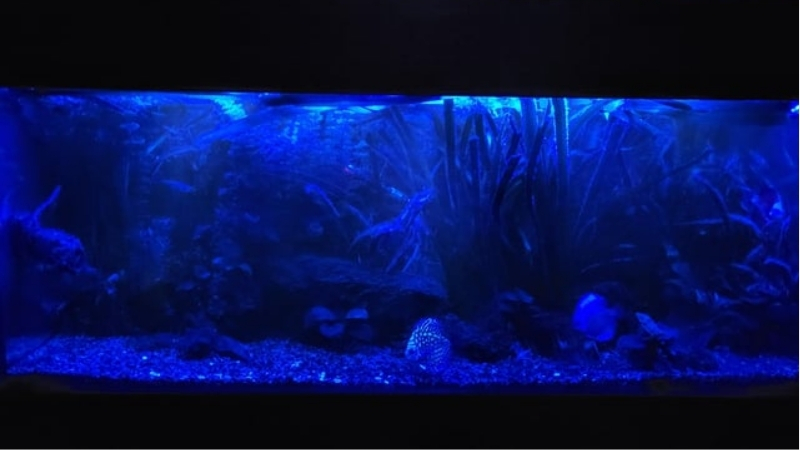
There is no universal percentage that turns a fixture into good night lighting. The best moonlight setting aquarium light plan is dim, time-limited, and paired with a genuine dark period, because a controller’s percentage maps to a different photon output on every fixture you own.
As an Amazon Associate we earn from qualifying purchases.
By David Nguyen
Quick answer: For most people in 2026, the best moonlight setting aquarium light is the Intensity — our #1 rated choice. See the full ranked comparison, alternatives and buying advice below.
The Best Moonlight Setting Is Dim and Time-Limited
A good night setting does three things: keeps intensity very low, runs for a limited window, then leaves a true dark period. Because a slider percentage is relative to each light, copy the behavior below rather than a number, and confirm your own fixture’s night output before trusting it.
| Setting Lever | Practical Target | Why It Matters | Exception |
|---|---|---|---|
| Intensity | Lowest useful blue | Preserves rest and viewing | Percentage differs per fixture |
| Duration | A few evening hours | Avoids all-night light stress | hygger preset ~18:00–22:50 |
| Dark period | Several hours fully off | Fish need real darkness | Skip only to observe briefly |
| Control | Timer or app phases | Repeatable, hands-off cycle | Manual lights need a timer |
Start With the Lowest Useful Intensity
Moonlight should be just bright enough to see movement, not to light the room. Start at your fixture’s lowest blue level and raise it only if you truly cannot see the fish. The hygger HG005 offers five DIY brightness levels (hygger, 2026), enough granularity to find a dim setting that still allows viewing.
Because a controller percentage is relative, 5% on one light is not 5% on another, so the same number gives different output across fixtures. Judge by how the tank looks rather than by the slider value, and lean darker than you think you need, since fish rest better in genuinely low light.
Give Fish a Real Dark Period
A night phase is not meant to run until sunrise. Fish and inverts need a genuine dark stretch to rest, so the goal is a short evening blue window followed by hours of full darkness. Blue light all night is not a safe default and can disrupt natural rhythms even at low intensity.
Set the light to switch fully off, not just dim, for the bulk of the night. hygger’s default preset moves to blue roughly 18:00–22:50 and then turns off (hygger, 2026), a finite example rather than a target to copy exactly. Match the idea to your household’s actual viewing hours.
Manufacturer Example: hygger Blue 18:00–22:50
The hygger HG005 default 24/7 mode shows what a finite night phase looks like: a blue window from about 18:00 to 22:50, roughly 4 hours 50 minutes, then off (hygger, 2026). It also offers DIY timers of 6, 10 or 12 hours for the full day cycle if you want more control.
Treat that window as one manufacturer’s design, not a universal lunar schedule. If you keep late hours, shift the blue phase later; if the tank is in a bedroom, shorten it. The principle that carries across fixtures is dim and finite, followed by real darkness, regardless of the exact clock times.
App-Controlled Night Phases
App fixtures make the dark period repeatable. The Fluval Aquasky 3.0 programs sunrise, midday, dusk and night phases (Fluval, 2026), so the night step can be set very low and scheduled to end automatically. That hands-off cycle is more consistent than remembering to dim the light manually each evening.
When programming, set the night phase near the bottom of the range and give it a clear end time. The Aquasky’s daytime output is 65 µmol/m²/s at 12 inches (Fluval, 2026); the night phase should sit far below that. App control also lets you adjust timing seasonally without rewiring a timer.
Practical Moonlight Setups by Fixture Type
The right setup depends on what your light can do. Preset fixtures need almost no configuration, app lights want a low night phase scheduled to end, and a manual blue channel needs an external timer. Here is how to get a dim, finite night phase from each type without overcomplicating it.
hygger HG005 Preset
The hygger HG005 is the simplest path because its default mode already includes a finite blue phase then an off period (hygger, 2026). For most tanks, leaving the preset alone gives a reasonable night cycle with no programming, and the five DIY brightness levels let you dim further if the blue reads strong.
The catch is flexibility: preset timing is fixed unless you switch to DIY mode, where you pick 6, 10 or 12-hour timers. It is a current, widely sold submersible light, but confirm the exact model and mode before relying on the schedule, since presets vary across hygger’s lineup.
Fluval Aquasky Programmable Night
The Fluval Aquasky 3.0 is the choice when you want a programmed night phase. Its app sets sunrise, midday, dusk and night steps (Fluval, 2026), so you can drop the night level low and have it end automatically. At around $125 at Petco as of 09/2026, it sits in the mid tier.
Because the same app controls daytime output, keep the two separate in your mind: a strong photoperiod for plants, then a dim night phase for viewing. Its daytime PAR is 65 at 12 inches and 42 at 18 inches (Fluval, 2026), which is a daylight figure, not a night-phase target.
Finnex Stingray Moonlight Feature
The Finnex Stingray 3.0 lists a dedicated moonlight feature in its spec table (Finnex, 2026), giving a built-in low blue mode without app setup. It is a slim, low-profile fixture whose daytime PAR is around 80 µmol/m²/s at 14 inches on the 48-inch model in open air (Finnex, 2026).
That makes it a straightforward choice for planted or community tanks that want simple night lighting. Pair it with an outlet timer to enforce a real dark period, since a moonlight feature alone does not guarantee the light turns fully off for the rest of the night.
Manual Blue Channel Plus Timer
Many fixtures have a blue channel but no scheduling, and that is fine if you add an external timer. Run the blue channel at its lowest useful level for a few evening hours, then let the timer cut power completely. A basic mechanical or digital outlet timer costs only a few dollars.
The limitation is precision: mechanical timers switch in coarse steps and cannot fade, so the light snaps on and off. That is acceptable for a night phase, but if smooth transitions matter to you, an app fixture or a controller with ramping is the better long-term buy.
Frequently Asked Questions
The same questions come up whenever people set up night lighting: how long it should run, what percentage to use, whether blue equals moonlight, and whether it feeds algae. Short answers first, then the caveats that depend on your specific fixture and livestock.
Should moonlight stay on all night?
No. A short evening blue window followed by a real dark period is healthier than light until sunrise. Fish and inverts rest better in darkness, and running any light all night can disrupt natural rhythms. hygger’s own preset switches off after its blue phase rather than staying lit (hygger, 2026).
If you want to watch nocturnal species, use the dim blue phase during your viewing hours, then let the tank go dark. The aim is a finite window matched to when you are actually in the room, not a permanent low glow spread across the whole night.
What percentage should moonlight be?
There is no universal number, because a slider percentage maps to different output on every fixture. The safe approach is to start at the lowest useful blue level and judge by how the tank looks, not by the value shown. On a five-step light like the hygger, the bottom step is usually plenty.
Avoid copying a specific percentage from another setup, since 5% on one fixture is not 5% on another. If your light lets you measure or compare output, use that; otherwise treat very dim as the target and adjust until you can just make out movement in the tank.
Is blue LED the same as natural moonlight?
Not exactly. Aquarium moonlight is usually a blue LED chosen for a pleasing look and low intensity, not a match for the moon’s actual spectrum or brightness. It works as a viewing and ambiance tool, and its main job is to stay dim enough to preserve a sense of night.
That is why intensity and timing matter more than the exact color. A dim white or warm night light can serve the same purpose; blue is popular mostly because it reads as nighttime to the eye. Whatever the color, keep it low and time-limited rather than bright and constant.
Can moonlight grow algae?
A dim, finite blue phase adds very little usable light for algae compared with the daytime photoperiod, so on its own it is rarely the cause of a bloom. The bigger drivers are day-cycle intensity, run hours and nutrients, which deliver far more energy than a short night window.
Where night lighting contributes is when it is left bright or runs for many hours, effectively extending the photoperiod. Keep the blue phase short and dim, and if algae creeps up, look first at daytime settings and feeding before blaming the night light for the problem.
Final Thoughts
The best moonlight setting aquarium light plan is dim, finite and followed by real darkness, with the exact level judged by how your tank looks rather than a number copied from elsewhere. Presets like the hygger, app phases on the Fluval, and a timer on a manual blue channel all get you there once you match the window to your viewing hours.
As an Amazon Associate we earn from qualifying purchases at no extra cost to you. Prices and availability are accurate as of the date shown and are subject to change.
Ready to decide? Our #1 pick for 2026 is the Intensity.
Live price & availability on Amazon.
Related Reviews & Guides

Best Bio Media for Aquarium Filter: Compared by the Numbers
11 Best Aquarium Rocks and Stones for Tank Decor