Last Updated: September 25, 2026
Best LED light for freshwater aquarium shopping is made harder by specification sheets that lead with lumens and colour temperature, neither of which predicts how a tank will actually look or whether plants will grow. Coverage, control and build quality decide far more, and this comparison ranks options on those.
As an Amazon Associate we earn from qualifying purchases.
As an Amazon Associate we earn from qualifying purchases at no extra cost to you. Prices and availability are accurate as of the date shown and are subject to change.
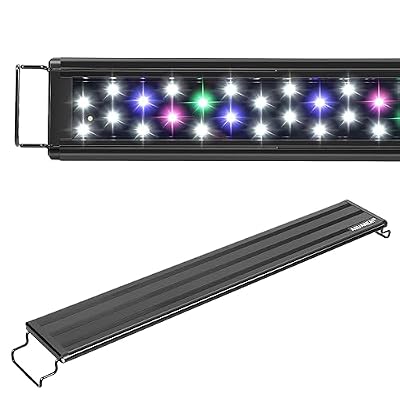
AQUANEAT LED Aquarium Light Full Spectrum for 18 Inch to 24 Inch Fish Tank Light Fresh Water
Selected for "Best LED Light for Freshwater Aquarium: How to Choose One": this listing is lighting (AQUANEAT LED Aquarium Light Full Spectrum for 18 Inch to 24 Inch Fish ), matching the equipment this article covers.
View on AmazonAQUANEAT LED Aquarium Light Full Spectrum 12 Inch Fish Tank Light Fresh Water
Selected for "Best LED Light for Freshwater Aquarium: How to Choose One": this listing is lighting (AQUANEAT LED Aquarium Light Full Spectrum 12 Inch Fish Tank Light Fres), matching the equipment this article covers.
View on Amazon
hygger Advanced LED Aquarium Light with Timer, 24/7 Lighting Cycle & DIY Mode, Full Spectrum Fish Tank Light for 48-54 in Freshwater Planted Tank
Selected for "Best LED Light for Freshwater Aquarium: How to Choose One": this listing is lighting (hygger Advanced LED Aquarium Light with Timer, 24/7 Lighting Cycle & D), matching the equipment this article covers.
View on AmazonAQUANEAT LED Aquarium Light Full Spectrum for 48 Inch to 54 Inch Fish Tank Light Fresh Water
Selected for "Best LED Light for Freshwater Aquarium: How to Choose One": this listing is lighting (AQUANEAT LED Aquarium Light Full Spectrum for 48 Inch to 54 Inch Fish ), matching the equipment this article covers.
View on AmazonBy David Nguyen
Coverage, Colour Rendition and the Value of Dimming
Choosing the best LED light for freshwater aquarium use starts with an honest description of the tank: fish only, a few easy plants, or a properly planted setup. Those three cases need genuinely different fixtures, and buying for the wrong one is the usual source of disappointment.
The decisive numbers: length, depth and photoperiod
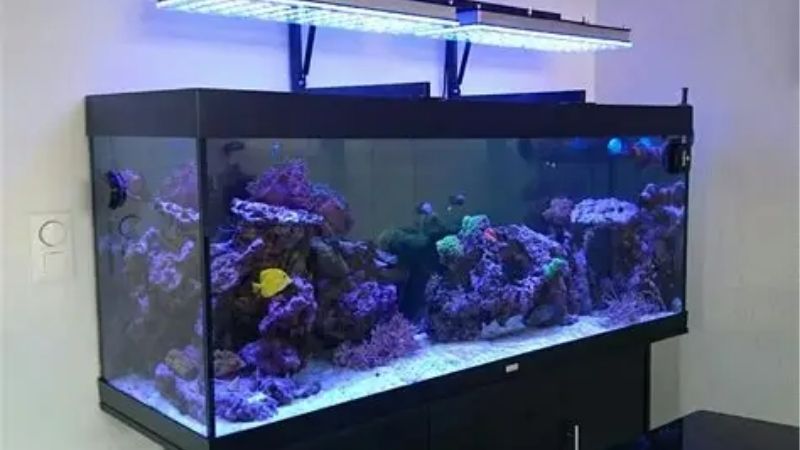
The best LED light for freshwater aquarium use starts with length: the fixture should cover most of the tank, because a short unit leaves visibly dim ends. A 36 inch (91 cm) tank wants a fixture close to that span, and a unit standing on tall legs delivers noticeably less light to the substrate.
Depth decides whether plants are viable in the tank at all. The same fixture giving useful light on a 12 inch (30 cm) tank may reach the bottom of a 21 inch (53 cm) tank far more weakly, which is why depth belongs in the decision alongside the photoperiod of 6–8 hours most tanks should run.
Colour rendition, controls and the specs worth ignoring
Colour rendition is what most people actually end up noticing. Fixtures with separate white, red, blue and sometimes green channels make fish colours read far more naturally, whereas a single cool white diode array can leave everything looking flat and slightly grey however bright it is.
Ignore lumens as a plant metric, since it weights output towards green where plants use relatively little, and treat watts as a consumption figure rather than a performance one. Dimming is the specification that matters most, because it lets you correct an algae problem without buying again.
Tank size, placement and physical fit
Mounting style decides what will actually fit. Clip fixtures need a rim they can grip, legged fixtures need the right tank width, and rimless tanks often need a different bracket entirely, so check the mounting style against your tank before comparing anything about the light output itself.
Weight sets the wider limits here: a full tank runs near 10 lb per gallon (about 1 kg per L), so a 55 gallon (208 L) setup passes 600 lb (272 kg) and needs a purpose-built stand. Measure the tank length and the rim width with a tape before ordering any fixture or mounting hardware.
| Option | Main number | Tank it suits | Recurring cost | Who it fits |
|---|---|---|---|---|
| Basic LED bar | Fixed output, no dimming | Fish-only, any size | None, no bulbs | Budget community tanks |
| Full-spectrum multi-channel | Separate colour channels | Display tanks of any depth | None | Anyone prioritising fish colour |
| Plant-capable adjustable | Dimmable, medium output | Under 20 in (51 cm) deep | Fertiliser, trimming time | Easy planted community tanks |
| Programmable with ramping | Timed intensity curve | Larger or automated setups | None beyond power | Aquascapers and hands-off owners |
| Undersized fixture | Covers part of the length | None | Replacement sooner | Nobody, measure first instead |
The Options, Grouped by Who They Suit
There is no universal best LED light for freshwater aquarium use, because a fish-only tank and a planted one want quite different things from the very same fixture. Each option below is tied to a particular group of keepers, with the limitation that comes attached stated plainly.
Basic LED bars, for fish-only tanks on a budget
A simple fixed-output bar does the job wherever the goal is seeing the fish clearly and nothing more. They are inexpensive, draw very little power, have no bulbs to replace and are entirely adequate for tanks with artificial décor or a few hardy plants tucked into shaded corners.
The limitations here are control and colour rendition. Without dimming, an algae problem can only be addressed by shortening the photoperiod, and single-tone white output tends to flatten the appearance of colourful fish that a multi-channel fixture would show off considerably better.
Full-spectrum multi-channel fixtures, for display tanks
Separate white, red and blue channels let you tune the whole look of the tank, and reds in particular bring out the colour of fish that would appear washed out under cool white alone. For a living room display tank this is the upgrade that people notice immediately after installation.
The limitation is that the tuning can easily be overdone. Heavy blue looks dramatic but it renders plants oddly and, if intensity is raised to compensate, encourages algae. The honest approach is a mostly neutral setting with a modest red boost rather than a strongly coloured one.
Plant-capable adjustable fixtures, for easy planted tanks
An adjustable fixture with enough output for shade-tolerant species covers the majority of community tanks that want real plants without injected carbon dioxide. Java fern, anubias, cryptocoryne and vallisneria all grow steadily at this level, and dimming keeps any algae manageable.
The limitation here is depth combined with carbon. Beyond about 20 inches (51 cm) of water the light arriving at the substrate falls away sharply, and pushing intensity higher without carbon dioxide reliably produces algae rather than faster growth in the plants you were aiming at.
Programmable fixtures with ramping, for automated setups
Built-in scheduling removes the plug-in timer and adds a gradual sunrise and sunset, which fish visibly settle into better than an abrupt switch. On larger or planted tanks the ability to shorten the peak period without changing the total photoperiod is a genuinely useful control.
The limitation is complexity as well as cost. More electronics means more that can fail, app-based control can become unsupported after a few years, and the practical benefit over a dimmable fixture on a cheap mechanical timer is smaller than the price difference usually suggests.
Direct Comparison and Who Should Not Buy
Most of the difficulty around the best LED light for freshwater aquarium use comes down to one single comparison and to one honest question about whether the existing fixture is really the problem at all. Answering both prevents the most common unnecessary purchase in this category.
Basic bar against full-spectrum fixture
For a fish-only tank in a spare room, the basic bar is entirely sufficient and the money is better spent elsewhere. For a display tank in a living space, the multi-channel fixture changes the appearance enough that most people consider it the better value despite the higher price.
Neither of those choices determines whether plants actually grow. That comes down to intensity at the substrate, tank depth and carbon supply, so a fixture chosen purely for colour rendition may still leave a planted tank underlit while looking excellent in photographs of the fish.
When a new fixture is the wrong purchase
If the tank already has an algae problem, a brighter fixture will only make it worse. The first moves are a shorter photoperiod, a consistent timer and reduced intensity, and it is worth checking that nitrate sits at 20–40 ppm rather than being stripped to zero by heavy water changes.
If plants are struggling under otherwise adequate light, the limiting factor is usually carbon or nutrients. Confirm ammonia and nitrite read 0 ppm, review the fertiliser routine, and only then consider whether the fixture genuinely lacks the output the plant list actually requires.
Cheaper approaches that genuinely work
A plug-in timer costs very little indeed, and it fixes the single most common cause of algae, which is an inconsistent photoperiod driven by whoever happens to walk past the tank. Holding a steady 6–8 hours does more for the tank’s appearance than most fixture upgrades achieve on their own.
Changing the mounting height is the other genuinely free adjustment. Raising a fixture a few inches (several cm) reduces intensity at the substrate noticeably, which is often exactly what an algae-prone tank needs, and lowering it recovers output without any new purchase being made.
Running Costs, Failure Points and Twelve Month Ownership
LED fixtures usually outlast the tank beneath them, so the true cost of the best LED light for freshwater aquarium use is electricity plus whatever routine the light commits you to. There are no bulbs to replace, which changes ownership considerably against older fluorescent units.
How LED fixtures actually fail
Output declines gradually rather than stopping outright, and the change is slow enough that most owners never notice it until plant growth slows or colours look duller than they remember. Individual diodes fail occasionally, leaving a visibly dim section along part of the fixture.
Driver failure is the usual reason that a unit stops entirely, and it is rarely repairable at home in any practical sense. Moisture is the underlying cause in a great many cases, since condensation reaches the housing on open-top tanks and corrodes connections steadily across months of normal running.
What you will actually spend money on
Beyond electricity itself, the ongoing costs are all indirect: fertiliser and trimming time if the fixture supports plants, and a timer if scheduling is not built in. A more powerful light commits you to more maintenance, which is the real cost rather than anything on the price tag.
Price levels move constantly across the budget, mid-range and premium fixtures, so check the current figures at the time of purchase rather than relying on remembered prices. Lighting discounts cluster into just a few events each year, with late November usually the deepest of them.
Certification, safety and mounting
Any powered device sitting above the water should carry recognised safety certification such as UL or ETL, run through a residual current device or GFCI outlet, and have a drip loop in the cable. Splash and condensation are constant on any open-top tank, so this genuinely does matter.
Check that the mounting hardware is included and that it suits your tank, since brackets and legs are frequently sold separately and rarely fit rimless tanks without an adapter. A fixture that cannot be mounted at the right height over the tank is the wrong fixture regardless of its output.
Frequently Asked Questions
These questions come up repeatedly once people stop comparing fixtures by lumens, because selecting the best LED light for freshwater aquarium use depends on tank depth, on what is planted in it, and on whether the fixture can be dimmed when something in the tank starts going wrong.
How many hours should the light be on?
Six to eight hours suits most freshwater tanks, run on a timer so that the period stays completely consistent. Longer photoperiods rarely improve anything once the light is adequate, and they reliably favour algae, so shortening the schedule is usually the first correction worth making.
Is a higher colour temperature better?
Not inherently better, no. Around 6500 K is a common default because it renders both fish and plants naturally, but colour temperature describes appearance rather than usable output. Judge a fixture on coverage, dimming and how the tank actually looks rather than on the Kelvin figure.
Can one LED fixture grow plants and suit fish?
Often yes, provided that the tank is not too deep and the plant list stays undemanding. A dimmable fixture is the key here, because it allows the intensity to be tuned down if algae appears while still supporting the shade-tolerant species that grow without injected carbon dioxide.
Do LED fixtures need replacing on a schedule?
No, and unlike fluorescent tubes they have no scheduled replacement interval. Output declines slowly across many years, so replace only when growth or appearance changes noticeably, or when a driver fails, rather than following any fixed interval printed in older aquarium literature.
See More:
Conclusion
For most tanks the sensible default among the best LED light for freshwater aquarium options is a dimmable full-spectrum fixture spanning most of the tank length, run on a timer at 6–8 hours a day. The budget choice is a basic LED bar where the tank holds fish and no real plants.
6 Best Aquarium Tank Chillers 2026
Best Aquarium Light With Timer Built In: Smart Top Picks