Last Updated: October 4, 2026
Tank geometry and glass thickness decide these pumps more than a headline GPH number. The best cross flow wave maker for reef tanks is the one sized to your tank length and panel thickness first, since the Maxspect Jump 4K clears 20 mm glass while the AI Orbit 2 and Red Sea ReefWave 25 mount to around 15 mm.
As an Amazon Associate we earn from qualifying purchases.
As an Amazon Associate we earn from qualifying purchases at no extra cost to you. Prices and availability are accurate as of the date shown and are subject to change.
By David Nguyen
Quick answer: For most people in 2026, the best cross flow wave maker for reef tanks is the AI Orbit 2 — our #1 rated choice. See the full ranked comparison, alternatives and buying advice below.
How to Choose a Cross-Flow Wave Maker
Match pump length and flow to tank dimensions, check glass thickness before comparing GPH, compare the flow range rather than just the maximum, and decide how much smart control you want. A cross-flow pump has to fit your tank mechanically before its flow rating matters at all.
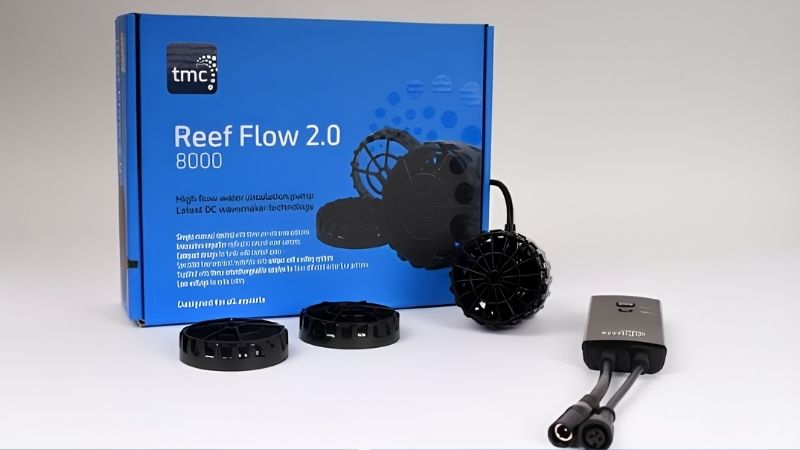
Match Pump Length and Flow to Tank Dimensions
Makers recommend by size: the Red Sea ReefWave 25 targets 1.5 to 4 ft aquariums, and the AI Orbit 2 is recommended for 20 to 88+ gallons. These are manufacturer guidelines for those pumps, not universal sizing laws, so read them as starting points for your specific tank.
Use the recommendation to bracket the right pump, then refine by your aquascape. A cross-flow pump’s linear sheet works best matched to tank length, so start from the maker’s size range and adjust for rockwork and layout rather than treating one figure as a fixed rule for all reefs.
Check Glass Thickness Before Comparing GPH
Glass rating is a hard mechanical limit: the Orbit 2 and ReefWave 25 support around 15 mm, while the Jump 4K supports 20 mm. If your panel is thicker than a pump’s rating, it will not mount securely, so this check comes before any flow comparison.
Measure your glass first. A thick rimless panel can exceed the 15 mm pumps and require the Jump 4K’s 20 mm rating, so confirm the mount fits before weighing GPH, since flow figures are irrelevant on a pump that cannot hold to your glass.
Compare Flow Range, Not Just Maximum Flow
A published range helps more than a single peak: the IceCap 4K lists 1,286 to 4,000 GPH and 13 to 45W, showing both its low and high settings. That range tells you how far you can turn the pump down, which matters for tuning flow to corals and aquascape.
So read the low end as well as the maximum. A pump you can dial to a gentle setting suits a mixed reef better than one that only makes sense near full output, which is why the adjustable range, not the headline GPH, is the more useful selection figure.
Decide How Much Smart Control You Want
Control tiers differ: the Orbit offers myAI and Mobius with optional Apex MXM integration, the ReefWave uses a dedicated controller with ReefBeat, the Jump 4K includes a programmable controller, and the IceCap’s basic package has five flow modes. Match the tier to your needs.
Decide whether you want app and controller integration or just onboard modes. A reefer running an ecosystem benefits from Mobius or ReefBeat, while a simpler tank may only need the built-in modes, so choose the control depth you will actually use rather than the most features.
Top Picks
These four span an ecosystem-integrated pump to a value 4K-class gyre, with prices checked September 2026. Flow, glass and control differ, so use the table to match tank size and panel thickness to the pump, and note where a GPH figure is an approximation rather than a hard spec.
| Product | Best For | Key Spec | Watch Out For |
|---|---|---|---|
| AI Orbit 2 | Mobius/AI ecosystem | 25W; 15-mm glass | AI does not hard-publish GPH |
| ReefWave 25 | ReefBeat ecosystem | 1,980 GPH; 4-25W | Higher price for lower GPH |
| Maxspect Jump 4K | High-output standalone gyre | 3,962 GPH; 20-mm glass | Controller less ecosystem-centric |
| IceCap 4K | Lower-cost 4K-class gyre | 1,286-4,000 GPH | Smart tier depends on package |
AI Orbit 2
The AI Orbit 2 draws 25W max, mounts to 15 mm glass and is recommended for 20 to 88+ gallons, priced around $300 as of September 2026, with four modes including Constant, Pulse, Random and Reverse. It suits reefers in the Mobius and AI ecosystem who want app control.
One caution: AI does not hard-publish a GPH figure for the Orbit 2, and the retailer BRS lists it as approximately 2,000 GPH. So treat its flow as an approximate retailer figure rather than a manufacturer-rated max, and do not compare it one-to-one with rated pumps.
Red Sea ReefWave 25
The Red Sea ReefWave 25 delivers 1,980 GPH at 4 to 25W on 15 mm glass, priced around $359 as of September 2026, with a dedicated Wi-Fi controller and ReefBeat support. For a Red Sea ecosystem, its integrated control and true-rated flow are the appeal.
Its trade-off is a higher price for a lower headline GPH than the 4K-class pumps, since its 1,980 GPH is roughly half their maximum. Tank suitability still depends on flow shape, placement and aquascape, so judge it by fit and control rather than the raw flow number alone.
Maxspect Jump Gyre 4K
The Maxspect Jump 4K provides 3,962 GPH at 45W on 20 mm glass, priced around $275 as of September 2026, and includes a programmable controller with multiple 24-hour flow modes. Its high output and 20 mm rating make it the pick for larger tanks or thick panels.
Its controller is less ecosystem-centric than the app-integrated options, so it suits a standalone high-output setup. Its 3,962 GPH sits within about 1% of the IceCap 4K’s 4,000 GPH, so that tiny gap should not be read as one being meaningfully more powerful than the other.
IceCap 4K Gyre
The IceCap 4K Gyre spans 1,286 to 4,000 GPH at 13 to 45W on 5/8-inch glass, priced around $225 as of September 2026, making it about 15% cheaper than the Jump 4K. Its wide published range and low price make it the value 4K-class gyre here.
Its smart-control tier depends on the controller package, so confirm what your version includes. The 4,000 GPH max is only about 1% above the Jump 4K’s 3,962, so choose it for price and control range rather than assuming it meaningfully outflows the Maxspect.
Frequently Asked Questions
Reefers ask whether 4,000 GPH is too much, how a gyre differs from a powerhead, which models fit thick glass, and whether two pumps are needed. The answers below treat max flow as one input and keep an approximate retailer figure separate from a rated spec.
Is 4,000 GPH Too Much for a Reef Tank?
Not necessarily, because 4,000 GPH is a maximum output, not a required operating point. The IceCap 4K, for example, is controllable down to a published 1,286 GPH, so a high-ceiling pump can run gently when dialed back to suit a smaller or coral-sensitive tank.
So a 4K-class pump is not automatically too strong, since you can turn it down. Judge it by the low end of its range and your tank’s needs rather than the peak figure, and set the flow to what your corals and aquascape actually call for.
What Is the Difference Between a Gyre and a Regular Powerhead?
Cross-flow or gyre models are designed for broader, linear circulation along the tank’s length, rather than the more focused stream of a typical powerhead. That sheet-like flow is why they suit spreading movement across a longer display.
They do not, however, eliminate all dead spots as a guaranteed result, since aquascape and rockwork alter water movement. So treat a gyre as a tool for broad circulation you tune to your layout, rather than a device that removes every low-flow area on its own.
Which Models Work on Thick Glass?
The Maxspect Jump 4K supports 20 mm or 0.79-inch glass, while the ReefWave 25 and AI Orbit 2 are around 15 mm limits. So for a thick panel, the Jump 4K is the compatible choice among these, and the 15 mm pumps may not mount securely.
Do not assign the Jump’s 20 mm rating to the Orbit or ReefWave, since each pump’s glass limit is specific. Measure your panel and match it to the correct rating, since glass compatibility is a hard limit that decides which pumps you can even mount.
Do I Need Two Cross-Flow Pumps?
Not automatically. Pump count depends on tank length, rockwork and your target circulation, so a single pump suffices for many tanks. AI notes that reverse-flow capability becomes more useful with a second Orbit, but that does not make two pumps mandatory.
So add a second pump only if your tank’s length or layout leaves low-flow areas one cannot cover. Judge by how the single pump circulates your specific aquascape rather than assuming a pair is required, since one well-placed gyre handles many reef tanks.
Final Thoughts
The best cross flow wave maker for reef tanks is selected by tank geometry, glass thickness and the flow-control ecosystem you will use, with max GPH as only one input. Confirm the mount fits your glass first, compare the full flow range rather than the peak, and treat an approximate retailer GPH figure differently from a manufacturer-rated maximum.
Ready to decide? Our #1 pick for 2026 is the AI Orbit 2.
Live price & availability on Amazon.
Related Reviews & Guides



Best 75 Gallon Aquarium Kit for Goldfish: Top Compared Guide

Quick Picks: Aquarium Protein Skimmers