Last Updated: October 4, 2026
The best chiller for hydroponics and fish tanks has to satisfy two different jobs with one machine: cooling a nutrient reservoir without leaching metals, and cooling an aquarium without harming livestock. Wetted materials, real heat load and loop flow decide whether a unit does both well.
As an Amazon Associate we earn from qualifying purchases.
As an Amazon Associate we earn from qualifying purchases at no extra cost to you. Prices and availability are accurate as of the date shown and are subject to change.
By David Nguyen
Quick answer: For most people in 2026, the best chiller for hydroponics and fish tanks is the Active Aqua AACH10HP — our #1 rated choice. See the full ranked comparison, alternatives and buying advice below.
How to Choose a Chiller for Reservoirs and Aquariums
A unit that works on both sides needs the right wetted materials, honest capacity for your actual heat load, a flow rate your pump can deliver, and enough margin for the room it sits in. Those four points matter more than horsepower printed on the carton. A chiller that suits a 20-gallon reservoir under lights may be undersized for a 40-gallon fish room in July.
Wetted Materials Come First
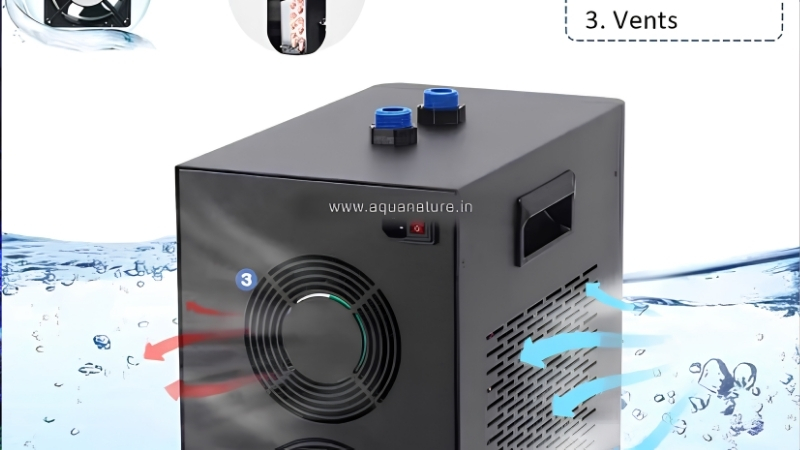
Whatever touches the water decides compatibility. The Active Aqua AACH10HP uses a titanium evaporator rated for both fresh and saltwater, and the TECO TK-500 also uses a titanium exchanger. Titanium tolerates salt and concentrated nutrient solutions far better than cheaper metals. Fittings elsewhere in the loop matter too, since nutrient concentrates attack some alloys faster than tank water.
Titanium resists corrosion but not fouling. Mineral scale from hydroponic nutrients and biofilm from aquarium water both build up inside the exchanger and cut transfer efficiency over months, so plan periodic flushing and check whether the exchanger is serviceable before buying. Ask whether replacement exchangers and control boards are sold separately, because a sealed unit with no spares becomes disposable once something fails.
Read Capacity as a Range, Not a Promise
Published chiller bands assume test conditions you may not share. Active Aqua rates the AACH10HP for 10 to 40 gallons at 1,020 BTU per hour and the AACH25HP for 40 to 92 gallons at 3,010 BTU per hour, while TECO lists the TK-500 up to 120 gallons.
Those bands come from different test protocols, so comparing gallon figures across brands tells you very little. TECO is unusually specific: it cites holding 40 gallons at 77F in an 86F room, a 9F pull-down at a 1.89 watt per gallon heat load, which is the kind of stated condition worth looking for. Treat any band without a stated ambient temperature and heat load as marketing rather than engineering data.
Match the Required Flow Window
Each chiller needs a particular flow through its exchanger. The AACH10HP asks for 132 to 396 GPH, the AACH25HP wants 396 to 925 GPH, and the TECO TK-500 runs on a much lower 106 to 211 GPH. A narrower window is not weaker cooling; it reflects the contact time that particular exchanger needs to move heat into the refrigerant.
Published pump ratings assume zero head, so delivered flow falls once water climbs through hose, elbows and fittings. Size the loop pump after head loss and trim with a valve if you overshoot, since running outside the stated window costs efficiency at either end.
Account for Ambient Heat
Room temperature sets how hard the compressor works. A grow tent under lights and a fish room in summer both run warmer than the test conditions behind a gallon rating, which shortens the effective capacity of any unit you buy. Every degree the room gains lengthens runtime, and a chiller running continuously through summer wears its compressor faster than one cycling hourly.
The chiller also exhausts its removed heat into that space, which quietly raises ambient and lengthens duty cycle. Leave clearance around the vents, avoid sealed cabinets, and remember running cost follows watts times hours: 190W on the AACH10HP, 460W on the AACH25HP, 225W on the TK-500.
Top Picks
These three units plus one loop-design note cover most dual-use setups. Each lists manufacturer specifications, a relative price position as of 09/2026 and a real drawback, so you can match hardware to measured load rather than to a number on the box.
| Product | Best For | Key Spec | Watch Out For |
|---|---|---|---|
| Active Aqua AACH10HP | Best overall value | 10-40 gal; 1,020 BTU/h; titanium evaporator | Gallon band assumes a modest heat load |
| Active Aqua AACH25HP | Best for larger reservoirs | 40-92 gal; 3,010 BTU/h; 460W | Highest power draw here |
| TECO TK-500 | Best documented performance | Up to 120 gal; 106-211 GPH; 225W; titanium | Most expensive by a wide margin |
| Shared loop setup | Best for dual-use builds | Match pump to the stated GPH window | Never share water between systems |
Active Aqua AACH10HP: Best Overall Value
The AACH10HP covers 10 to 40 gallons with 1,020 BTU per hour, drawing 2.2 amps at 120 volts and listed at 190 watts. Its titanium evaporator is rated for fresh and saltwater, and the forgiving 132 to 396 GPH window suits most small circulation pumps. It runs near under $500 as of 09/2026.
The 40-gallon ceiling assumes a modest heat load, so a lit grow reservoir or a warm fish room can push the same volume past it. Confirm your measured daily rise before trusting the top of that band. Hydrofarm units are widely stocked, so replacement parts and service support are easier to find than with marketplace brands that appear and vanish.
Active Aqua AACH25HP: Best for Larger Reservoirs
Stepping up to the AACH25HP brings 3,010 BTU per hour across a 40 to 92 gallon band, roughly triple the smaller unit’s output. It draws 4.7 amps at 120 volts, listed at 460 watts, and needs a stronger 396 to 925 GPH feed. At about $699 as of 09/2026 it sits around 41.2% above the AACH10HP.
That capacity costs real money to run and exhausts more heat into the room, which matters in a tent or closed cabinet. Choose it when measured load genuinely calls for it, not as blanket insurance against a hot week. Check your circuit as well, since 4.7 amps alongside lights and pumps can crowd a shared household breaker in a grow space.
TECO TK-500: Best Documented Performance
TECO publishes what most brands leave vague. The TK-500 is rated up to 120 gallons on 106 to 211 GPH at 225 watts with a titanium exchanger, and TECO states a specific controlled point: 40 gallons held at 77F in an 86F room, a 9F pull-down at 1.89 watts per gallon of heat load.
That transparency comes at a price. At roughly $1,300 as of 09/2026 it runs about 168.7% above the AACH10HP, a gap near under $900. Its narrow 106 to 211 GPH window also means the feed pump must be sized or valved carefully. Weigh that against the Active Aqua pair before paying for documentation you may not need on a modest reservoir.
Designing a Dual-Use Loop
One chiller can serve both applications, but not simultaneously through shared water. Run each system as its own closed loop and move the unit between them, or plumb separate loops with disconnects so nutrient solution and aquarium water stay entirely separate.
Cross-contamination is the real risk: nutrient salts carried into a display tank or aquarium biology carried into a reservoir causes problems no chiller spec sheet addresses. Flush the exchanger and hoses thoroughly between uses, and keep dedicated hoses for each system if you can. Label each hose set and store them separately, because a single mistaken connection can undo months of careful reservoir hygiene.
Frequently Asked Questions
Growers and fishkeepers ask the same four things: whether one unit really covers both uses, how much flow the smaller model needs, what the BTU jump actually buys, and how seriously to take an up-to-120-gallon rating.
Can one chiller serve both uses?
Yes, provided the wetted parts suit both and you keep the water separate. Titanium exchangers like those in the Active Aqua and TECO units handle nutrient solution and saltwater alike, which is the main compatibility hurdle.
What you cannot do is share a single loop between a reservoir and a tank. Use separate closed loops, clean the exchanger between applications, and size for whichever system carries the higher heat load rather than averaging the two. Budget a second set of hoses and unions rather than reusing one set across both systems.
How much flow does the AACH10HP need?
This chiller specifies 132 to 396 GPH through the exchanger. That range is wide enough that most small circulation pumps can feed it once you account for head loss from lift, hose length and fittings.
Delivered flow matters, not the box rating, because published GPH assumes zero head. If your pump overshoots the top of the window, throttle it with a valve rather than assuming more flow produces more cooling.
What does the jump to 3,010 BTU buy?
Roughly triple the thermal output of the 1,020 BTU per hour AACH10HP, which matters when ambient is high or the reservoir is large. It also triples the published band to 40 to 92 gallons and raises draw from 190W to 460W.
More capacity is not automatically better. Pay for it when your measured temperature rise justifies it; otherwise the smaller unit runs cheaper, exhausts less heat and still holds target on a moderate load. Oversizing also short-cycles the compressor, which is harder on components than steady moderate running.
How literally should I read up to 120 gallons?
As a ceiling under favorable conditions, not a guarantee that the chiller fits your setup. The TECO TK-500 carries that band, yet its own stated control point describes holding 40 gallons at 77F in an 86F room at a 1.89 watt per gallon load.
That gap between headline band and stated condition is the lesson for every brand here. Measure the rise your system produces across a full day, then size to that measured pull-down instead of the largest number on the listing. Large cooling equipment tends to discount hardest around Prime Day and Black Friday, which is worth timing if your purchase can wait for cooler months.
Final Thoughts
The best chiller for hydroponics and fish tanks combines a titanium exchanger, capacity matched to measured heat load, and a flow window your pump can actually deliver. The Active Aqua AACH10HP near under $500 covers most dual-use builds, while the TECO TK-500 buys documented performance at a steep premium.
Ready to decide? Our #1 pick for 2026 is the Active Aqua AACH10HP.
Live price & availability on Amazon.
Related Reviews & Guides



Quick Picks: Aquarium Fish Food Flake & Pellet
Best Dosing Pump for Beginners: Top Expert Buying Guide