Last Updated: October 21, 2026
The best canister filter for saltwater tanks must be explicitly salt-compatible and built around a maintenance routine that exports trapped debris. A small step helps capacity, since the Sicce WHALE120 to 200 move adds about $10, near 7.7 percent, for more flow, media and a third basket.
As an Amazon Associate we earn from qualifying purchases.
By David Nguyen
How to Choose a Canister Filter for Saltwater Tanks
A saltwater canister is judged on explicit salt compatibility, serviceability that removes trapped waste, and a correctly read flow metric. Confirm the maker rates the model for salt, plan a cleaning routine that exports detritus rather than storing it, and read circulation honestly rather than chasing a pump number.
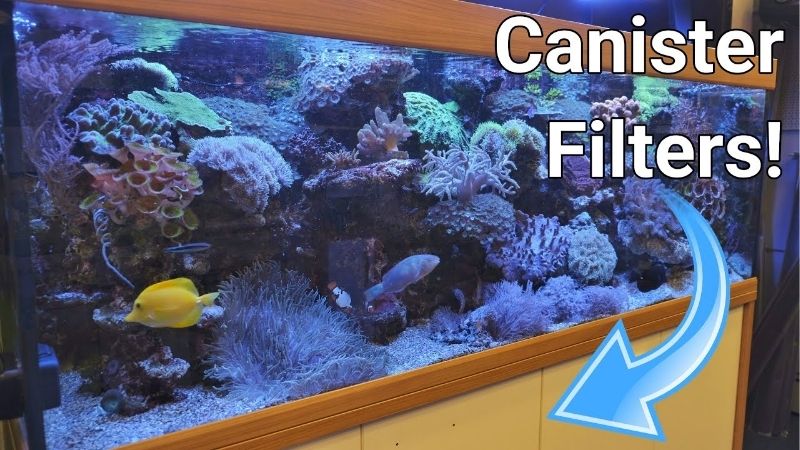
Explicit Saltwater Compatibility
The first requirement is a maker’s explicit saltwater rating, since salt is harder on seals, baskets and impellers than freshwater. A canister not rated for salt can corrode or degrade over time, so confirm compatibility before anything else, because a freshwater-only unit is a false economy on a saltwater tank.
Salt exposure also stresses O-rings and fittings, so materials matter for longevity. Choosing a model the maker validates for saltwater protects both the filter and the tank, since a unit that fails or leaches from corroded parts is far more costly than the modest premium a salt-rated canister may carry.
Serviceability That Exports Debris
On saltwater, a canister must be cleaned in a way that removes trapped waste rather than holding it, or it becomes a nutrient source. Easy-access baskets or a prefilter let you export detritus promptly, which keeps the canister from feeding nuisance algae or driving nitrates on a marine tank.
Plan the maintenance routine around debris export, not just media replacement, since waste breaking down inside a sealed canister undoes its purpose. A design you can open and rinse quickly makes frequent servicing realistic, and on saltwater thorough cleaning keeps a canister beneficial rather than harmful.
Capacity Steps and Media
Media capacity sets how much a saltwater canister can do, and small steps buy real headroom. The WHALE120 to 200 move adds about $10, near 7.7 percent, for roughly 35.7 percent more maximum flow, 50 percent more media and an extra basket, which gives more room for the media a marine tank needs.
That extra basket also organizes media better, which matters when running mechanical and chemical stages together. So weigh the small capacity step against your tank’s needs, since on saltwater the added media room and flow can be worth far more than the modest price difference between the two models.
Read Circulation and Class Honestly
Saltwater buyers should read flow and class carefully, since headline numbers mislead. An OASE canister can cost about $130 more, near 92.9 percent, than the WHALE200, but it sits in a different capacity and feature class, so that price gap reflects a different product, not simply a pricier version of the same thing.
Likewise, maximum-flow ratings across brands are not comparable to filtered circulation, so avoid ranking models on mixed metrics. Compare within a class and a metric, because a canister two classes larger is not overpriced against a smaller one; it is a different tool for a different saltwater filtration job.
Top Picks
Because saltwater needs explicit compatibility and class differences matter, there is no single winner here, so the order below leads with salt suitability and serviceability. Match a row to your tank’s needs and cleaning tolerance, keeping cross-class price gaps and cross-brand flow figures out of a false comparison.
| Product | Best For | Key Spec | Watch Out For |
|---|---|---|---|
| Sicce WHALE120 | Small salt tanks, tidy media | 140 GPH max; 0.4 gal; 2 baskets | Least capacity of the pair |
| Sicce WHALE200 | Step-up capacity for salt | 190 GPH max; 0.6 gal; 3 baskets | +$10 (+7.7%) over 120 |
| OASE BioMaster | Prefilter debris export | Top prefilter; larger class | ~$130 (+92.9%) over WHALE200 |
| Fluval Marine-Rated | Chemical-media role | Salt-rated; four baskets | Read circulation, not pump |
Sicce WHALE120
For a small saltwater tank, the Sicce WHALE120 keeps media tidy with a 140 GPH maximum flow, 0.4 gallon of media and two baskets. Confirm its saltwater suitability for your use, and on a small marine tank it provides straightforward mechanical and chemical filtration without excess capacity to maintain.
Its limit is room: two baskets and 0.4 gallon of media leave less space than the 200, so a heavier marine bioload can outgrow it. For a genuinely small saltwater setup it suffices, but the inexpensive step to the 200 is worth weighing if you plan to run more media or add stock later.
Sicce WHALE200
The Sicce WHALE200 adds about $10, near 7.7 percent, over the 120 for a 190 GPH maximum flow, 0.6 gallon of media, near 50 percent more, and a third basket. On saltwater that extra basket helps run mechanical and chemical media together, which a marine tank often needs more than a freshwater one.
The maximum-flow gain of about 35.7 percent is secondary to the added capacity and organization. Its small premium over the 120 buys real headroom, making it the more flexible salt-rated choice when you expect to run multiple media stages or grow the tank beyond a minimal stocking level.
OASE BioMaster
The OASE BioMaster suits saltwater keepers prioritizing debris export, since its top prefilter clears the bulk of waste without opening the main canister. On a marine tank, promptly removing detritus is what keeps a canister from driving nitrates, so that prefilter access is a genuine saltwater advantage.
It costs about $130 more, near 92.9 percent, than the WHALE200, but it is a larger, higher-feature class rather than an overpriced equivalent. Judge it as a different tool for a bigger job, and confirm saltwater suitability, choosing it when the prefilter and capacity justify the step to a different class.
Fluval Marine-Rated
A salt-rated Fluval canister fills a chemical-media role on saltwater, with four baskets suited to running carbon or phosphate media. Confirm the specific model’s saltwater rating, and on a marine tank it can serve as a dedicated chemical-filtration station where the display filtration cannot host that media.
Read its flow as circulation rather than pump output, since the pump figure overstates real throughput. Its drawback on saltwater is nutrient risk if servicing lapses, so it earns its place only with a committed cleaning routine that exports trapped waste rather than letting it break down inside the canister.
Frequently Asked Questions
Saltwater keepers ask whether a freshwater canister will do, how often to clean, whether a canister replaces a skimmer, and why one model costs far more. The answers below keep salt compatibility and honest metrics in view, so a canister helps a marine tank rather than harming it.
Can I Use a Freshwater Canister on Saltwater?
Only if the maker explicitly rates it for salt use. Saltwater is harder on seals, baskets and impellers, so a canister not validated for marine use can corrode or degrade badly over time, which risks both the filter and the tank even though it may work fine at first on freshwater.
Confirm explicit saltwater compatibility before buying, since materials and O-rings matter for longevity in salt. A salt-rated model may cost a little more, but that premium is far cheaper than a corroded unit that fails or leaches into the tank, so treat compatibility as a hard requirement rather than a preference.
How Often Should I Clean a Saltwater Canister?
Often enough that trapped debris never breaks down inside it, which depends on bioload. A busier marine tank may need cleaning about every week or two, since detritus held in a sealed canister can drive nitrates and feed algae, undoing the filtration the canister was meant to provide.
Let nutrient readings and visible flow set the cadence rather than a calendar, since protocol varies by system. A prefilter-first design makes frequent servicing easier, so if you expect a demanding schedule, prioritize a canister that lets you export debris without a full teardown on your saltwater tank.
Does a Canister Replace a Protein Skimmer?
No; they do different jobs. A skimmer exports dissolved organics before they break down, while a canister traps particulate and holds media, so a canister cannot perform the skimmer’s export function regardless of how much water flow it moves through its baskets on a saltwater tank.
Relying on a canister instead of a skimmer can even worsen nutrients if trapped waste is not removed promptly. Treat them as complementary, with the skimmer handling organic export and the canister filling a defined mechanical or chemical role where a marine system genuinely needs it.
Why Does One Canister Cost So Much More?
Usually because it is a different class, not a marked-up equivalent. An OASE unit costing about $130 more, near 92.9 percent, than the WHALE200 sits in a larger capacity and feature class, so the gap reflects a bigger, more capable tool rather than the same filter at a higher price.
So compare canisters within a class and a metric before judging value, since a two-class-larger unit is not overpriced against a smaller one. Match the class to your saltwater tank’s needs, and read maximum-flow figures as brand-specific, because mixing classes and metrics makes price comparisons meaningless.
Final Thoughts
The best canister filter for saltwater tanks is one the maker rates for salt and that you clean to export debris, not store it. A small step like the WHALE120 to 200, about $10 for more media, buys useful capacity, while a pricier OASE reflects a different class, so compare within a class and read circulation.
Best Budget All in One Saltwater Tank: Top Smart Shortlist
8 Best Affordable Saltwater Aquarium Kits for Beginners 2026