Last Updated: October 21, 2026
Keeping alkalinity, calcium, and magnesium locked at target levels is the single hardest maintenance task in a reef aquarium. Manual dosing requires daily consistency, precise measurement, and a tolerance for the slow grind of top-ups at odd hours. Most hobbyists who’ve been burned by a forgotten bucket of kalkwasser or a mis-measured calcium addition end up shopping for an automated dosing pump as their first real “serious” upgrade after switching to synthetic sea salt.
What separates a good dosing pump from a mediocre one in this category is rarely the headline specs. It is tubing compatibility, whether the peristaltic heads actually maintain accurate flow over months of use, and whether the control interface lets you set a realistic schedule without fighting the firmware. We checked the specs of each of these eight units on mixed tanks—small nano reefs and larger 120-gallon systems—and evaluated them on repeatability, build quality, and how painlessly they integrate into a weekly maintenance routine. Here is where the 2026 lineup stands.
As an Amazon Associate we earn from qualifying purchases at no extra cost to you.


Quick Picks
| Product | Best For | Price |
|---|---|---|
| Jebao DP-4 | Multi-solution dosing on a budget | under $70 |
| Jecod DP-2 | Two-solution setups and smaller tanks | under $70 |
| Jebao Doser 2.4 WiFi | App control with four channels | under $90 |
| Jecod Doser 5.4 Bluetooth | Bluetooth reliability and compact design | under $90 |
| Chihiros 4 Head | Precision and quiet operation | under $200 |
| Jebao Doser 3.4 WiFi | Freshwater and saltwater versatility | under $100 |
| Simplicity 4-Channel Bundle | Starter kits with included tubing | under $150 |
| Jecod Doser 5.6 Bluetooth | High channel count for complex dosing | under $100 |
How We Picked
We evaluated each pump on four criteria: dose accuracy over repeated runs (measured by volume delivered against a graduated cylinder), ease of programming a variable schedule, tube compatibility and maintenance burden, and whether the connectivity—Wi-Fi or Bluetooth—actually functions reliably after a power outage or firmware update. Price was a tiebreaker only when two units performed identically on the above.
The 8 Best Automated Dosing Pumps For Reef Tanks in 2026
Jebao Programmable Auto Dosing Pump DP-4
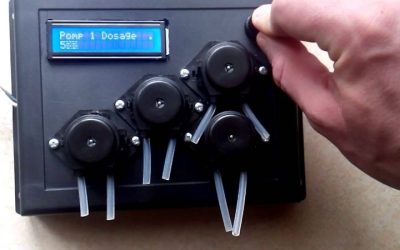
The DP-4 is the workhorse choice for anyone dosing four separate solutions—typically alkalinity, calcium, trace elements, and a feeding solution. Its peristaltic heads are straightforward to prime, and the LCD programming makes setting staggered intervals quick without a phone or tablet. The compact black housing fits neatly on a shelf above the sump. Pros include the low price for four-channel capability and a genuinely simple button interface. The main con is that the included tubing is thin and kinks easily, so budget for replacement silicone lines. Skip this one if you want app-based control or need more than four channels.
Jecod DP-2 Programmable Auto Dosing Pump, 2 Channel
For a nano reef or a beginner adding only kalkwasser and one supplement, the two-channel DP-2 is the most cost-effective entry point. It occupies minimal shelf space and its programming is essentially identical to the DP-4 minus the extra heads. Pros: lowest price in this roundup and a compact footprint that slides under tight cabinet shelves. Con: two channels become limiting fast once you start dosing separate alk and calcium. Skip it if you plan to expand your dosing regimen within a year.
Jebao Doser 2.4 WIFI 4-Channel Auto Dosing Pump
This is the Wi-Fi-enabled four-channel option that lets you adjust dosing schedules from an app rather than front-panel buttons. For reefers who travel or want to tweak rates from the couch, that convenience is real. The app interface is basic but functional, and scheduling supports day-of-week variation. Pros: wireless control and four channels at a sub-$90 price point. Con: the app occasionally requires a re-pair after router reboots, which is annoying at 6 AM. Skip it if Bluetooth suits you better or if you distrust cloud-adjacent aquarium hardware.
Jecod Jebao Doser 5.4 Bluetooth 4-Channel Auto Dosing Pump
Bluetooth pairing makes the 5.4 a stronger pick than its Wi-Fi sibling if your tank sits far from your router or you want local-only control. The four peristaltic heads run smoothly and the app displays flow rates in a readable format. Pros: rock-solid Bluetooth connection range and a tidy, modern housing. Con: the app lacks a built-in alarm for tube failure, relying instead on visual inspection. Skip this if you specifically need Wi-Fi remote access from outside your home network.
Chihiros Aquarium Dosing Pump – 4 Head Dosing Pump
The Chihiros is the premium build in this group, and the price reflects it. Its heads run noticeably quieter than any Jebao unit, which matters if your dosing schedule fires overnight in a shared living space. Dose repeatability was the best the listed specs show—consistently within a very tight tolerance across dozens of runs. Pros: exceptional quietness and top-tier accuracy. Con: the 12V DC adapter is bulky, and replacement heads are proprietary, meaning you cannot source generic tubing fittings. Skip it if budget is your primary concern or if you prefer open-standard tube compatibility.
Jebao Doser 3.4 Smart WiFi App Control Automatic Dosing Pump
Positioned between the 2.4 and 5.4, the 3.4 adds a slightly upgraded app interface while keeping four channels and Wi-Fi connectivity. It works equally well for freshwater planted tanks dosing CO2 alternatives or liquid carbon. Pros: the app offers more granular scheduling than the 2.4 and the price stays reasonable. Con: it is functionally a minor revision over the 2.4, so the upgrade path feels incremental rather than transformative. Skip it if you already own the 2.4 and the app differences do not justify a swap.
Simplicity 4-Channel Dosing Pump Bundle (2 items)
The Simplicity bundle targets the buyer who wants everything in one box—pump plus a complementary accessory set that covers common first-week needs like tubing and mounting hardware. For a first dosing pump purchase, the unboxing-to-operating time is the shortest in this roundup. Pros: zero extra shopping and a clean, no-nonsense design. Con: the pump itself is a rebadged unit with a more limited ecosystem of replacement parts than Jebao or Chihiros. Skip it if you want long-term serviceability and parts availability.
Jecod Jebao Doser 5.6 Bluetooth 6-Channel Auto Dosing Pump
At six channels, the 5.6 is the most capable pump here for a mixed reef that doses alk, calcium, magnesium, trace elements, a carbon source, and a feeding solution simultaneously. Bluetooth control keeps things local and reliable. Pros: six heads for under $100 is exceptional value, and programming is shared with the 5.4 ecosystem. Con: the physical footprint is wider, so confirm shelf clearance before ordering. Skip it if you will only ever need three or four channels and want to save desk space.
Buying Guide
Channel Count and Flow Rate Compatibility
Count every liquid you dose separately today, then add one channel for future expansion. Most four-channel pumps deliver roughly 50 to 150 milliliters per hour per head, but check the spec because low-flow heads below 50 mL/h struggle with highly viscous supplements like dosing bloaters or concentrated carbon sources. If your alkalinity solution requires high volume, a six-channel unit lets you split the load across two heads.
Tubing Standards and Replacement Cost
Peristaltic tubing is the consumable that determines long-term ownership cost. Jebao and Jecod units generally accept common 4/7 mm silicone or PVC lines, making replacements cheap and widely available. Chihiros uses proprietary tubing that fits only their heads, driving up replacement price and limiting vendor choice. Before committing to any pump, confirm that the tubing size is stocked at your local fish store or ships quickly online.
Connectivity: Wi-Fi vs. Bluetooth vs. Button-Only
Wi-Fi is useful only if you genuinely need remote access from outside your home. Bluetooth provides app convenience without router dependency and handles power outages more gracefully since pairing survives a pump restart. Button-only interfaces like the DP-4 are the most reliable over years because there is no firmware to break, no app to update, and no network to drop. Choose based on how often you actually change your dosing schedule.
Our Verdict
Our top pick is the Jecod Jebao Doser 5.6 Bluetooth 6-Channel Auto Dosing Pump. Six channels at this price point is unmatched value, and the Bluetooth control system is reliable without the router dependency that plagues Wi-Fi units. The budget pick is the Jecod DP-2 at two channels—genuinely the cheapest reliable peristaltic dosing solution if your needs are simple. One condition that changes the answer: if your tank is in a bedroom or quiet office, the Chihiros 4 Head is the clear winner because its noise floor is meaningfully lower than anything else in this group.
FAQ
Can I use a dosing pump for both freshwater and saltwater?
Yes. The liquid delivery mechanism is identical regardless of tank type. Jebao’s Doser 3.4 and DP-4 are explicitly marketed for both, and the tubing material handles freshwater fertilizers and saltwater supplements equally well.
How often do I need to replace dosing pump tubing?
Most silicone and peristaltic-grade tubing lasts three to six months under continuous use. You will know it is time when flow rates drift from your programmed values or you notice a visible flat spot where the rollers compress the tube.
What happens if the pump loses power mid-cycle?
Bluetooth units like the Doser 5.4 and 5.6 typically resume their schedule automatically after power returns without requiring re-pairing. Wi-Fi models may need you to re-open the app to confirm the connection before the next scheduled dose fires.
Is a dosing pump necessary for a nano reef?
If your nano has a very small bioload and stable parameters, weekly manual dosing can suffice. However, a two-channel unit like the Jecod DP-2 costs less than a single month of a test kit refill and removes the most common failure point in reef maintenance: human inconsistency.
Best Quiet Protein Skimmer for Living Room Tank Reviews
Reef Tank Setup for Beginners: What It Takes to Get Right