Last Updated: October 4, 2026
Choosing the best auto top off system for large reef tanks is a question about failure modes, not fill speed. On a big display an ATO fault can shift salinity or empty a reservoir onto the floor, so redundant sensing and passive backups matter most.
As an Amazon Associate we earn from qualifying purchases.
As an Amazon Associate we earn from qualifying purchases at no extra cost to you. Prices and availability are accurate as of the date shown and are subject to change.
By David Nguyen
Quick answer: For most people in 2026, the best auto top off system for large reef tanks is the Tunze Osmolator 3 3154 — our #1 rated choice. See the full ranked comparison, alternatives and buying advice below.
How to Choose an ATO for a Large Reef
Four things separate a safe installation from an expensive lesson: how many independent ways the system can decide to stop, whether the pump reaches your reservoir, what happens when electronics fail, and how much water sits waiting to be pumped. On a large display the cost of getting this wrong is measured in livestock, not dollars.
Redundant Sensing Comes First
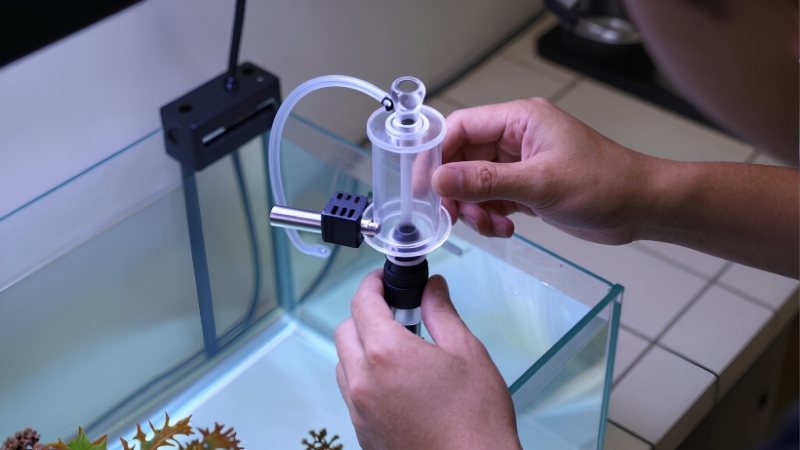
Every system here layers detection differently. The Tunze Osmolator 3 pairs a main sensor accurate to 0.5 mm with an independent safety sensor and a 10 minute safety timer, while the Neptune ATK v2 uses two optical sensors plus a mechanical float valve. Each approach assumes a different failure will happen first.
Red Sea takes another route, using a solid-state titanium conductivity sensor with backup pump-off probes positioned an inch higher. Counting sensors alone is misleading, since the technologies differ and a passive mechanical backup fails differently from a second electronic probe. Layered technologies protect better than duplicates of the same sensor type.
Check Pump Head Against Your Layout
Large reefs often put the reservoir far from the sump. Tunze quotes delivery head of 3.0 metres in standard mode and 6.2 metres in boost, while the Red Sea ReefATO+ pump lists 75 GPH maximum and 8 feet of maximum head at 6 to 10W. Neptune’s ATK v2 uses the PMUP v2 pump on a 24V 36W supply, which is a separate specification again.
Those figures describe different things and are not full-system fill-rate comparisons. Red Sea’s controller normally targets around 18 GPH fill flow rather than the pump’s maximum, which is a deliberate design choice rather than underperformance. Slower, controlled filling is generally safer than moving top-off water quickly.
Insist on a Passive Failure Path
Electronics can stick, and a pump that keeps running is the failure that floods rooms. The Neptune ATK v2 includes a mechanical float valve that closes independently of any sensor, and its kit ships with a siphon break and 4 metres of tubing. Mechanical backups keep working during a power interruption or a controller fault.
Anti-siphon protection matters just as much. Without a siphon break, a reservoir above the sump can continue draining after the pump stops, which turns a modest top-off reservoir into a salinity problem overnight. Position tubing so it cannot siphon even if the check device fails.
Limit the Reservoir Volume
Tunze states no maximum aquarium volume for the Osmolator 3, but that describes the tank rather than the reservoir. The safe practice is keeping stored top-off water to roughly what your system evaporates in a day or two. Evaporation rate is easy to measure across a couple of days.
That single decision caps the damage any failure can cause. A large reef evaporating several gallons daily still only needs a modest reservoir, and there is no advantage in storing a week of fresh water above a running system. Smaller reservoirs also mean you inspect the system more often, which catches problems early.
Top Picks
Three systems plus a note on controller integration cover large-reef needs. Each entry lists manufacturer specifications, a relative price position as of 09/2026, and one genuine drawback.
| Product | Best For | Key Spec | Watch Out For |
|---|---|---|---|
| Tunze Osmolator 3 3154 | Best sensing accuracy | 0.5 mm sensor; safety sensor; 10 min timer | Sensor fits glass up to 15 mm |
| Neptune ATK v2 | Best passive backup | 2 optical sensors plus mechanical float valve | Highest price of the three |
| Red Sea ReefATO+ | Best value with leak detection | Titanium EC sensor; backup probes 1 in higher | Saltwater use only |
| Controller integration | When it matters | Apex optional on ATK; ReefBeat on Red Sea | Standalone operation still essential |
Tunze Osmolator 3 3154: Best Sensing Accuracy
At roughly $250 as of 09/2026, the Osmolator 3 combines a main sensor accurate to 0.5 mm, an independent safety sensor and a 10 minute safety timer that halts pumping if a fill runs too long. Delivery head reaches 3.0 metres standard or 6.2 metres in boost mode. That timer is a genuinely useful backstop against a sensor held in the wrong state.
Its sensor mounts on glass up to 15 mm thick, so confirm your rim or sump wall before ordering. Tunze’s statement that maximum aquarium volume is unlimited refers to the display, not permission to attach an oversized reservoir. Tunze has long parts support, and replacement sensors are available separately.
Neptune ATK v2: Best Passive Backup
Near under $350 as of 09/2026, about 29.6% above the Tunze, the ATK v2 layers two optical sensors with a mechanical float valve that works regardless of electronics. It mounts on glass or acrylic up to 1/4 inch, ships with a siphon break and 4 metres of tubing, and uses a 24V 36W supply with the PMUP v2 pump. That mechanical valve is the feature large-reef owners most often cite.
It is the most expensive option here, and much of that premium buys redundancy rather than speed. It runs standalone through an FMM module, with Apex integration optional rather than required, which matters if you are not already in that ecosystem. The included siphon break and tubing reduce the number of parts you source yourself.
Red Sea ReefATO+: Best Value With Leak Detection
At roughly $225 as of 09/2026, about 10.0% below the Tunze, the ReefATO+ uses a solid-state titanium conductivity sensor with backup pump-off probes an inch higher, temperature sensing to plus or minus 0.1 degrees and a titanium leak detector. Backup probes placed higher give a clear second stopping point.
Its pump lists 75 GPH maximum and 8 feet of head at 6 to 10W, though the controller normally targets roughly 18 GPH during fills. The sensor is specified for saltwater only, so it is not a candidate for freshwater systems or a mixed fish room. Temperature and leak sensing bundled at this price is genuinely unusual.
When Controller Integration Actually Matters
Integration adds logging, alerts and the ability to pause top-off during maintenance. The ATK v2 connects to Apex when you want it, and the ReefATO+ works through ReefBeat, but both function without a full controller installed. Logging evaporation trends also reveals problems like a failing lid or a heater running long.
Judge any system on its standalone safety first. Integration is a convenience layer, and an ATO that depends on cloud connectivity or a controller to stop pumping is carrying a dependency you do not want above a large display. Test the standalone behaviour deliberately before trusting an unattended week away.
Frequently Asked Questions
Four questions decide most large-reef installations: what unlimited volume really means, how much head you need, whether one optical sensor suffices, and why reservoir size should be deliberately restricted.
Does unlimited tank volume mean any reservoir size?
No. Tunze’s statement that maximum aquarium volume is unlimited describes the display the Osmolator 3 can serve, not the amount of top-off water it is safe to store above it. Those are two separate specifications that get conflated constantly.
Reservoir size determines how much water a stuck pump can deliver. Keeping storage to a day or two of evaporation limits both the salinity swing and the flooding risk regardless of what the controller claims to handle. Treat reservoir sizing as a safety decision rather than a convenience one.
How much pump head do I need?
Measure the vertical rise from reservoir to sump plus any horizontal run, then compare against published figures: Tunze quotes 3.0 metres standard and 6.2 metres boost, while Red Sea lists 8 feet maximum head. Reservoirs in a basement below the display change this calculation entirely.
Maximum head is the point where flow stops, so leave margin rather than designing to that limit. Those numbers also come from different test conditions, which means they cannot be ranked against each other as fill-rate comparisons. Fittings, tubing diameter and bends all reduce delivered flow as well.
Is one optical sensor enough on a large reef?
Not for a display of real value. A single sensor is a single point of failure, and salt creep or a stray bubble can hold one in the wrong state long enough to matter. Redundancy is the entire point of an ATO on a large system.
Look for layered protection: a second sensor, a safety timer, or a mechanical float that closes without power. The ATK v2, Osmolator 3 and ReefATO+ each provide a second line in different ways. Clean sensors during every water change to keep salt creep from interfering.
Why limit the reservoir volume?
Because it caps the worst case. Fresh water pumped continuously into a reef drops salinity quickly, and a large reservoir turns a sensor fault into a livestock loss rather than an inconvenience. Large reefs hold more livestock, so the stakes scale with the display.
Add a leak detector and keep the reservoir where a spill reaches a floor drain or tray. On large systems, that combination of limited volume and physical containment protects more effectively than any sensor specification. A drip tray under the reservoir costs very little and contains small failures.
Final Thoughts
The best auto top off system for large reef tanks is the one with the safest failure behaviour, not the fastest fill. The Red Sea ReefATO+ near $225 adds leak detection at the lowest price, Tunze brings 0.5 mm sensing with a safety timer, and Neptune’s ATK v2 backs electronics with a mechanical float.
Ready to decide? Our #1 pick for 2026 is the Tunze Osmolator 3 3154.
Live price & availability on Amazon.
Related Reviews & Guides



6 Best Test Kits For Saltwater Aquarium 2026
Best Reef Light for a 120 Gallon Tank: How to Choose It