Last Updated: September 25, 2026
Best aquarium thermometer selection matters because the number you act on should never be the number the heater believes. Accuracy of about 1 °F (0.5 °C) is the working target here, and an alarm on a stuck heater is worth considerably more to a tank than another decimal place of resolution ever will be.
As an Amazon Associate we earn from qualifying purchases.
As an Amazon Associate we earn from qualifying purchases at no extra cost to you. Prices and availability are accurate as of the date shown and are subject to change.

PAIZOO Aquarium Thermometer Digital, Highly Accurate Fish Tank Thermometer
Selected for "Best Aquarium Thermometer: Accuracy, Display and Alarms": this listing is tanks (PAIZOO Aquarium Thermometer Digital, Highly Accurate Fish Tank Thermom), matching the equipment this article covers.
View on Amazon
AQUANEAT Aquarium Thermometer, Fish Tank Thermometer, Digital Temperature Test, with Large LCD Display (1 Pack)
Selected for "Best Aquarium Thermometer: Accuracy, Display and Alarms": this listing is tanks (AQUANEAT Aquarium Thermometer, Fish Tank Thermometer, Digital Temperat), matching the equipment this article covers.
View on Amazon
QZQ Fish Tank Thermometer Aquarium Thermometer Wireless Touch Stick Digital Aquarium Thermometer LED Display ±1°F for Monitoring The Fish Tank Aquarium Temperature Accessories (Black)
Selected for "Best Aquarium Thermometer: Accuracy, Display and Alarms": this listing is lighting (QZQ Fish Tank Thermometer Aquarium Thermometer Wireless Touch Stick Di), matching the equipment this article covers.
View on Amazon
Penn-Plax Therma-Temp Floating Aquarium Thermometer - Easy to Read - Temperature Gauge with Optional Suction Cup & Removable Mount - Safe for Freshwater & Saltwater Tanks - Multicolor, 4.25 Inches
Selected for "Best Aquarium Thermometer: Accuracy, Display and Alarms": this listing is tanks (Penn-Plax Therma-Temp Floating Aquarium Thermometer - Easy to Read - T), matching the equipment this article covers.
View on AmazonBy David Nguyen
Quick answer: For most people in 2026, the best aquarium thermometer is the Digital with external probe — our #1 rated choice. See the full ranked comparison, alternatives and buying advice below.
Accuracy, Readability and Whether It Warns You
Choosing the best aquarium thermometer is a matter of accuracy, readability and whether the device tells you when something has gone wrong. Four criteria settle it, and the last one is the difference between a gauge and a safeguard.
The Deciding Number: Stated Accuracy
Aim for a device stating around ±1 °F (0.5 °C) or better. That resolution is enough to catch the daily swing limit of 2 °F (1 °C) that most species need held steady, which is the practical reason the thermometer exists at all.
Accuracy claims are worth verifying rather than trusting. An ice water bath sits at 32 °F (0 °C), so a two-minute check against a glass of ice and water tells you immediately whether a device reads true at the low end.
Two More Criteria With Numbers Attached
Readability decides whether it gets checked. A display legible from across the room gets glanced at daily; a glass thermometer with fine markings behind a plant gets read weekly at best, which defeats the purpose of owning one.
Alarm capability is the criterion worth paying for. Heaters fail in both directions, and a device that alerts at a set high and low point converts a tank loss into an inconvenience, particularly overnight or while you are away.
Tank Size, Placement and Fit
Measure the cable run from the probe position to where the display will sit before ordering, since most probe leads are around 3 ft (0.9 m) and a display intended for a nearby shelf may not reach it.
Place the probe away from the heater and away from the filter outflow. Both create local temperature that does not represent the tank, and a probe sitting next to a heater reports the heater rather than the water the fish occupy.
The opposite end of the tank from the heater is usually the right position, since that is the coolest point and therefore the one that matters. A tank correct there is correct everywhere; a tank correct beside the heater may not be.
The Options by How You Will Use It
Four types cover essentially every tank. Each is matched below to a use, because the best aquarium thermometer depends on whether you need a quick daily glance, a precise reading, or an alert while nobody is home.
Digital With External Probe: The General-Purpose Default
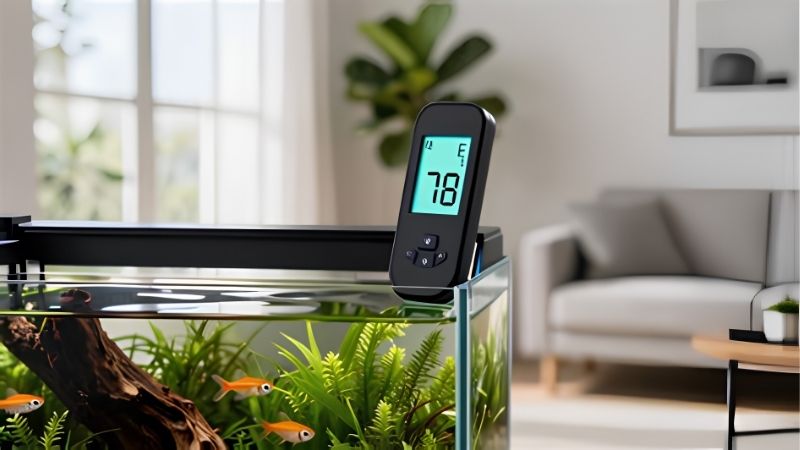
Main numbers: typically ±1 °F (0.5 °C) stated accuracy with a clear display and a probe on a 3 ft (0.9 m) lead. The display sits outside the tank, which makes it far easier to read than anything submerged.
It suits almost every freshwater and marine tank as a primary device. It does not suit anyone unwilling to change a small battery occasionally, and cheap units drift, which is why the ice water check matters more than the printed claim.
Glass Alcohol Thermometer: For Verification
Main numbers: no battery, no drift mechanism, and typically good accuracy for the price. Its real value is as a second opinion against a digital device, since two thermometers disagreeing tells you something a single one cannot.
It suits every tank as a backup, and it is cheap enough to keep one in each. It does not suit poor eyesight or a heavily planted tank, since the markings are fine and the tube is easy to lose behind decor.
LCD Stick-On Strip: For a Rough Indication Only
Main numbers: a strip adhered to the outside glass, reading in 2 °F (1 °C) bands. Because it sits on the glass it is influenced by room temperature as well as tank temperature, commonly reading 2-4 °F (1-2 °C) low.
It suits a rough at-a-glance indication and a backup that cannot break. It does not suit any decision that depends on the actual number, and it should never be the only temperature reference in a tank holding livestock.
Controller or Wireless Unit With Alarm: For Protection
Main numbers: settable high and low alarm points, often with a phone alert, and in controller versions the ability to cut power to a heater that has stuck on. That last function is the strongest argument in this whole category.
It suits reef tanks, expensive livestock and anyone who travels. It does not suit a minimal budget, and it adds a dependency on a network or an app, so keep a simple digital device alongside it as an independent reference.
| Option | Typical accuracy | Readability | Alarm | Best for |
|---|---|---|---|---|
| Digital with external probe | ±1 °F (0.5 °C) | High | Some models | Primary device on most tanks |
| Glass alcohol thermometer | Good, no drift mechanism | Low, fine markings | None | Verifying a digital reading |
| LCD stick-on strip | Often 2-4 °F (1-2 °C) low | Moderate | None | Rough glance, backup only |
| Controller with alarm | ±0.5-1 °F (0.3-0.5 °C) | High | Yes, high and low | Reef tanks, travel, valuable stock |
| Heater dial alone | Can drift 2-4 °F (1-2 °C) | Low | None | Never use as the only reference |
Head to Head, and When Not to Buy
Two types get compared constantly, and there is a case where the thermometer is not the thing to replace. The best aquarium thermometer is often the one you already have, checked against ice water.
Digital Versus Glass
Digital wins on readability and on the option of an alarm, which is what actually protects livestock. It loses on drift, since electronics wander over time and a cheap probe can be several degrees out after a year unnoticed.
Glass wins on having no drift mechanism and no battery, which makes it a reliable second opinion. It loses on being hard to read and easy to break, so it works better as a verification device than as the one you glance at daily.
When a New Thermometer Is the Wrong Fix
Two devices disagreeing does not mean one is broken. Check both against ice water at 32 °F (0 °C) first, since that identifies which is wrong in a couple of minutes and often shows that the older device is still fine.
A tank reading outside range with an accurate thermometer is a heater or placement problem rather than a measurement one. Verify the heater against the checked thermometer and look at where the tank sits before buying anything.
The Cheaper Route That Works
Two inexpensive devices of different types beat one expensive device, because disagreement between them is itself information. A digital probe plus a glass thermometer in the same tank costs very little and catches drift automatically.
The ice water check is free and takes two minutes. Fill a glass with ice and a little water, stir, wait a minute and insert the probe, and anything reading more than about 1 °F (0.5 °C) from 32 °F (0 °C) needs replacing.
Living With It and the 12-Month Cost
The best aquarium thermometer is cheap and its failures are quiet, which is an unhelpful combination. This section covers verification, what drifts, and the safety points that apply to anything with a probe in the water.
Verification and How Often
Check against ice water twice a year, and after any incident where the reading looked wrong. Comparing two devices in the tank is a useful daily habit, but only the ice bath tells you which of them is actually correct.
Record the tank temperature weekly alongside your other readings. A single number tells you very little, while a log shows drift developing across a season and catches a heater losing accuracy before livestock reacts to it.
Take the reading at the same time of day each week. Room temperature moves across a day, so a Monday morning figure and a Friday evening one are not comparable, and that difference alone can look like a heater fault.
What Drifts and What Fails
Digital probes drift gradually, and cheap ones can move 2-4 °F (1-2 °C) across a year with no sign of a fault. Probe leads also corrode at the junction in saltwater, which shows as erratic readings rather than a steady offset.
Stick-on strips fade and lose adhesion within a year or two, and glass thermometers separate in the column if dropped, which is visible as a gap in the liquid. A separated column reads incorrectly and cannot be repaired.
Safety, Batteries and Timing
Keep any mains-powered display or controller on a GFCI outlet with a drip loop in the cable, and route probe leads so they cannot be pulled into the tank. Change batteries on a schedule rather than when the display fades.
On timing, thermometers and controllers see their deepest discounts in late June and again in late November, which suits buying a spare. A sale changes nothing about accuracy, and prices move constantly, so check at the moment of purchase.
Best Aquarium Thermometer Questions
These arrive after a heater incident, which is usually when people start caring about temperature measurement. Every answer about the best aquarium thermometer stays with accuracy and verification rather than with brand claims.
Can I trust the heater dial?
No. Heater dials drift 2-4 °F (1-2 °C) across a year of continuous use, and they report the heater’s own thermostat rather than the tank. Always keep an independent thermometer and set the heater against that.
How do I calibrate one?
Use an ice water bath. Fill a glass with ice and a little water, stir, wait a minute and insert the probe; it should read 32 °F (0 °C). Anything more than about 1 °F (0.5 °C) out needs replacing rather than adjusting.
Are stick-on strips accurate enough?
Not as a primary device. They read the glass, which is influenced by room temperature, and commonly sit 2-4 °F (1-2 °C) below the actual water. They work as a rough backup and nothing more than that.
Do I need an alarm?
It is the most useful feature in the category, particularly for reef tanks or while travelling. Heaters fail in both directions, and an alert at a set high and low point turns a total loss into a phone notification.
See More:
Conclusion
The best aquarium thermometer for most tanks is a digital unit with an external probe stating around ±1 °F (0.5 °C), placed away from the heater and the filter outflow, with a cheap glass thermometer alongside it as a second opinion.
For reef tanks or anyone who travels, a controller with high and low alarms is worth the difference, since it protects against a stuck heater rather than merely reporting one. Verify everything against ice water twice a year.
Ready to decide? Our #1 pick for 2026 is the Digital with external probe.
Live price & availability on Amazon.
Related Reviews & Guides


Best LED Light for Freshwater Aquarium: How to Choose One

Best Aquarium Stand For A 75 Gallon Tank: Top Compared Guide