Last Updated: October 4, 2026
- Top Pick: 1.5 Gallon Aquarium Starter Kits – Plastic Fish Tank Kit Clear Beta Fish Tank Small with Filteration Oxygenation, Water Circulation, Lighting – Beginner's Gift for Guppy, Shrimp, Goldfish
- Best Value: Tetra LED Half Moon 1.1 Gallon Fish Tank Kit for Betta Fish
- Premium Choice: NICREW 2.5 Gallon Nano Nature Aquarium Kit Betta Fish Tank, Complete, Black
Best aquarium size for beginners is a question with a numeric answer rather than a matter of taste. Water volume decides how fast ammonia climbs, how far temperature drifts overnight, and how much a single overfeeding costs you. This comparison ranks common tanks by filled weight, footprint and running cost.
As an Amazon Associate we earn from qualifying purchases.
As an Amazon Associate we earn from qualifying purchases at no extra cost to you.




By David Nguyen
What Decides the Best Aquarium Size for Beginners
The best aquarium size for beginners comes down to four numbers: usable water volume, outside footprint, filled weight, and the equipment the tank forces you to buy. Every other argument about a first tank sits downstream of those four figures, so settle them first.
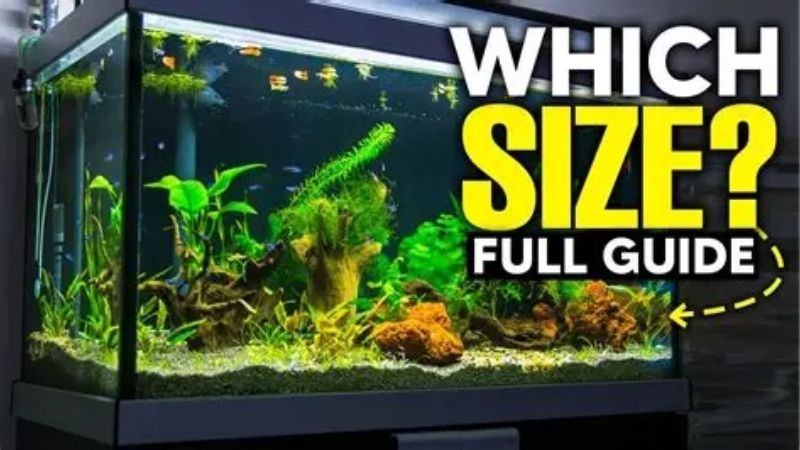
The four numbers that settle the choice
Volume comes first, and the figure on the box is optimistic. A tank sold as 20 gallons (76 L) holds roughly 17 to 18 gallons (64 to 68 L) once substrate and hardscape displace water, so dosing and stocking estimates should use the smaller number, not the label.
Filled weight ends more projects than any other figure. Budget about 10 lb per US gallon (roughly 1.2 kg per litre) with glass and substrate counted, which puts a 20 gallon (76 L) tank near 225 lb (102 kg) and a 55 gallon (208 L) tank past 600 lb (272 kg) when filled.
Footprint outranks height, and the equipment list closes the set with a filter moving four to six times tank volume per hour, a heater at 3 to 5 W per gallon, dechlorinator for every refill, and a liquid test kit. A tank missing those items is furniture, not an aquarium.
Why volume buys margin for error
The same mistake costs different amounts in different volumes. One uneaten pellet decaying in 5 gallons (19 L) drives ammonia several times higher than in 29 gallons (110 L), because concentration is mass divided by water, and a nano tank has almost none to divide by.
Temperature behaves the same way. A 5 gallon (19 L) tank tracks room temperature within an hour or two, while 40 gallons (151 L) coasts through a cold night with a fraction of the swing. Fish tolerate steady numbers far better than correct averages with daily spikes.
Tank size, placement and fit
Measure the stand top, the gap behind the tank and the clearance above it before ordering anything, because nothing returns once it holds water. Hang-on-back filters want 4 to 6 in (10 to 15 cm) of open wall, and canisters need cabinet height plus hose bends.
Floor loading is not theoretical. A 55 gallon (208 L) tank with stand and substrate concentrates 600 to 700 lb (272 to 318 kg) onto roughly 4 sq ft (0.37 sq m), routine in a house and a real question in an older upper-floor flat. Set tanks across joists, never along one.
Housing rules cap the answer for some readers. Many United States colleges limit dormitory aquariums to around 10 gallons (38 L) and restrict high-wattage equipment, which is why nano kits sell hardest from late July to early September. Check the handbook first.
Beginner Tank Sizes Compared by Need Group
Rankings help less than matching a tank to a household, so the best aquarium size for beginners is grouped below by need. The table sorts realistic sizes by the numbers that constrain you, and each section names the buyers it should send elsewhere.
| Tank size | Footprint and filled weight | Filter target (4-6x) | Recurring load | Fits who |
|---|---|---|---|---|
| 5 gallon (19 L) | 16 x 8 in (40 x 20 cm), 55 lb (25 kg) | 20-30 GPH (76-114 LPH) | Small doses, weekly testing | One betta, desk or shelf |
| 10 gallon (38 L) | 20 x 10 in (51 x 25 cm), 110 lb (50 kg) | 40-60 GPH (151-227 LPH) | Low volume, no margin | Dorms and tight rooms |
| 20 gallon high (76 L) | 24 x 12 in (61 x 30 cm), 225 lb (102 kg) | 80-120 GPH (303-454 LPH) | Moderate, weekly change | Short shelves, mid-water fish |
| 20 gallon long (76 L) | 30 x 12 in (76 x 30 cm), 225 lb (102 kg) | 80-120 GPH (303-454 LPH) | Moderate, weekly change | Most first-time keepers |
| 29 gallon (110 L) | 30 x 12 in (76 x 30 cm), 330 lb (150 kg) | 116-174 GPH (439-659 LPH) | Deeper cleaning reach | Display tanks, taller plants |
| 40 gallon breeder (151 L) | 36 x 18 in (91 x 46 cm), 450 lb (204 kg) | 160-240 GPH (606-908 LPH) | Larger changes and top-off | Keepers with floor space |
| 55 gallon (208 L) | 48 x 13 in (122 x 33 cm), 625 lb (283 kg) | 220-330 GPH (833-1249 LPH) | Highest water and power use | Committed to staying put |
For desks and dorm rooms: 5 to 10 gallons
A 5 gallon (19 L) at 16 x 8 in (40 x 20 cm) and about 55 lb (25 kg) filled is the only size that sits safely on ordinary furniture, and holds one betta with a sponge filter and a 25 W heater. A 10 gallon (38 L) doubles that and still fits most dormitory limits.
Neither size suits anyone who travels often, forgets feedings, or wants a school of tetras. Parameters here move within hours rather than days, so these tanks demand more testing discipline than a 29 gallon, the reverse of what most buyers assume.
For most first tanks: the 20 gallon long
The 30 x 12 in (76 x 30 cm) footprint is the reason this tank wins. It holds the same water as a 20 gallon high but adds roughly a quarter more floor and surface area, which gives corydoras usable territory and improves gas exchange on warm nights.
Its weakness is the stand. At roughly 225 lb (102 kg) filled it needs a purpose-built stand or furniture rated for the load, and the 30 in (76 cm) length rules out most desks. Buyers without that footprint should choose a 10 gallon rather than a taller tank.
For stability and display: 29 to 55 gallons
A 29 gallon (110 L) shares the 20 long footprint but stands 18 in (46 cm) tall at about 330 lb (150 kg) filled, while a 40 gallon breeder spreads 36 x 18 in (91 x 46 cm). Both buffer swings better, and the breeder is the best stability-per-footprint shape.
Depth is the trade-off. Reaching the substrate at 18 in (46 cm) means wet shoulders or long tools, and lighting must be chosen on PAR at that depth, not watts. A 55 gallon (208 L) past 600 lb (272 kg) is effectively permanent, so it belongs with a stable address.
Head-to-Head Sizes and Who Should Skip the Upgrade
Two decisions cause most of the regret over the best aquarium size for beginners: choosing a tall tank when a long one was needed, and buying more glass than the household can support. Both are settled by measurement, and both have cheaper alternatives.
20 gallon long versus 20 gallon high
These hold identical water and behave differently. The long measures 30 x 12 x 12 in (76 x 30 x 30 cm) and the high measures 24 x 12 x 16 in (61 x 30 x 41 cm). The long offers a quarter more floor and surface area, which changes stocking and oxygenation, not just looks.
When a bigger tank is the wrong call
Bigger is more stable, and stability is not the only variable. If you rent, move each year, or live above the ground floor in an older building, a 40 or 55 gallon tank turns a hobby into a logistics problem, and every breakdown risks a failed reseal.
The honest threshold is this: buy the largest tank you can service weekly, place permanently, and lift with the help you actually have. Someone who maintains a 20 gallon long every Sunday keeps healthier fish than the owner of a neglected 55 gallon.
Cheaper routes that still work
Used glass is often sound, though silicone degrades with age, so leak-test outdoors for 24 hours first. Buying parts separately also beats an all-in-one kit, since most kits omit a heater and a test kit while fitting an undersized filter. Price those gaps first.
Running Costs, Failure Points and the 12-Month View
An aquarium runs continuously, so the best aquarium size for beginners is partly a question of what breaks and what recurs rather than what it costs to buy. The pattern holds across sizes: consumables scale with water volume, while risk concentrates in a few components.
What fails first at each size
Heaters are the most dangerous failure because they fail in two directions. Stuck on, they overheat a small volume quickly; stuck off, they let it drop overnight. Stands fail more quietly: MDF swells wherever spilled water sits, and a swollen top loads the seams unevenly.
Seasonal power loss belongs here. Atlantic hurricane season runs June through November, and winter storms do the same, stopping filters and dropping oxygen within hours. Filter bacteria live in the media and start dying once flow stops, so a battery air pump protects biology.
Consumables scale with the water column
Dechlorinator, test reagents, filter floss, food and replacement media scale with volume and stocking. A 55 gallon tank uses roughly five times the dechlorinator of a 10 gallon on the same schedule, and each change takes longer, a cost paid in time.
Winter shifts these numbers. Once indoor heating runs, dry air accelerates evaporation, top-off frequency climbs, and dissolved minerals concentrate in the water that remains. Heater wattage should be chosen against the coldest room the tank will see.
Warranty, certification and electrical safety
Warranty terms usually separate the housing from moving parts, and exclude consumables like cartridges and airstones. Check whether replacement impellers, gaskets and suction cups are sold individually, since that decides whether a noisy filter is a repair or a write-off.
Every powered device beside water should carry a recognised safety certification such as UL or ETL. Pair that with a GFCI outlet and a drip loop, so water tracking down a cable falls to the floor instead of the socket. This applies at 5 gallons as much as 55.
Timing a purchase is reasonable. Prime Day in late June and Black Friday in late November are the two points when tanks and canisters see real reductions. None of it shortens biology: a discounted tank still needs three to eight weeks to cycle before fish go in.
Frequently Asked Questions
These questions surface once the choice has narrowed to two or three sizes. Each answer stays with measurable figures rather than preference, so you can check them against the room, the shelf and the floor you actually have before anything is ordered.
What is the best aquarium size for beginners with only desk space?
A 10 gallon (38 L) at 20 x 10 in (51 x 25 cm) is the practical floor for a community tank, and 5 gallons (19 L) suits a single betta. Below that, parameters swing faster than most people test, and the tank becomes harder to run rather than easier.
Is a 20 gallon tank really easier than a 10 gallon?
Yes, measurably. Twice the water dilutes the same waste to half the concentration and slows temperature swings, so mistakes appear as small readings instead of emergencies. The trade-off is a 30 in (76 cm) footprint and roughly 225 lb (102 kg) of filled weight on a proper stand.
Do larger tanks cost much more to run?
Recurring cost scales with volume. Expect more dechlorinator, more food, and a higher-wattage heater working against the same room temperature. Power draw is dominated by heater duty cycle, while filters typically pull single-digit watts continuously.
Can I put a 55 gallon tank upstairs?
Often yes in a modern house, with caution in older buildings. Roughly 625 lb (283 kg) across a small footprint should sit perpendicular to the joists and against a load-bearing wall. If the floor flexes underfoot, choose a 29 or 40 gallon rather than guessing.
See More:
Choosing Your Tank
The best aquarium size for beginners, for most households, is a 20 gallon long at 30 x 12 in (76 x 30 cm) and roughly 225 lb (102 kg) filled, paired with a filter moving 80 to 120 GPH (303 to 454 LPH) and a 100 W heater. It gives real margin without a dedicated room.
If space or budget rules that out, a 10 gallon (38 L) is the lower-cost answer, with tighter stocking and more testing. Either way, size the stand for filled weight, keep a written maintenance schedule, and follow the 20 gallon setup walkthrough once the tank arrives.
Ready to decide? Our #1 pick for 2026 is the 5 gallon (19 L).
Live price & availability on Amazon.
Related Reviews & Guides

8 Best Aquarium Air Pumps: Top Picks Reviewed and Compared (2026)
Aqueon vs Tetra Aquarium Kits Which Is Better: Top Compared