Last Updated: September 25, 2026
Best aquarium heater decisions are usually made on wattage alone, when the numbers that matter most are temperature accuracy and what the unit does when it fails. A heater that sticks on cooks a tank in hours, so this comparison ranks options by sizing, control accuracy and failure behaviour rather than by feature lists.
As an Amazon Associate we earn from qualifying purchases.
As an Amazon Associate we earn from qualifying purchases at no extra cost to you. Prices and availability are accurate as of the date shown and are subject to change.

hygger Small Aquarium Betta Heater, Submersible Fish Tank Heater 10W/25W/50W/100W with LED Digital Display, Suitable for Marine Saltwater and Freshwater up to 5/10/16/26 Gallon
Selected for "Best Aquarium Heater: Watts, Accuracy and Safety Compared": this listing is heating (hygger Small Aquarium Betta Heater, Submersible Fish Tank Heater 10W/2), matching the equipment this article covers.
View on Amazon
HiTauing Aquarium Heater, 50W/100W/200W/300W/500W Submersible Fish Tank Heater with Over-Temperature Protection and Automatic Power-Off When Leaving Water for Saltwater and Freshwater
Selected for "Best Aquarium Heater: Watts, Accuracy and Safety Compared": this listing is heating (HiTauing Aquarium Heater, 50W/100W/200W/300W/500W Submersible Fish Tan), matching the equipment this article covers.
View on Amazon
HiTauing Aquarium Heater, 300W Fish Tank Heater with LED Digital Display & 5 Safety Protection, Submersible Aquarium Heater with 2 Suction Cup and 8.2Ft Cord for 40-75 Gallon Fish Tank.
Selected for "Best Aquarium Heater: Watts, Accuracy and Safety Compared": this listing is heating (HiTauing Aquarium Heater, 300W Fish Tank Heater with LED Digital Displ), matching the equipment this article covers.
View on Amazon
DaToo Mini Aquarium Heater 25W Small Fish Tank Heater 25 Watt with Free Thermometer Sticker
Selected for "Best Aquarium Heater: Watts, Accuracy and Safety Compared": this listing is heating (DaToo Mini Aquarium Heater 25W Small Fish Tank Heater 25 Watt with Fre), matching the equipment this article covers.
View on AmazonBy David Nguyen
Quick answer: For most people in 2026, the best aquarium heater is the Adjustable glass submersible — our #1 rated choice. See the full ranked comparison, alternatives and buying advice below.
Wattage, Accuracy and What Happens When It Fails
Choosing the best aquarium heater starts with two figures and a single behaviour: how many watts the tank needs, how close the unit holds the set temperature, and what happens when the thermostat sticks. Everything else printed on the packaging is secondary to those three points.
The decisive numbers: wattage and temperature difference
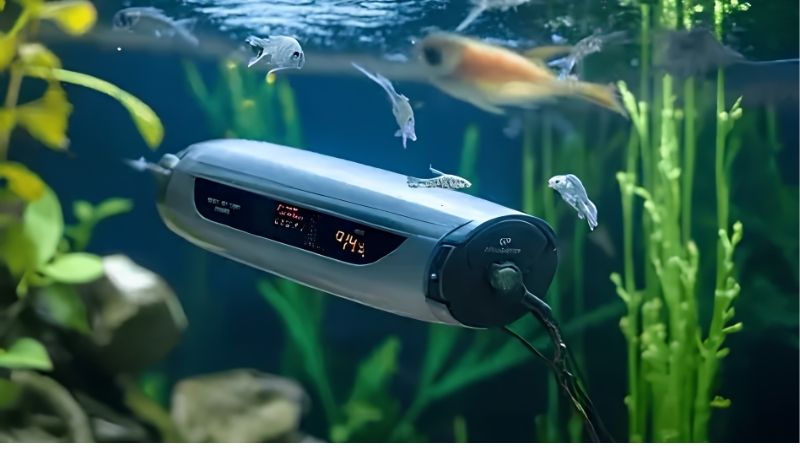
The best aquarium heater for a tank is sized against the gap between room temperature and target temperature, not against volume alone. The working baseline is 3–5 watts per US gallon for a rise of about 10 °F (5.5 °C), so a 20 gallon (76 L) tank standing in a 68 °F (20 °C) room typically needs around 75–100 W.
Target temperature for most tropical community fish sits at 76–80 °F (24–27 °C). A room that already holds 74 °F (23 °C) needs far less heater than a garage or a poorly insulated bedroom at 60 °F (15.5 °C), which is why the same tank size turns up recommended with quite different wattages.
Accuracy, auto shut-off and build, each with a number
Accuracy is the quietly important figure here. Budget heaters commonly drift ±2–4 °F (roughly 1–2 °C) from the dial setting and that error tends to grow over time, which means the dial is only a starting point and a separate thermometer is not optional equipment in any setup at all.
Two build features matter more than the rest: automatic shut-off when the unit is exposed to air, and a shatter-resistant body. Both address the same scenario, which is a heater left running during a water change, and that single event accounts for a large share of heater failures.
Tank size, placement and physical fit
The heater has to fit comfortably below the working water line. Compare the heated length of the unit against your actual water depth, since many units must be fully submerged, and place it in the flow path near the filter outflow so warmed water circulates instead of forming a warm pocket.
Weight and access to the tank set the rest. A full tank runs near 10 lb per gallon (about 1 kg per L), so a 55 gallon (208 L) setup passes 600 lb (272 kg) and needs a proper stand. Measure water depth against heater length with a tape before ordering, and leave a drip loop in the cable.
| Option | Main number | Tank it suits | Recurring cost | Who it fits |
|---|---|---|---|---|
| Adjustable glass submersible | 3–5 W per gallon | 10–40 gal (38–151 L) | None, replace on failure | Standard community tanks |
| Shatter-resistant body | Same wattage, tougher case | Any, especially large fish | None | Cichlids, goldfish, turtles |
| Titanium with controller | Controller accuracy, often ±1 °F | 40 gal (151 L) and up | Probe replacement over years | Large or high-value stock |
| Preset nano heater | Fixed near 78 °F (26 °C) | Under 10 gal (38 L) | None | Betta and shrimp tanks |
| Two smaller units split | Half the wattage each | 55 gal (208 L) and up | Two units to replace | Anyone wanting redundancy |
The Options, Grouped by Who They Suit
There is no single best aquarium heater that will suit every tank, because room temperature, stocking and the consequences of a failure all differ so enormously. Each option below is matched to a particular group of keepers, together with the limitation that comes attached to it.
Adjustable glass submersibles, for standard community tanks
This is the default category and it covers the majority of freshwater tanks between 10 and 40 gallons (38–151 L). Adjustable models let you set a precise target rather than accepting a factory value, which matters when species ranges differ or when a tank runs slightly cool in winter.
The limitation is the glass body itself. It cracks if the unit is left running when water level drops during a maintenance session, and the cheaper examples drift ±2–4 °F (1–2 °C) from the dial. Neither is a reason to avoid the category, but both make a separate thermometer essential.
Shatter-resistant bodies, for large or boisterous fish
Composite and coated units trade a little size for a body that survives impact and exposure far better. In tanks holding large cichlids, goldfish or anything that rearranges décor, this is worth more than any accuracy claim, because the common failure in those tanks is physical damage rather than drift.
They tend to cost more for the same wattage and are often bulkier, which matters in a small tank where the unit becomes visually dominant. Accuracy is not automatically better either, so treat toughness and thermostat precision as two entirely separate specifications rather than one.
Titanium units with an external controller, for larger tanks
Separating the heating element from the thermostat is the most reliable arrangement generally available. The controller holds temperature far more tightly, often within about 1 °F (0.5 °C), and a titanium element is effectively unbreakable, which suits tanks above 40 gallons (151 L).
The drawback is cost and complexity: two components, an external probe that must stay clean, and a failure mode where a fouled probe reports the wrong temperature. Probes need periodic wiping, and a mineral-coated probe in hard water is a genuine source of slow calibration drift.
Preset nano heaters, for tanks under 10 gallons
Small preset units hold a fixed temperature near 78 °F (26 °C) and suit betta and shrimp tanks where adjustable models are physically too long. Removing the dial also removes the most common user error of all, which is a knob nudged during maintenance and then not noticed for days.
The limitation is obvious enough: no adjustment at all. Species needing a cooler or warmer range are out of scope, and a preset unit in an already warm room can overshoot. Small tanks swing faster than large ones, so check with a thermometer every day for the first week after installing one.
Direct Comparison and Who Should Not Buy
Most confusion about the best aquarium heater comes down to a single product pairing and to one question about whether a heater is needed at all. Settling both saves more money than any discount, and it prevents the common mistake of buying a larger unit than the room actually requires.
Glass against shatter-resistant bodies
For a calm community tank in a stable room, glass is entirely adequate and cheaper for the same wattage. For a tank with large fish, or a household where the heater might get knocked during cleaning, the tougher body earns its price because it removes the most likely failure of the lot.
Neither of these choices fixes accuracy on its own. Both categories contain units that drift, so the deciding factor between two models is whether the thermostat holds within a stated tolerance and whether the unit shuts off when it is exposed, not what the body happens to be made from.
When a bigger or better heater is the wrong purchase
Oversizing carries a real risk. A heater far larger than the temperature difference requires will raise the tank faster if the thermostat sticks on, so matching wattage to the actual room gap is a safety decision rather than an efficiency one, particularly in tanks under 20 gallons (76 L).
Some tanks need no heater at all. A room that holds steady inside the species range, or a tank stocked with subtropical species such as white cloud mountain minnows, may be better served by a thermometer and careful observation than by adding another powered device beside the water.
Cheaper approaches that genuinely work
A separate glass or digital thermometer costs very little and does more for safety than upgrading the heater, because it reveals the drift that the dial hides completely. Checking it daily for the first week after any change is the single most useful habit in this part of the hobby.
Reducing the temperature gap is the other genuinely free improvement. A tank moved away from a draughty window or from a cold external wall, or fitted with a lid to slow down evaporative cooling, needs less wattage and puts far less run time on the heater across the whole winter.
Operation, Failure Points and Twelve Month Ownership
Heaters run continuously through the cold months, so the honest measure of the best aquarium heater is how it behaves at month twelve and how it fails. Unlike filters they have almost no consumables at all, which means the entire cost picture sits in reliability and eventual replacement.
The two failure modes that matter
A heater can fail on or fail off, and the first is far more dangerous. A stuck thermostat with no cut-out will push a small tank well past safe temperature within hours, which is why an automatic shut-off and correct wattage sizing both function as safety features rather than conveniences.
Failing off is slower and far more survivable, showing up as a gradual decline that any thermometer will catch. The classic physical failure sits between the two: a glass body cracked by exposure during a water change, which usually trips the circuit rather than heating anything at all.
What wears out and what cannot be replaced
Thermostat calibration drifts over years, so a unit that held 78 °F (26 °C) when new may sit two degrees off by its third winter without giving any visible sign of it. Suction cups harden and let go, dropping the heater against substrate or glass, which is a common cause of cracking.
Almost nothing here is user-serviceable. Sealed units are replaced rather than repaired, and only controller-based systems offer a separate probe or element as a spare part. That makes warranty terms and the availability of replacement probes a genuine differentiator between options.
Certification, electrical safety and buying at the right time
Any powered device sitting in water should carry recognised safety certification such as UL or ETL, run through a residual current device or GFCI outlet, and have a drip loop in the cable. These are not optional extras in any room where water and mains electricity share the same surface.
Equipment discounts cluster into a few events, with late November being the deepest of the year for tank hardware. Buying then is sensible, but it changes nothing biologically: a new tank still needs 3–8 weeks of cycling before any fish go in, and prices move, so check them at the time of purchase.
Frequently Asked Questions
These questions come up repeatedly once people stop shopping on wattage figures alone entirely, because the practical choice of best aquarium heater usually turns on room temperature, on failure behaviour, and on whether the household actually checks a thermometer between water changes.
How many watts do I actually need?
Start at 3–5 watts per US gallon for a rise of about 10 °F (5.5 °C), then adjust that for your own room. A 20 gallon (76 L) tank in a 68 °F (20 °C) room needs roughly 75–100 W, while the same tank standing in a 74 °F (23 °C) room can be held comfortably by considerably less wattage.
Should I unplug the heater during a water change?
Yes, whenever the water level is going to drop below the unit. Switch it off, wait a few minutes before the level falls, and allow it to return to tank temperature before switching it back on. This single habit prevents most cracked heater bodies and most premature thermostat failures.
Do I still need a thermometer?
Always, without exception. The dial reports what the heater was told, not what the water is actually doing, and drift of ±2–4 °F (1–2 °C) is common in budget units. Place the thermometer well away from the heater so that it reads circulated water rather than the warm plume leaving the element.
Is one large heater better than two small ones?
Above roughly 40 gallons (151 L), two smaller units are usually safer. A single stuck-on heater rated for the whole tank raises temperature quickly, whereas two half-rated units fail more gracefully in both directions, at the cost of a second device and a second position in the tank.
See More:
Conclusion
For most freshwater tanks the sensible default among the best aquarium heater options is an adjustable submersible sized at 3–5 watts per gallon for your actual room gap, with automatic shut-off and a separate thermometer. The budget choice is a preset unit in tanks under 10 gallons (38 L).
Ready to decide? Our #1 pick for 2026 is the Adjustable glass submersible.
Live price & availability on Amazon.
Related Reviews & Guides


Best Budget Pond Filter System: Reliable Low-Cost Picks
Best Submersible Aquarium LED Light: Top IP68 Top Picks