Last Updated: September 25, 2026
Best 5 gallon aquarium kit comparisons should start with what is missing rather than what is included. Almost every kit at this size ships without a heater and without a test kit, which are the two items that decide whether the tank survives its first month. Budget both before comparing one box against another.
As an Amazon Associate we earn from qualifying purchases.
As an Amazon Associate we earn from qualifying purchases at no extra cost to you. Prices and availability are accurate as of the date shown and are subject to change.

Marineland Portrait Glass LED Aquarium Kit, 5 Gallons, Hidden Filtration,Black
Selected for "Best 5 Gallon Aquarium Kit: Options Compared by Numbers": this listing is lighting (Marineland Portrait Glass LED Aquarium Kit, 5 Gallons, Hidden Filtrati), matching the equipment this article covers.
View on Amazon
Koller Products 5-Gallon Aquarium Kit with LED Lighting and Power Filter, Ideal for a Variety of Tropical Fish
Selected for "Best 5 Gallon Aquarium Kit: Options Compared by Numbers": this listing is filtration (Koller Products 5-Gallon Aquarium Kit with LED Lighting and Power Filt), matching the equipment this article covers.
View on Amazon
5 Gallon Glass Aquarium Starter Kit, Rimless Fish Tank
Selected for "Best 5 Gallon Aquarium Kit: Options Compared by Numbers": this listing is tanks (5 Gallon Glass Aquarium Starter Kit, Rimless Fish Tank), matching the equipment this article covers.
View on Amazon
Aqueon MiniBow Small Aquarium Starter Kit, All-in-One Desktop Fish Tank for Betta, Shrimp or Small Fish, Includes SmartClean Filter Technology, LED Light and Conditioner, Black, 5 Gallon
Selected for "Best 5 Gallon Aquarium Kit: Options Compared by Numbers": this listing is filtration (Aqueon MiniBow Small Aquarium Starter Kit, All-in-One Desktop Fish Tan), matching the equipment this article covers.
View on AmazonBy David Nguyen
Quick answer: For most people in 2026, the best 5 gallon aquarium kit is the All-in-one rimless — our #1 rated choice. See the full ranked comparison, alternatives and buying advice below.
Costing the Finished Tank, Not the Box
Judging the best 5 gallon aquarium kit means costing the finished tank rather than the box. Four numbers matter: real water volume, loaded filter flow, whether the filter takes loose media, and the total spend needed to reach a working setup.
The Deciding Numbers: Real Volume, Flow and Heater Wattage
A 5 gallon (19 L) tank at 16 x 8 x 10 in (41 x 20 x 25 cm) holds roughly 4-4.5 gallons (15-17 L) once substrate, hardscape and the surface gap are subtracted. Every other figure should be calculated against that working volume rather than the label.
Turnover targets 4-6 times per hour, so 20-30 GPH (76-114 LPH) loaded. Kit filters are typically rated 45-70 GPH (170-265 LPH), which lands correctly once loaded flow drops 30-50%. Heater sizing is 3-5 W per gallon, giving 25-50 W, and it is almost never included.
Two More Criteria With Numbers Attached
Media type is the criterion that decides 12-month cost. A filter taking a proprietary cartridge forces a monthly purchase and discards the bacterial colony each time, while an open basket lets you run sponge, then ceramic media, then carbon only when needed.
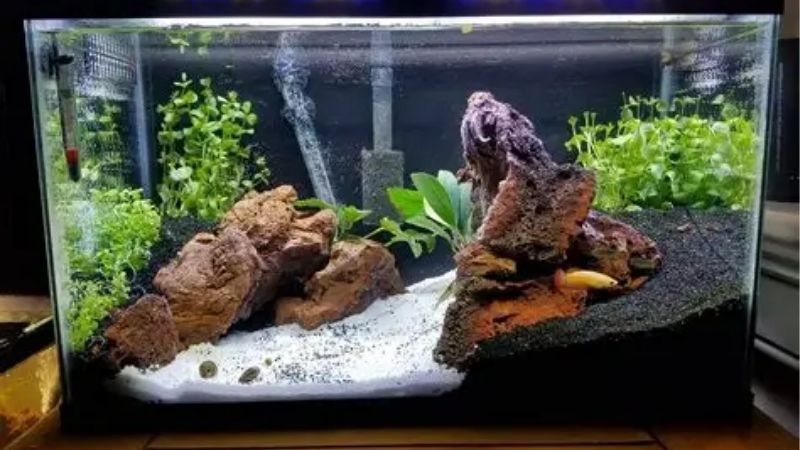
Light output decides what will grow. Kit lights are generally low-output fixtures suiting 15-30 PAR species such as anubias, java fern and moss. That is adequate and arguably ideal, since a strong light without CO2 in a small tank produces algae.
Tank Size, Placement and Fit
Measure the shelf or desk against the 16 x 8 in (41 x 20 cm) footprint and check it can carry 50 lb (23 kg) before ordering, since a filled 5 gallon weighs more than most people estimate and desks flex under a concentrated load.
Check the lid arrangement carefully. A close-fitting lid slows evaporation, which is the main source of instability at this volume, and any gap around a filter or heater cable becomes an escape route for a betta and a fast route to a dropped water line.
The Options by Configuration
Kits at this size fall into four configurations. Each is matched below to a use, since the best 5 gallon aquarium kit depends on whether you want an integrated display, the cheapest working setup, low flow for a betta, or full control of every part.
All-in-One Rimless Kit With Integrated Filter Chamber
Main numbers: filtration hidden in a rear compartment holding 0.2-0.4 gallons (0.8-1.5 L) of media, pump typically 40-70 GPH (151-265 LPH), and low-iron glass with no plastic frame. Media chambers are open, so loose sponge and ceramic media both fit.
It suits a desk display where equipment should be invisible and where loose media matters. It does not suit a tight budget, since it is the most expensive configuration here, and the rear chamber reduces usable display volume by a further half gallon or so.
Basic Kit With Hang-on-Back Filter and LED Lid
Main numbers: filter rated 45-70 GPH (170-265 LPH), a lid-mounted low-output LED, and a plastic-framed tank. This is the cheapest route to a working tank and the configuration most commonly sold as a first aquarium or as a gift.
It suits anyone starting out who accepts buying a heater separately. It does not suit anyone unwilling to modify the filter, since these units almost always use a proprietary cartridge that must be replaced with sponge and loose media to avoid the monthly cost.
Kit With Internal Filter and Adjustable Outflow
Main numbers: an internal pump rated 40-60 GPH (151-227 LPH) with a flow control, occupying roughly 5% of the tank interior. The adjustable outflow is the point, since it solves the current problem that long-finned fish have in a small tank.
It suits a betta tank specifically, where flow control matters more than media volume. It does not suit planted or shrimp setups needing maximum biological capacity, because an internal housing trades media space for a compact footprint inside the glass.
Bare Tank Plus Chosen Equipment
Main numbers: the same 5 gallon (19 L) tank with a filter, heater and light selected individually, usually for a similar total to a mid-range kit. Nothing is wasted on components you would replace, and everything takes standard consumables.
It suits anyone who has kept a tank before and knows what they want. It does not suit a first purchase, since the component matching is exactly the work a kit exists to remove, and a mismatched filter or light costs more than the saving.
| Option | Filter flow | Media type | Usually missing | Best for |
|---|---|---|---|---|
| All-in-one rimless | 40-70 GPH (151-265 LPH) | Loose, open chamber | Heater, test kit | Desk display, hidden equipment |
| Basic hang-on-back kit | 45-70 GPH (170-265 LPH) | Proprietary cartridge | Heater, test kit, substrate | Lowest entry cost |
| Internal filter kit | 40-60 GPH (151-227 LPH) | Small cartridge or sponge | Heater, test kit | Betta tanks needing low flow |
| Bare tank plus parts | Your choice | Loose | Nothing, you choose it | Second tank, experienced keeper |
| Any kit, as supplied | Adequate | Varies | Dechlorinator, thermometer | Budget the extras before buying |
Head to Head, and What Every Kit Leaves Out
Two configurations get compared constantly, and there is a list of omissions common to all of them. Assessing the best 5 gallon aquarium kit honestly means adding those omissions to the price of each box before any comparison between them is made.
All-in-One Versus Basic Hang-on-Back
The all-in-one wins on appearance and on media flexibility, since the rear chamber takes loose sponge and ceramic media from the start. It loses on price and on usable display volume, giving up perhaps half a gallon to the filter compartment.
The basic kit wins on cost and on serviceability, since everything is visible and reachable. It loses on the cartridge, which is a recurring purchase and a recurring small ammonia spike unless you replace it with loose media in the first week.
What Every Kit at This Size Leaves Out
A heater is missing from almost every 5 gallon kit, and it is not optional in a room that swings across the day. Budget 25-50 W. A liquid test kit is also missing, and without it there is no way to know when cycling has finished.
Add dechlorinator, a thermometer independent of any heater dial, and usually substrate. Those four items together frequently cost more than a budget kit itself, which is the single most useful thing to know before comparing prices between boxes.
The Cheaper Route That Works
Buy the cheapest kit with a filter you can convert to loose media, then spend the saving on a heater and a liquid test kit. Those two purchases affect survival far more than any difference between one kit tank and another at this size.
Convert the cartridge slot in the first week. Cut coarse sponge to fit, add a small bag of ceramic media behind it, and rinse both in old tank water thereafter. That single change removes the largest recurring cost the kit was designed around.
Running It and the 12-Month Cost
The best 5 gallon aquarium kit is a starting point rather than a finished system, so what matters is how it behaves after six months rather than on day one. This section covers what fails, what you keep buying, and the electrical safety points that apply to every configuration above.
What Fails First
Small pumps collect grit and lose flow gradually, and the impeller in an integrated rear chamber is often awkward to reach. Loaded flow can fall below the 20-30 GPH (76-114 LPH) target with no change in noise, showing up as nitrate climbing instead.
Lid-mounted LEDs corrode at the contacts in a humid tank and dim over two to three years rather than failing outright. Heaters bought separately drift 2-4 °F (1-2 °C) across a year, which at this volume moves the tank noticeably.
Consumables and the Cartridge Trap
The largest 12-month cost difference between two otherwise similar kits is whether the filter takes cartridges or loose media. Cartridges are a monthly purchase, cannot be staged mechanically then biologically then chemically, and discard the colony every time.
That is a biological cost as well as a financial one. Established tanks often show a small ammonia rise a few days after a cartridge change, which in 4 gallons (15 L) of actual water is a genuine risk to livestock rather than a curiosity.
Electrical Safety and Timing
Every powered device beside water should carry a recognised certification such as UL or ETL, sit on a GFCI outlet, and have a drip loop formed in its cable. Heaters with automatic shut-off when uncovered are worth the difference at this volume.
On timing, small kits discount most deeply in late June and again in late November, and they are marketed heavily as gifts through December. A sale never shortens the three to eight weeks of cycling the tank still needs, and prices move constantly.
Best 5 Gallon Aquarium Kit Questions
These arrive while the kit is still in the basket. Every answer about the best 5 gallon aquarium kit stays with real volume, loaded flow and missing items, since those three decide the outcome far more than any feature list printed on a box.
Is a 5 gallon kit good for a beginner?
It is workable but not the easiest option. A small volume swings faster than a larger one, so the weekly change has to actually happen. A 10 gallon (38 L) kit costs slightly more and gives roughly twice the margin for a mistake.
Does the kit include a heater?
Almost never at this size, and the omission is rarely stated on the front of the box. Budget a 25-50 W unit separately, sized at 3-5 W per gallon, and verify it against an independent thermometer rather than trusting the dial once running.
Can I keep a betta in a 5 gallon kit?
Yes, with a heater holding 78-80 °F (26-27 °C) and the filter outflow diffused. This is the size and species combination kits are effectively designed around, provided the two missing items are bought at the same time as the box.
Should I replace the filter cartridge?
Replace the approach rather than the filter itself. Fit coarse sponge and a small bag of ceramic media into the cartridge slot during the first week, then rinse both in old tank water thereafter rather than buying replacements every month.
See More:
Conclusion
The best 5 gallon aquarium kit is an all-in-one with an open media chamber where budget allows, since loose media removes the recurring cartridge cost and the ammonia rise that comes with it. Aim for 20-30 GPH (76-114 LPH) loaded turnover.
On a tight budget, the cheapest hang-on-back kit converted to loose media in week one performs almost as well. Either way, add a 25-50 W heater, a liquid test kit, dechlorinator and a thermometer to the price before comparing one box against another.
Ready to decide? Our #1 pick for 2026 is the All-in-one rimless.
Live price & availability on Amazon.
Related Reviews & Guides
Best Aquarium for Hard Water Fish: Top Compared Size Guide
Aquarium Stand Weight Capacity: A Safety Checklist