Last Updated: October 4, 2026
- Build a conservative total-load worksheet
- Example without pretending to certify
- Match the tank’s support geometry
- Inspect the stand as a load path
- The floor is part of the system
- Level means planar, stable, and rechecked
- Control tip, impact, and access hazards
- Warning signs require unloading, not optimism
- Keep a load record
Aquarium Stand Weight Capacity: A Safety Checklist
An aquarium’s label gives water volume, not installed weight. Glass or acrylic, water, substrate, rock, wood, equipment, lid, and cabinet contents all load the stand and floor. The load remains for years, while spills, unevenness, corrosion, vibration, and accidental impact change its safety context.
This guide is a screening worksheet, not a structural approval. Only the aquarium and stand manufacturers can confirm their product pairing and support requirements. Only a qualified structural engineer with site information can assess an uncertain floor, altered building, unusual load, or custom stand.
As an Amazon Associate we earn from qualifying purchases at no extra cost to you.


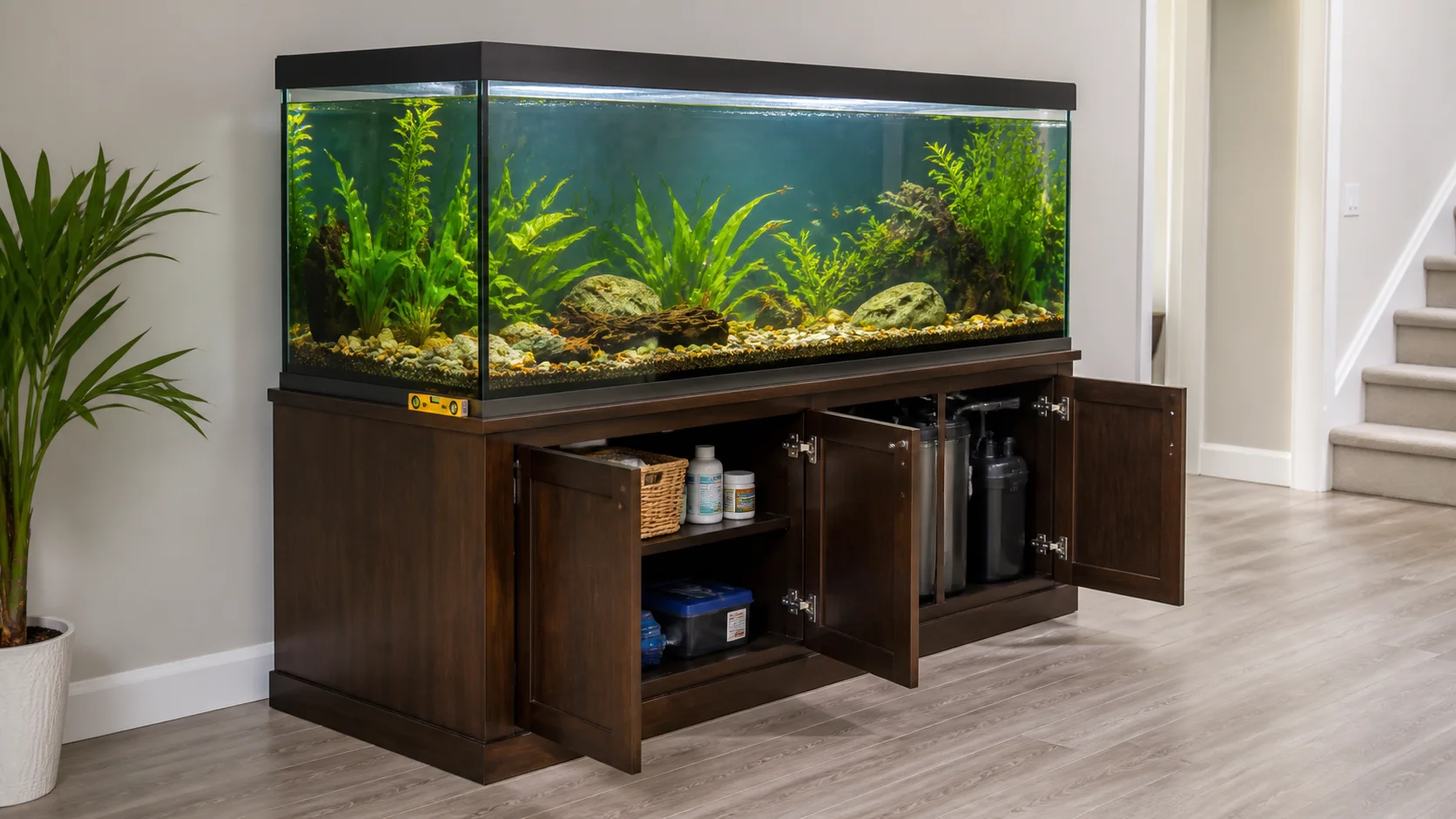
Editorial illustration; not evidence for species identification.
Build a conservative total-load worksheet
List each component separately and use measured or manufacturer values whenever available:
- empty aquarium, including braces and fixed overflow;
- operating water in display, sump, pipes, and reservoirs;
- dry substrate plus water retained within it;
- rock, wood, background panels, and decorations;
- filters, pumps, lights, lids, reactors, and plumbing;
- stand, canopy, shelf contents, and stored top-off water;
- any temporary maintenance load that may rest on the structure.
Do not subtract the full volume of rock from water and then forget the rock’s own mass. The simplest conservative estimate often uses nominal water capacity plus the full known mass of other items, though it may overstate the operating total. State the margin and uncertainty.
Water density changes modestly with temperature and dissolved material. For a practical screening estimate, use a recognized conversion and preserve units throughout. NIST’s SI unit guidance for mass supports correct unit practice. One liter of ordinary freshwater is approximately one kilogram for rough planning, but this is not an engineering design value. A U.S. gallon of freshwater is commonly estimated near 8.34 pounds. Saltwater is heavier and should use an appropriate verified density.
Example without pretending to certify
Suppose a nominal 200-liter aquarium has an 45-kilogram empty tank, 30 kilograms of substrate, 35 kilograms of rock, and 18 kilograms of equipment and lid. A conservative freshwater screen is:
200 kg water + 45 kg tank + 30 kg substrate + 35 kg rock + 18 kg equipment = 328 kg
The stand’s own mass and stored supplies then add to what the floor carries. Actual operating water may be lower because of displacement and air space, but the conservative result is useful for asking the manufacturer and engineer the right question. It is not proof that a stand labeled “350 kg” is acceptable; ratings may have conditions, safety factors, required distribution, and approved tank models.
Avoid false precision. A bathroom scale may not safely or accurately weigh large rock. Use supplier weights, verified packaging, or multiple safe smaller measurements without lifting beyond personal limits. Never stand beneath or reach under a partly supported aquarium.
Match the tank’s support geometry
Framed glass tanks may be designed to bear on the perimeter frame. Rimless glass or acrylic tanks may require continuous, planar support and a specified foam or mat. These arrangements are not interchangeable. Follow the exact aquarium manual, including overhang limits, pad type, and cabinet opening requirements.
A top that looks flat may twist under load. Seams are vulnerable when corners do not share the intended plane. Never “correct” a gap between aquarium and stand by inserting random shims directly under the tank unless the aquarium manufacturer specifies that method. Level the supporting structure as directed, usually at the stand-to-floor interface, and confirm all required contact.
The site’s aquarium stand selection guide helps compare formats, but a general article cannot override the model manual. Obtain written manufacturer confirmation when combining brands or using a custom top.
Inspect the stand as a load path
Trace how weight travels from the aquarium support surface through panels, rails, fasteners, legs, and feet to the floor. Decorative furniture may have a large top but weak joinery or unsupported spans. A manufacturer-rated aquarium stand is preferable to guessing from appearance.
Check for swelling particleboard, delamination, rust, cracked welds, split wood, missing fasteners, loose joints, and altered panels. Holes cut for plumbing can remove critical material. Do not repair, brace, or modify a loaded stand based on internet advice; unload safely and contact the manufacturer or a qualified designer.
Assemble flat-pack stands exactly as instructed, using every specified fastener and orientation. Do not substitute screws or leave a back panel off because it looks cosmetic; that panel may resist racking. Observe cure times for any manufacturer-specified adhesive before loading.
Keep the stand dry. Wipe spills promptly and find leaks rather than allowing repeated wetting. Cabinets need ventilation appropriate to sumps and electrical equipment. Water damage can reduce capacity without producing an obvious dramatic crack.
The floor is part of the system
Total load, footprint, joist direction and span, position relative to supports, building material, condition, alterations, and local code all matter. Dividing weight by the stand’s top area does not determine whether a residential floor is safe. Small feet may also create concentrated loads even when the top is broad.
The American Institute of Steel Construction provides engineering education on floor behavior, illustrating that load response involves system design rather than one online number. Its material is context, not a residential aquarium approval.
Consult a licensed structural engineer for large aquariums, upper floors, old or modified buildings, visible deflection, bounce, cracks, unknown framing, concentrated feet, rental restrictions, or any uncertainty. Provide dimensions, the conservative worksheet, stand foot geometry, photographs, and building plans if available. Landlord permission does not replace engineering review.
Never place an aquarium where it obstructs an exit or where a failure would expose electrical panels, stairs, sleeping areas, or critical equipment. Consider how the tank could be safely drained and removed later.
Level means planar, stable, and rechecked
Use an accurate level in both directions on the empty stand, following manufacturer instructions. Verify that it does not rock. Shim only with durable, load-appropriate material and only in the location approved by the stand manufacturer or engineer. Soft cardboard, stacked scraps, and isolated wedges can compress or distort the frame.
Fill in stages while watching the stand, seams, floor, and level. Stop for new rocking, widening gaps, creaks, visible bowing, or unexpected floor movement. Do not crawl under a loaded structure to adjust it. Drain safely and obtain professional advice.
Recheck after the substrate and hardscape are installed because their placement changes distribution. The substrate guide and freshwater planted aquarium guide help estimate components, but rocks must rest securely without point-loading glass. Use the tank manufacturer’s bottom-protection method.
Control tip, impact, and access hazards
Aquariums are top-heavy assemblies and can attract climbing children or pets. The CPSC’s Anchor It! furniture and tip-over safety resources reinforce the importance of preventing climbing and instability. Aquarium anchoring is product- and wall-specific; use only manufacturer-approved restraints installed into appropriate structure, with professional help when uncertain.
Keep chairs, toys, and climbable storage away. Doors should not swing into the glass. Protect the stand from carts, vacuum cleaners, and foot traffic. Do not hang heavy canisters, reservoirs, or shelves from panels not rated for them.
A sump changes both total weight and internal humidity. Confirm the shelf or cabinet floor supports the filled sump at every foot or required contact point. Plan enough free volume for power-off drain-down so an outage does not overflow into the cabinet and damage the stand.
Warning signs require unloading, not optimism
Act on new seam separation, glass contact gaps, cabinet leaning, persistent rocking, growing cracks, bowed panels, loose joints, rust loss, swollen wood, floor deflection, or doors that suddenly bind. Keep people clear. If immediate failure seems possible, contact emergency services or building management and avoid approaching the load.
Do not attempt a rushed full-tank move. Water is heavy and moving it creates dynamic forces. A qualified aquarium service can coordinate livestock containers, aeration, temperature, draining, and disassembly after the area is declared safe. Animal distress during relocation requires an aquatic professional or qualified aquatic veterinarian.
Keep a load record
Save manuals, model numbers, purchase records, written compatibility confirmations, the component worksheet, floor assessment, and dated photographs. Update the total before adding large rocks, a canopy, reservoir, larger sump, or hanging equipment. Inspect after leaks, earthquakes, impacts, moves, and building work.
The safe capacity is not merely a number greater than estimated weight. It is a verified tank-and-stand pairing, correct support geometry, an acceptable floor, careful assembly, controlled access, and continued dry condition. Where any link is unknown, the conservative next step is manufacturer confirmation or a structural engineer—not a larger safety guess.
Sources
- NIST: SI Units—Mass
- AISC: Design Considerations for Floor Vibrations
- U.S. CPSC: Anchor It! Furniture and Tip-Over Safety
- CDC/NIOSH: Revised NIOSH Lifting Equation
Related Reviews & Guides


Best Shallow Aquarium For Aquascaping: Top Top Picks 2026
Best Rimless Aquarium for the Money: Smart Value Top Picks