Last Updated: September 25, 2026
Aquarium light color spectrum for plants is where marketing and plant biology diverge most sharply, because the numbers printed on a box describe how light looks rather than what a leaf can use. This guide separates the two, covering which wavelengths drive photosynthesis and why intensity usually matters more than colour.
As an Amazon Associate we earn from qualifying purchases.
As an Amazon Associate we earn from qualifying purchases at no extra cost to you. Prices and availability are accurate as of the date shown and are subject to change.

hygger Clip On 24/7 Lighting Aquarium LED Light,Sunrise-Daylight-Moonlight and DIY Mode, Adjustable Timer/Brightness Fish Tank Light with 7 Colors for Planted Tank (14W for 12~20in Tank)
Selected for "Aquarium Light Color Spectrum for Plants: Kelvin and PAR": this listing is lighting (hygger Clip On 24/7 Lighting Aquarium LED Light,Sunrise-Daylight-Moonl), matching the equipment this article covers.
View on Amazon
AQQA LED Aquarium Light, 24/7 & DIY Mode Full Spectrum Fish Tank Light
Selected for "Aquarium Light Color Spectrum for Plants: Kelvin and PAR": this listing is lighting (AQQA LED Aquarium Light, 24/7 & DIY Mode Full Spectrum Fish Tank Light), matching the equipment this article covers.
View on Amazon
NEOAQLUX 24/7 LED Aquarium Light for 12-18 Inch Plant & Fish Tank, 12-Color & Gradient & Full Spectrum with Auto On/Off, Brightness, Sunrise-Daylight-Moonlight, Extendable Brackets for Freshwater IP68
Selected for "Aquarium Light Color Spectrum for Plants: Kelvin and PAR": this listing is lighting (NEOAQLUX 24/7 LED Aquarium Light for 12-18 Inch Plant & Fish Tank, 12-), matching the equipment this article covers.
View on Amazon
SEAOURA Clip On Aquarium Light for Plants-24/7 Fish Tank Light, 12-20 Inch
Selected for "Aquarium Light Color Spectrum for Plants: Kelvin and PAR": this listing is lighting (SEAOURA Clip On Aquarium Light for Plants-24/7 Fish Tank Light, 12-20 ), matching the equipment this article covers.
View on AmazonBy David Nguyen
The Mechanism and the Numbers That Matter
Understanding aquarium light color spectrum for plants starts with separating three different measurements that get used interchangeably in shops. Kelvin describes appearance, lumens describe brightness to human eyes, and PAR describes the light a plant can actually photosynthesise with.
The decisive numbers behind spectrum and intensity
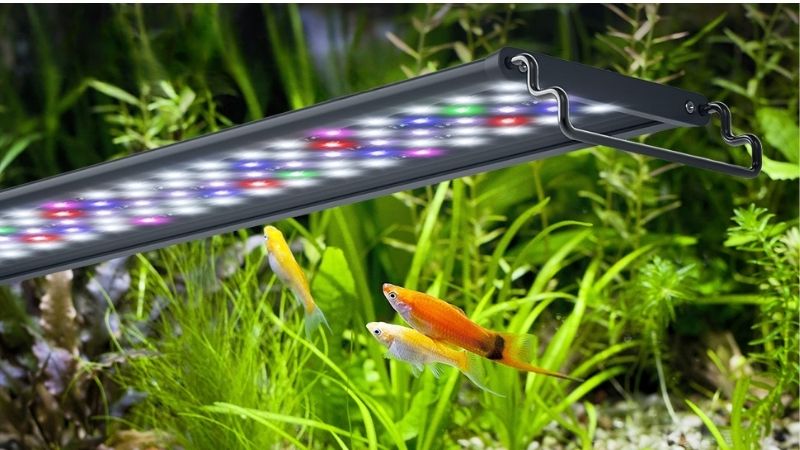
PAR covers roughly 400 to 700 nanometres, the band plants can use, and is measured in micromoles per square metre per second. The working levels at substrate are around 10–30 for low light, 30–50 for medium and above 50 for high light, and those bands drive most planting decisions.
Chlorophyll absorption peaks sit in two separate regions: chlorophyll a absorbs strongly near 430 and 662 nanometres, chlorophyll b near 453 and 642, which is why blue and red output matter. Carotenoid pigments extend that absorption through roughly 450 to 500 nanometres as well.
The aquarium light color spectrum for plants is usually sold on Kelvin, which is the number most often quoted and the least useful for growth. Around 6500 K is common because it renders plants and fish naturally, but two fixtures at the same colour temperature can deliver very different PAR.
How plants actually use the available wavelengths
The old picture of plants using only red and blue light comes from absorption spectra measured on extracted pigment in solution, rather than on whole leaves. In an intact leaf, green light penetrates deeper into the tissue and is used more than that simplified graph suggests it would be.
This matters in practical terms. A fixture heavily weighted to red and blue can look purple and unpleasant while growing plants no better than a good full-spectrum white with a red boost, which is why most modern planted tank fixtures have moved back towards natural-looking output.
Water changes the spectrum with depth as well as with distance. Red wavelengths attenuate faster than blue through a water column, so a deeper tank receives proportionally less red at the substrate, which is one reason deep tanks often need more total output rather than a different colour mix.
Normal ranges against situations that need attention
For most planted tanks the practical answer is a full-spectrum white fixture somewhere between 5000 and 7000 K, ideally with adjustable intensity. That range renders the tank naturally, supports the whole plant list and avoids the algae risk that comes with pushing output higher.
Attention is needed once plants start growing leggy with long gaps between the nodes, when red plants simply stay green, or when algae appears within days of cleaning the glass. The first two usually indicate too little intensity, while the third of them almost always means too much total light.
| Band | Wavelength | What plants do with it | Practical note |
|---|---|---|---|
| Blue | Around 430–470 nm | Strong chlorophyll absorption | Heavy blue looks stark, can favour algae |
| Green | Around 500–570 nm | Used more than graphs suggest | Makes the tank look natural |
| Red | Around 640–670 nm | Strong chlorophyll absorption | Attenuates fastest with depth |
| Full spectrum white | Broad 400–700 nm | Covers all absorption peaks | The practical default choice |
| Beyond 700 nm | Infrared | Little photosynthetic value | Adds heat, not growth |
What This Means for a Real Planted Tank
The theory is constant, but the aquarium light color spectrum for plants that suits a shallow nano tank differs from what suits a deep display tank. Depth, plant list and whether carbon dioxide is injected all shift the answer more than the colour temperature printed on the fixture.
Tank size, placement and physical fit
Depth drives the whole requirement here. A fixture giving medium light on a 12 inch (30 cm) tank may only reach low light at the substrate of a 21 inch (53 cm) tank, and mounting height compounds that further, since a unit on tall legs sits further away and delivers noticeably less.
Weight sets the wider limits as well: a full tank runs near 10 lb per gallon (about 1 kg per L), so a 55 gallon (208 L) setup passes 600 lb (272 kg) and needs a purpose-built stand. Measure the tank length and rim width with a tape before ordering any fixture or mounting bracket.
How the picture changes across 10, 20 and 55 gallon tanks
Shallow nano tanks are easy on spectrum and rather hard on control. The short water column means even a modest fixture delivers useful light at the substrate, so the usual problem there is too much light rather than too little, and dimming matters more than any colour specification.
Deeper tanks reverse that situation entirely. In a 21 inch (53 cm) column, red attenuates noticeably and total output falls, so the practical answer is a stronger full-spectrum fixture rather than one tuned differently, paired with a plant list that tolerates lower light near the substrate.
How the plant list and carbon supply change the answer
Low-tech tanks planted with java fern, anubias, cryptocoryne and mosses need very little, and pushing spectrum or intensity brings algae rather than growth. A full-spectrum fixture at low output covers all of these species comfortably and keeps the tank easy to maintain week to week.
Injected tanks change that balance completely. With carbon dioxide available, plants can use higher intensity productively, and red stem plants develop colour that they never show under low light. That colour response is driven mostly by intensity, not by adding more red to the mix.
Carpeting species sit in between these and are the most demanding of all. They need light reaching the substrate rather than the surface, which brings depth and mounting height back to the centre of the decision, and no adjustment to colour temperature compensates for a shortfall there.
Myths That Cost Money
Several beliefs about aquarium light color spectrum for plants circulate widely, and they lead to purchases that change nothing at all. Replacing each of them with the underlying mechanism makes the decision simpler, and usually cheaper, than the specification sheets would suggest.
The myth that a specific Kelvin rating grows plants better
Colour temperature describes the appearance of white light rather than its usable energy. Two fixtures both rated 6500 K can deliver very different PAR at the substrate, so choosing on Kelvin alone tells you how the tank will look, and almost nothing at all about how the plants will grow.
Use Kelvin to judge appearance and use PAR to judge actual growth. Somewhere between 5000 and 7000 K suits most tanks visually, and within that band the decision should come down to output, dimming and coverage rather than to a hundred Kelvin either side of some preferred figure.
The myth that purple grow lights are superior
Red and blue fixtures grow plants perfectly well, and they are widely used in horticulture where appearance does not matter. In a display aquarium they render fish and plants unnaturally, and the growth advantage over a good full-spectrum white is small enough to be hard to observe.
The practical objection is that you cannot see problems developing. Algae, deficiency symptoms and fish health are all harder to assess under strongly coloured light, so most planted tank keepers end up back at a natural white fixture with a modest red boost for the plant colour.
The myth that changing spectrum will fix algae
Algae responds to total light budget, nutrients and carbon rather than to colour balance. Claims that shifting away from blue eliminates algae are widely repeated but poorly supported, and the reliable levers remain a shorter photoperiod, lower intensity and better nutrient balance.
Check the tank itself rather than the fixture above it. Ammonia and nitrite should read 0 ppm and nitrate should sit at 20–40 ppm rather than zero, because a tank stripped of nutrients starves plants while algae carries on, which looks convincingly like a lighting problem and is not.
Living With the Fixture Over Years
Once chosen, the aquarium light color spectrum for plants in your tank barely changes, but the output certainly does. LED fixtures decline slowly rather than failing outright, and the routine around them matters more to long-term results than any decision made at the point of purchase.
What to check periodically, and how often
Run the light on a timer at a consistent 6–8 hours, and then review that whole schedule seasonally, since the ambient daylight lengthens considerably from late spring into midsummer. A window-side tank effectively runs a longer photoperiod in June than the timer setting suggests.
Wipe the fixture lens or its cover down every few months, because condensation deposits a mineral film that reduces the output measurably. On open-top tanks that film builds up faster, and it is the most common reason a fixture appears to have dimmed when nothing has actually failed.
What degrades and how it shows up
LED output declines gradually across the years, which shows up first as slower plant growth long before anything looks dim to the eye. Individual diodes occasionally fail as well, leaving a visibly dark section, and driver failure is the usual reason a unit stops working altogether.
The spectrum can also shift slightly as the different diode types age at different rates, though the practical effect on the plants is minor compared with the loss of total output. Moisture reaching the housing is the underlying cause of most premature failures on open-top tanks.
The twelve month cost of running a planted tank
The recurring costs here are not lighting parts at all, since LEDs have no bulbs to replace. They are fertiliser, the extra water changes and trimming that faster growth demands, and electricity, which is modest but real for a high-output fixture running eight hours every day of the year.
A higher-output fixture commits you to that routine whether you intended it to or not. Prices move constantly across budget, mid-range and premium units, so check the figures at the time of purchase, and remember that a new planted tank still needs several weeks to establish regardless.
Frequently Asked Questions
These questions come up repeatedly once people stop shopping purely on the colour temperature figure alone, because the aquarium light color spectrum for plants matters a great deal less than the intensity reaching the substrate and the carbon available to use that light productively.
What Kelvin is best for a planted tank?
Anywhere between 5000 and 7000 K works well, with 6500 K the common default because it simply looks natural. Treat it purely as an appearance choice rather than as a growth specification, and compare fixtures on output, dimming and coverage instead of on colour temperature alone.
Do plants need red and blue light specifically?
Those wavelengths are absorbed strongly, but plants also use green light rather more than simplified absorption graphs suggest. A good full-spectrum white fixture covers all the peaks and lets you see the tank properly, which is why it remains the practical choice for a display tank.
Will a purple grow light make plants grow faster?
Not meaningfully faster than a full-spectrum white of similar output, and it does make the tank harder to assess visually. Horticultural fixtures are designed for greenhouses where appearance does not matter at all, which is a different problem from a display aquarium in a living room.
Does spectrum affect red plant colouration?
Intensity is the main driver here, alongside nutrient levels and carbon availability. Red stem plants will colour up under strong light regardless of a red-heavy spectrum, and adding red output to a weak fixture rarely produces the effect people are hoping to achieve in the tank.
Should I change the spectrum to control algae?
No, adjust the total light budget instead of the colour. Shorten the photoperiod by an hour, dim or raise the fixture, and check that nutrients are balanced rather than stripped to zero, since all of those levers work reliably where changing the colour balance generally does not.
See More:
Conclusion
The practical answer on aquarium light color spectrum for plants is that a full-spectrum white fixture between 5000 and 7000 K covers every absorption peak that actually matters, and the decision should then turn on PAR at the substrate, dimming and coverage rather than on colour.
Judge growth by the plants and judge algae by the glass. If the plants are leggy, raise the intensity or lower the fixture; if algae returns within days, cut the photoperiod and check that nitrate sits at 20–40 ppm rather than zero, because neither problem is solved by changing colour.
Apex vs HYDROS Aquarium Controller: Best Compared Guide
6 Best Smallest Heaters For Fish Tank 2026