Last Updated: October 4, 2026
The Short Answer
For a 20-gallon aquarium, choose a filter rated for at least 20 to 40 gallons with a stated flow rate of roughly 80 to 160 gallons per hour (GPH). That range turns the tank’s full water volume over about four to eight times per hour before media, lift height, and normal buildup reduce the flow.
For a lightly stocked freshwater community tank, a 100 to 130 GPH filter is usually the practical sweet spot. A filter such as the Tetra Whisper IQ 130 GPH or Tetra Whisper 135 GPH Internal Power Filter gives enough circulation for a standard 20-gallon setup without automatically creating a harsh current.
As an Amazon Associate we earn from qualifying purchases at no extra cost to you.

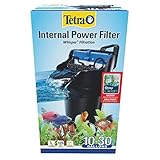


Move up to about 150 to 170 GPH for goldfish, messy eaters, heavily planted tanks with added circulation needs, or a 20-gallon tank stocked near its sensible limit. The Tetra Whisper 170 GPH Internal Power Filter is an example of this higher-flow category. If the flow is too strong for bettas, long-finned fish, fry, shrimp, or slow-moving species, use the filter’s flow control if included, aim the outlet at the glass, or add a sponge baffle.
In 2026, most suitable filters for a 20-gallon aquarium cost approximately $20 to $40. Expect a typical hang-on-back or internal unit to use about 3 to 10 watts, depending on the motor and rated flow.
Standard Sizes
“Filter size” is more than the outside dimensions of the unit. The key measurement is its tank-size rating and GPH, but physical clearance matters just as much when the aquarium sits against a wall, inside a cabinet opening, or under a shelf.
| Filter category | Best 20-gallon use | Recommended flow | Typical physical space needed | Approximate price |
|---|---|---|---|---|
| Small internal filter | Betta, shrimp, quarantine tank, or aquarium without rear clearance | 80–135 GPH | About 3–5 in. wide × 3–5 in. deep × 7–10 in. tall 7.6–12.7 cm × 7.6–12.7 cm × 17.8–25.4 cm |
$20–$30 |
| Medium internal filter | Higher-bioload community tank or goldfish grow-out setup | 135–170 GPH | About 4–6 in. wide × 4–6 in. deep × 9–12 in. tall 10.2–15.2 cm × 10.2–15.2 cm × 22.9–30.5 cm |
$26–$35 |
| Hang-on-back filter | Most standard freshwater 20-gallon tanks | 100–150 GPH | About 7–9 in. wide × 4–6 in. deep × 6–9 in. tall behind the tank 17.8–22.9 cm × 10.2–15.2 cm × 15.2–22.9 cm |
$23–$30 |
| Higher-flow hang-on-back filter | Heavy stocking, larger fish waste load, or extra water movement | 150–170 GPH | About 8–10 in. wide × 5–7 in. deep × 7–10 in. tall behind the tank 20.3–25.4 cm × 12.7–17.8 cm × 17.8–25.4 cm |
$30–$40 |
A standard 20-gallon long aquarium measures about 30.25 inches long × 12.5 inches deep × 12.75 inches high (76.8 × 31.8 × 32.4 cm). A standard 20-gallon high is about 24.25 inches long × 12.5 inches deep × 16.75 inches high (61.6 × 31.8 × 42.5 cm). Both hold the same nominal water volume, but the long tank offers more horizontal swimming room and more surface area for gas exchange.
For example, the Tetra Whisper IQ 130 GPH Power Filter and the AQQA Quiet 20–30 Gallon Hang-on-Back Filter fit the common mid-flow recommendation. The Tetra Whisper 135 GPH Internal Power Filter is useful where there is no room behind the aquarium. The 170 GPH internal model is better treated as a high-flow option rather than the default for every 20-gallon tank.
How to Measure Your Space
- Measure the aquarium’s rear clearance. For a hang-on-back filter, measure from the back glass to the wall, window, backsplash, or furniture panel. Plan for at least 6 inches (15.2 cm) of clear depth; 8 inches (20.3 cm) is more comfortable for removing the lid and media basket.
- Measure vertical clearance above the rim. Hang-on-back filters need room for their cover to lift off. Leave 8 to 10 inches (20.3 to 25.4 cm) from the tank rim to a shelf, cabinet, or countertop above.
- Check the tank rim. Most framed aquariums have a rear cutout for a filter intake tube. If you use a glass lid, confirm that its hinged section or cutout leaves space for the filter body and intake.
- Measure the interior for an internal filter. An internal filter takes up swimming space. Keep it at least 1 to 2 inches (2.5 to 5.1 cm) away from substrate, rockwork, and the heater where possible so the intake does not clog quickly.
- Confirm cord and outlet access. The power cord should reach a grounded outlet while still forming a drip loop below the outlet. Do not place a power strip directly under the aquarium.
- Account for the filled tank’s weight. Water alone weighs about 167 pounds in a 20-gallon tank. With glass, substrate, décor, lid, and equipment, a complete setup commonly weighs 200 to 250 pounds. Choose furniture that supports the entire tank base, not just its corners.
By Room or Use Case
Living Room Display Tank
A 100 to 130 GPH hang-on-back filter is the easiest choice for most living room community aquariums. It keeps equipment mostly outside the tank, leaves more room for plants and décor, and makes media changes simple. Look for a unit rated for 20 to 30 gallons, such as a 130 GPH model. Place the aquarium at least 6 inches from the wall so the filter does not force the stand forward or pinch the intake tube.
Bedroom or Home Office Tank
Noise and splash control matter more in a bedroom or office. Choose a filter with adjustable flow and keep the aquarium water level high enough that the return does not waterfall loudly. A 100 to 135 GPH filter is generally sufficient. Internal filters can be especially useful here because they eliminate the rear clearance requirement, though the submerged motor may still create a low hum if it touches glass or décor.
Tank on a Bookcase, Desk, or Tight Cabinet Opening
Use an internal filter when the tank sits close to a wall or under a fixed shelf. Measure the available water-column height before buying: many medium internal filters are 9 to 12 inches tall. A 20-gallon high tank has more vertical room than a 20-gallon long, but décor and substrate reduce usable space. Select a 135 GPH internal filter for a standard community setup, or 170 GPH only when the livestock and aquascape can handle stronger movement.
Betta, Shrimp, Fry, or Long-Finned Fish
Do not size solely for maximum GPH. These animals need stable filtration but may struggle in a fast current. Use a 20- to 30-gallon-rated filter with adjustable output, then reduce and diffuse the flow. A sponge over an intake protects shrimp and fry, while a coarse sponge or purpose-made baffle on the outlet softens the return. Avoid placing the outlet directly across the tank at the fish’s resting area.
Goldfish or High-Waste Fish
Goldfish produce more solid waste than a similarly sized tropical community. Aim closer to 150 to 170 GPH, use substantial mechanical media, and plan regular water changes. A high-flow internal filter can work, but a larger hang-on-back filter often provides easier access to media. Even a strong filter does not make a 20-gallon tank suitable for overcrowding or replace routine gravel vacuuming.
Common Sizing Mistakes
- Buying a filter rated for exactly 20 gallons. Ratings are broad and often assume light stocking. A 20–30 gallon or 20–40 gallon rating gives useful reserve capacity.
- Choosing only by GPH. A 170 GPH filter may be excellent for waste management but excessive for a betta or shrimp tank unless the outlet is baffled.
- Ignoring real installed dimensions. The filter’s listed width is not the whole story. A hang-on-back unit also needs rear depth, lid-lifting room, and clearance for the intake tube.
- Forgetting that media slows flow. New filters are tested with clean media. As floss, sponges, and carbon collect debris, actual water movement drops. Clean mechanical media in removed tank water according to the manufacturer’s instructions.
- Replacing all media at once. Beneficial bacteria live on filter media and tank surfaces. Replace disposable cartridges gradually when possible, and avoid washing biological media under untreated tap water.
- Using filtration to compensate for an overloaded tank. Filtration supports good husbandry; it does not eliminate the need for appropriate stocking, testing, and water changes.
FAQ
Is a 130 GPH filter too much for a 20-gallon tank?
No. A 130 GPH filter is usually an appropriate all-purpose size for a 20-gallon freshwater aquarium. It provides a strong margin over the minimum turnover target while remaining manageable for many community fish. Adjust or baffle the output for fish that prefer calm water.
Should I get a 20-gallon or 30-gallon-rated filter for a 20-gallon tank?
Choose the 30-gallon-rated option when comparing similar filter designs, especially for a fully stocked community aquarium. A larger rating generally means more media capacity and stronger flow. The exception is a low-flow setup for a betta, shrimp, or fry, where adjustable output matters more than maximum capacity.
Can I use an internal filter instead of a hang-on-back filter?
Yes. An internal filter is a practical choice when the aquarium cannot sit far enough from the wall for a hang-on-back model. Choose one rated around 100 to 135 GPH for typical use, make sure it fits below the waterline, and leave room to remove it for cleaning.
How much space should I leave behind a 20-gallon aquarium for a filter?
Leave at least 6 inches behind the tank for a compact hang-on-back filter. Eight inches is better if you want easy access to the lid, intake, and media. Also leave 8 to 10 inches above the tank rim if a shelf or cabinet is overhead.
Ready to decide? Our #1 pick for 2026 is the Small internal filter.
Live price & availability on Amazon.
Related Reviews & Guides
6 Best Aquarium Water Chillers 2026
How to Choose Aquarium Water Test Kit in 2026: What Actually Matters