Last Updated: November 23, 2026
A dedicated fish room is a different kind of aquarium space. Instead of one display tank in a living room, you have rows of tanks, racks, water change stations, spare media, and a routine that repeats every week. In that setting, the best quiet aquarium canister filters for dedicated fish rooms earn their place by staying out of the way. They should hum softly enough that you can hear a trickle, a loose hose, or a fish splashing at the surface. They should also be simple to open, clean, and restart, because you may be doing that job on several filters in one session.
Noise matters more in a fish room than many keepers expect at first. One filter with a rattling impeller is annoying. Four or five of them together can turn a calm workroom into a space where conversation is hard and long maintenance sessions feel tiring. A quiet canister also helps you notice problems early. When the room is calm, a change in sound often points to trapped air, a clogged intake, or a media basket that needs attention. That early warning is valuable when many tanks share the same room and the same daily routine.
How to Choose a Quiet Canister Filter for a Fish Room
Start with sound, then work through flow, media space, and maintenance. A filter that is quiet on day one but hard to clean will become loud later, because trapped debris and air make pumps work harder and vibrate more. A filter that is easy to service will stay quiet longer, because you can keep the impeller, intake, and pre-filter clear without a long struggle. Look for a pump design described by the maker as low noise or ultra-quiet, with a solid motor housing and rubber feet or mounts that limit vibration against a cabinet or shelf.
Match flow to the tank, not to the largest number on the box. In a fish room, many tanks hold breeding groups, grow-out juveniles, or community fish that need steady circulation without a strong current. Adjustable flow, a spray bar, or a directional output helps you spread water gently across the surface and avoid blasting plants, fry, or shy fish into a corner. Place the canister on a stable surface, level it, and keep hoses from pulling at an angle.
Media space matters too. Stacked baskets that lift out cleanly let you rinse one layer at a time, and a separate pre-filter helps when you service several tanks in a row.
Priming and shut-off valves matter just as much. A push-button primer reduces the time spent coaxing water into the filter after cleaning. Shut-off valves let you disconnect hoses without draining water across the floor. Measure the height under the tank and the depth of the cabinet before you commit, and keep a spare impeller, seals, and extra foam on hand.
Our Picks for Dedicated Fish Rooms
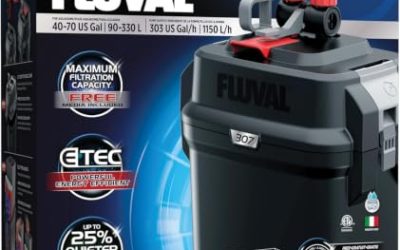
Fluval 307 Performance Canister Filter

Fluval 307 Performance Canister Filter
The Fluval 307 is a compact canister for aquariums up to 70 gallons, with a maximum flow rate of 1150 litres per hour as listed by the maker. It uses Fluval eTEC construction, which the maker describes as efficient technology for strong pump performance and ultra-quiet operation. The maker also states that the re-engineered pump runs up to 25 percent quieter than previous generations, which is useful in a room where several filters run together.
The 307 has EZ-Lift media baskets with a centre handle, so the media stack can be lifted out with one finger, with less mess and without emptying the canister of water. A vertical pre-filter cartridge has independent access, giving more surface area for mechanical filtration. The included media set covers foam, carbon, and biological media, and the AquaStop valve helps you stop water flow before disconnecting hoses. This filter suits a medium tank where quiet running and fast pre-filter access matter. It is not the right choice for a very large display tank, and it will need more frequent pre-filter rinsing in a heavily stocked tank.
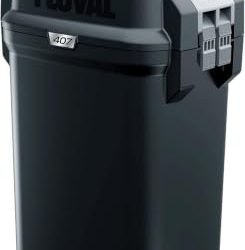
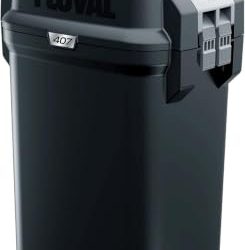
Fluval 407 Performance Canister Filter

Fluval 407 Performance Canister Filter
The Fluval 407 is the larger sibling in the same family, rated for aquariums up to 100 gallons, with a maximum flow rate of 1450 litres per hour as listed by the maker. It shares the eTEC construction, the quiet pump design, the EZ-Lift baskets, and the vertical pre-filter cartridge found on the 307. The larger body gives you more media volume, which helps in a fish room tank with a higher fish load or a longer interval between full cleanings.
The 407 suits a larger community tank, a grow-out tank, or a display tank that sits at the end of a fish room rack. Using the same family across several tanks also helps you standardise spares, because the baskets, valves, and service steps follow the same pattern. Limitations include size and flow. The 407 is taller and heavier than the 307, so check cabinet height before you buy. On a smaller tank, the flow may be too strong unless you direct the output along the surface or through a spray bar.
OASE BioMaster 2 Thermo 350 Canister Filter

OASE BioMaster 2 Thermo 350 Canister Filter
The OASE BioMaster 2 Thermo 350 is an external canister for aquariums up to 90 gallons, with a sealed four-stage filtration path, an EasyClean pre-filter module, and quiet operation as described in the listing. The four-stage path moves water through activated carbon foams, filter foams of differing pore densities, and Hel-X Biomedia, giving mechanical, chemical, and biological filtration in a clear order.
The EasyClean pre-filter is the standout feature for a fish room. It can be removed separately from the rest of the filter, which makes a quick rinse far simpler than opening the whole canister. That design helps the main foams last longer between deep cleanings, and it keeps routine service short when you have several tanks to work through. The Thermo version is built around heater integration, which reduces equipment inside the tank. This filter suits a keeper who wants a tidy tank interior and a filter that can be cleaned in stages. Confirm the heater setup for your model, and measure the cabinet before you buy.
Penn-Plax Cascade 1000 Canister Filter

Penn-Plax Cascade 1000 Canister Filter
The Penn-Plax Cascade 1000 is an all-in-one canister for tanks up to 100 gallons, cycling water at 265 gallons per hour as listed by the maker. It has three stackable, large capacity media baskets with built-in handles, two independent valve taps that rotate 360 degrees, a push-button primer, a spray bar, tubing, and a directional spout. The included media set has three poly fiber floss pads, one coarse bio-sponge, and one bag of activated carbon.
The Cascade 1000 suits a fish room where you want a straightforward canister with generous basket space and simple controls. The rotating valve taps make hose routing easier on a rack, and the push-button primer helps you restart the filter after cleaning without a long siphon routine. The three baskets give you room to layer floss, sponge, and biological media in the order that suits each tank. Limitations include a larger footprint than the Fluval 307, and a design that rewards regular cleaning of the floss pads. Floss traps fine debris well, but it can clog and slow flow if left too long.
Comparison Table
| Product | Key Feature | Best For |
|---|---|---|
| Fluval 307 Performance Canister Filter | Ultra-quiet eTEC pump, up to 70 gallons, EZ-Lift baskets | Medium fish room tanks where quiet running and fast access matter |
| Fluval 407 Performance Canister Filter | Larger media volume, up to 100 gallons, 1450 litres per hour | Larger community and grow-out tanks in a fish room |
| OASE BioMaster 2 Thermo 350 Canister Filter | EasyClean pre-filter, sealed four-stage path, up to 90 gallons | Keepers who want staged cleaning and a tidy tank interior |
| Penn-Plax Cascade 1000 Canister Filter | Three large baskets, 265 gallons per hour, rotating valve taps | Straightforward multi-tank use with generous media space |
Frequently Asked Questions
How many canister filters do I need in a dedicated fish room?
Most keepers use one canister per tank, or one canister per display tank plus sponge filtration in breeding and quarantine tanks. A single canister per tank keeps maintenance simple, because a problem in one tank does not affect the others.
What makes a canister filter quiet in a fish room?
A quiet canister usually has a well-sealed pump, a balanced impeller, rubber mounts, and a design that limits vibration. Keeping the impeller clean, removing trapped air, and placing the canister level on a stable surface also help. A clogged intake or a media basket that is packed too tightly can make a quiet filter louder, so regular rinsing is part of noise control.
Can I use the same canister model on every tank in the room?
Yes, and many keepers do exactly that. Using one model, or one family of models, simplifies spares, media, and cleaning steps. You will still need to match the size to each tank. A model that suits a 70 gallon tank may be too strong for a 20 gallon tank, so use flow control, a spray bar, or a smaller model from the same family for the smaller tanks.
How often should I clean a canister filter in a fish room?
Rinse the pre-filter or floss every one to two weeks in a heavily stocked tank, and open the main canister for a deeper clean every four to eight weeks. Rinse biological media in water taken from the tank, not in tap water, to protect the bacteria that support the nitrogen cycle.
Conclusion
Choosing the best quiet aquarium canister filters for dedicated fish rooms comes down to sound, service, and fit. The Fluval 307 suits medium tanks where space is tight and quiet running matters. The Fluval 407 adds media volume for larger tanks. The OASE BioMaster 2 Thermo 350 stands out for staged cleaning, while the Penn-Plax Cascade 1000 gives you large baskets and simple controls. List your tanks, their sizes, and their stocking levels, then choose a filter that matches each tank and fits your weekly routine.
Disclosure: As an Amazon Associate, we may earn from qualifying purchases.
5 Best Topfin Aquarium Filters (2026)
Best Aquarium Filter Cartridges Replacement: Smart Top Picks