Last Updated: November 23, 2026
A single pad cannot do everything a freshwater tank needs. Waste comes as particles, dissolved compounds, and ammonia, and each one needs a different kind of filtration. The best multi stage aquarium canister filters with quick disconnect valves for freshwater aquarium setups handle all three in one canister: mechanical media catches particles, biological media supports helpful bacteria, and chemical media removes discoloration and odors.
How to Choose a Multi Stage Canister Filter With Quick Disconnect Valves
The three stages and their order
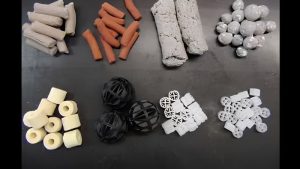
A true multi stage filter covers mechanical, biological, and chemical filtration. Mechanical media includes foam pads, floss pads, and pre-filter cartridges. Biological media includes ceramic rings, bio balls, and porous stone. Chemical media includes activated carbon and resin pads. The usual order is mechanical first, then biological, then chemical, so debris is caught before it reaches the bacteria and the carbon. Check that the canister has enough baskets to hold all three, and that the baskets lift out separately.
Basket design and media capacity
Stacked baskets are the heart of a multi stage canister. Look for baskets with handles, foam liners that stop water from bypassing the media, and enough volume to hold a useful amount of biological media. A canister that holds one gallon of media gives far more biological capacity than one that holds half a gallon, and that capacity shows up as steadier water conditions between cleanings.
Quick disconnect valves
The valve is where the hoses meet the filter head, and it decides how easy cleaning day will be. Fluval uses its AquaStop valve, which stops the flow and lifts away from the motor head. Marineland uses a quick release valve block that shuts down flow and separates from the motor housing. Penn-Plax uses independent valve taps with flow rate control cut off valves. In each case, closing the valve should stop the water, and separating the valve should leave the water in the hoses. Check that the valve is included and that spare seals are available.
Flow rate, priming, and maintenance
Flow rate tells you how fast water moves through the stages, and the tank rating tells you which tank the filter is built for. A filter rated for tanks up to 250 gallons with a pump output of 700 gallons per hour suits a different setup than one rated up to 100 gallons at 360 gallons per hour. Look for a self priming design or a smart pump that purges trapped air, since trapped air reduces flow and causes noise. For upkeep, rinse mechanical media in water taken from the tank, rinse biological media gently in tank water, and keep a spare set of fine pads on hand.
Best Multi Stage Aquarium Canister Filters With Quick Disconnect Valves for Freshwater Setups
Fluval 407 Performance Canister Filter

Fluval 407 Performance Canister Filter
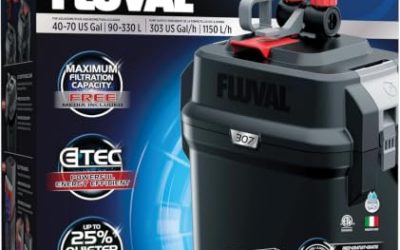
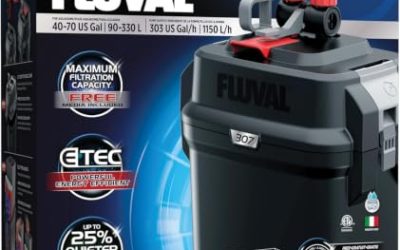
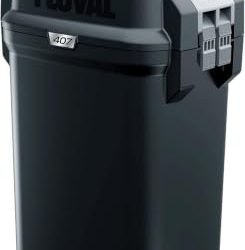
The Fluval 407 is rated for aquariums up to 100 gallons, with a maximum flow rate of 1450 litres per hour. It uses Fluval eTEC construction, which the manufacturer describes as delivering powerful pump performance with ultra quiet operation. The AquaStop valve is included, so you can stop the flow and lift the valve away from the motor head for maintenance. The media stack uses EZ-Lift baskets with a center handle, plus a vertical pre-filter cartridge with independent access that adds mechanical filtration surface before the main baskets. Included media covers all three stages: Bio-Foam, Bio-Foam Max, carbon, Quick-Clear, and Bio-Foam Plus.
This model suits freshwater setups from 55 to 100 gallons where the keeper wants a full multi stage layout with a pre-filter that can be rinsed often without opening the whole canister. Limitations: the 100 gallon rating is a ceiling, so a heavily stocked tank near that size may need a larger filter.
Fluval FX4 High Performance Canister Filter

Fluval FX4 High Performance Canister Filter
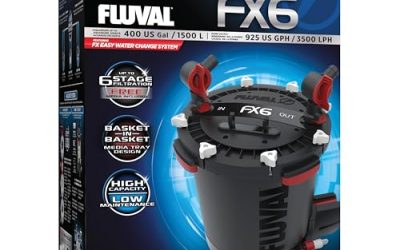
The Fluval FX4 is rated for aquariums up to 250 gallons, with a pump output of 700 gallons per hour and a filter circulation of 450 gallons per hour. Its canister volume is 3.7 US gallons, and the removable stack of media baskets sits at the heart of the multi stage filtration design. The baskets are precision engineered to reduce water bypass, and they can hold a total of one gallon of media, stacked in the combination that suits the tank. Each basket is lined with a foam insert for mechanical pre-filtering, and instant release T-handles let you lift and separate the baskets. Smart Pump Technology monitors the pump and purges trapped air on a 12 hour cycle. It carries a 3 year limited warranty.
This model suits larger freshwater setups up to 250 gallons where media capacity and strong circulation matter, including tanks with large fish or heavy stocking. Limitations: it is a large, heavy canister when full, so place it on a strong, level cabinet floor and leave room to lift the basket stack out.
Penn-Plax Cascade 1500 Canister Filter

Penn-Plax Cascade 1500 Canister Filter
The Penn-Plax Cascade 1500 is rated for aquariums up to 200 gallons, with a flow rate of 350 gallons per hour. It has five stackable, large capacity media baskets with built in handles, which give plenty of room to arrange mechanical, biological, and chemical layers in the order that suits the tank. The included media are five poly fiber floss pads, one coarse bio-sponge, and one bag of activated carbon. Two independent valve taps rotate 360 degrees, plus flow rate control cut off valves, so each hose can be shut off and separated for maintenance. A push button primer makes startup simple, and the filter comes with a spray bar, tubing, and a directional spout.
This model suits freshwater tanks up to 200 gallons where the keeper wants five baskets of media flexibility and valves that adjust the flow at the canister. Limitations: the flow rate is modest for a 200 gallon rating, so it is a closer match for lightly to moderately stocked tanks at that size.
Marineland Magniflow 360 Canister Filter

Marineland Magniflow 360 Canister Filter
The Marineland Magniflow 360 is rated for aquariums up to 100 gallons, with a pump output of 360 gallons per hour. It uses multi stage filtration with stacked flow trays that force water through the media layers rather than around them, covering mechanical, chemical, and biological filtration. A quick prime button fills the filter chamber with water for self priming startup, and the quick release valve block shuts down water flow and separates from the motor housing for quick, spill free maintenance. The lid uses a top sealing gasket and lifts up for access to the media baskets, with no clamps to work around.
This model suits freshwater tanks up to 100 gallons where the keeper wants a clear multi stage layout, simple priming, and a valve block that comes apart in one motion. Limitations: the media trays are smaller than those in the Fluval FX4 or the Cascade 1500, so a heavily stocked tank may need more frequent cleaning.
Comparison Table
| Product | Key Feature | Best For |
|---|---|---|
| Fluval 407 Performance Canister Filter | AquaStop valve, pre-filter cartridge, rated up to 100 gallons | Multi stage filtration for tanks from 55 to 100 gallons |
| Fluval FX4 High Performance Canister Filter | Stacked baskets holding 1 gallon of media, rated up to 250 gallons | Larger freshwater tanks up to 250 gallons |
| Penn-Plax Cascade 1500 Canister Filter | Five media baskets, 350 GPH, rated up to 200 gallons | Keepers who want maximum basket flexibility |
| Marineland Magniflow 360 Canister Filter | Quick release valve block, stacked flow trays, 360 GPH | Simple multi stage filtration up to 100 gallons |
Frequently Asked Questions
What are the three stages of canister filtration?
The three stages are mechanical, biological, and chemical. Mechanical media such as foam and floss pads catch particles. Biological media such as ceramic rings and bio balls give helpful bacteria a place to live, and those bacteria process ammonia and nitrite. Chemical media such as activated carbon removes discoloration and odors. A multi stage canister holds all three in separate baskets so each layer can be cleaned or replaced on its own schedule.
In what order should I stack filter media?
The usual order is mechanical first, then biological, then chemical. Water should pass through coarse foam, then fine pads, then biological media, then carbon or a similar chemical media. That order keeps debris from clogging the biological media and lets the carbon polish water that is already clear of particles.
How often should I clean each stage?
Rinse mechanical pads every few weeks, or when the flow drops. Rinse biological media gently in tank water only when it looks clogged, since the bacteria living on it do the main work of the filter. Replace chemical media such as carbon on the schedule in the manual, since it stops absorbing once it is full.
Do quick disconnect valves affect filtration?
No, the valve does not change how the media filters the water. It sits where the hoses meet the filter head and only controls the flow during maintenance. When the valve is open, water flows normally through the canister. When it is closed, the flow stops so the hoses can be separated.
Conclusion
Multi stage filtration works when each layer has room to do its job and when cleaning is simple enough to do on schedule. The Fluval 407 is a strong match for freshwater tanks from 55 to 100 gallons, with a pre-filter and a full media stack. The Fluval FX4 adds the capacity for tanks up to 250 gallons, with baskets that hold a gallon of media. The Penn-Plax Cascade 1500 gives five baskets for keepers who want the most flexibility in arranging layers. The Marineland Magniflow 360 keeps the layout simple for tanks up to 100 gallons, with a valve block that separates in one motion.
Disclosure: As an Amazon Associate, we may earn from qualifying purchases.

Best Air Pump for Two Sponge Filters in 2026: Compared and Ranked
Best Bio Media for Aquarium Filter: Compared by the Numbers