Last Updated: September 18, 2026
Quick answer: Our top pick in 2026 is the DIY air-driven filter using coarse aquarium foam — our #1 rated choice. See the full ranked comparison, alternatives and buying advice below.
The Short Answer
Yes—an aquarium sponge filter is worth it if you value gentle filtration, low operating costs, and easy maintenance, provided you size it for your tank and run it with a separate air pump. It is especially useful for shrimp, betta fish, fry, quarantine tanks, and aquariums where strong water movement would be stressful.
A sponge filter is not the best choice for every aquarium. It takes up visible space, looks less polished than an internal or hang-on-back filter, and may not provide enough circulation or chemical filtration for a heavily stocked display tank. Think of it as a dependable biological filter rather than an all-in-one solution.
As an Amazon Associate we earn from qualifying purchases at no extra cost to you. Product prices and availability are accurate as of the date shown and are subject to change.


What You Actually Get
A sponge filter usually consists of a porous foam cylinder or block, a plastic uplift tube, an air intake, and sometimes an air stone or ceramic-media chamber. You connect it to an air pump with airline tubing. As bubbles rise through the uplift tube, they pull water through the sponge. The sponge catches particles while hosting beneficial bacteria that convert toxic ammonia and nitrite into less harmful nitrate.
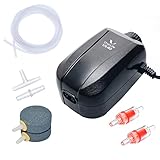
The filter itself has no electrical motor. The separate air pump typically uses about 2 to 5 watts for a small or medium aquarium, although larger pumps can use more. You may also need a check valve, which commonly costs a few dollars and prevents water from flowing backward during a power outage. An adjustable air valve helps you reduce bubbling in tanks with bettas or other fish that prefer calmer water.
Size claims vary by manufacturer, so treat labels such as “up to 60 gallons” or “100–120 gallons” as optimistic starting points rather than guarantees. A four-pack such as the AQUANEAT Aquarium Sponge Filter Breeding Fry Betta Shrimp Nano Fish Tank set costs about $19.98 and can be practical when you need several small filters for breeding, quarantine, or shrimp tanks. A larger 100–120-gallon-style sponge filter with an air stone and ceramic media may cost around $18.99, but it still requires a suitably powerful air pump and should not automatically be expected to handle a fully stocked 120-gallon aquarium by itself.
In a typical setup, leave at least 1 to 2 inches of clearance around the sponge so water can reach it from all sides. Small models may measure roughly 4 to 7 inches tall, while large models can be 10 to 14 inches tall and occupy a footprint of about 4 to 8 inches. Check the actual product dimensions before buying, particularly for nano tanks, planted aquariums, and tanks with limited floor space.
Pros
- Excellent biological filtration. The large, open-pore surface gives beneficial bacteria a place to colonize. Once established, a sponge filter can provide stable filtration with very little complexity.
- Safe for fry and shrimp. There is no exposed impeller to pull in baby fish or small shrimp. The gentle intake is also less likely to toss delicate animals around the tank.
- Low energy use. The air pump generally consumes only a few watts, so running costs are modest compared with many larger powered filters.
- Quiet when properly installed. The pump itself can make a hum, but placing it on a soft pad and using an air-flow control valve can reduce vibration. An air stone often produces smaller, less disruptive bubbles.
- Inexpensive to replace. Basic sponge filters commonly cost about $6 to $20 each, depending on size and included media. Replacement foam is often cheaper than replacing a complete motorized filter.
- Power-outage resilience. The sponge retains beneficial bacteria while wet, and many air pumps can be connected to a battery backup. The filter will not circulate water without air, but it is simple to restart after an outage.
- Easy to clean. A sponge can be rinsed in removed aquarium water during a water change. This preserves more beneficial bacteria than rinsing it under chlorinated tap water.
- Useful as backup filtration. Keeping a mature sponge filter running in a main aquarium gives you an instantly seeded filter for a quarantine or hospital tank.
Cons
- It needs a separate air pump. The advertised filter price is not the complete setup cost. Allow roughly $8 to $25 for a small-to-medium air pump, $3 to $8 for airline tubing and a check valve, and potentially more for a high-output pump.
- Limited mechanical filtration. Sponge foam catches debris, but it may not polish water as finely as a cartridge or fine mechanical pad. Water can remain slightly cloudy if the tank is dusty, overfed, or heavily stocked.
- No chemical filtration by default. A standard sponge does not remove medications, tannins, odors, or dissolved contaminants the way activated carbon or specialty media can. Some models add ceramic media, but ceramic rings primarily support bacteria rather than chemically cleaning the water.
- Visible and bulky. A sponge filter takes up space inside the aquarium and is not easy to hide in a minimalist layout. Large versions can be particularly conspicuous in tanks under 20 gallons.
- Air bubbles can be disruptive. Strong bubbling may stress calm fish, disturb floating plants, or increase evaporation. An adjustable valve or lower-output pump can help.
- Maintenance is still necessary. The sponge must be squeezed out when water flow drops, usually every few weeks to every few months depending on stocking and feeding. A neglected sponge can become clogged and restrict circulation.
- Tank-size labels can mislead. A filter marked for a very large aquarium may only provide adequate filtration in a lightly stocked tank with frequent water changes. Stocking level, fish size, feeding, and air-pump output matter more than the label alone.
Who Should Buy It
Buy a sponge filter if you keep shrimp, guppies, bettas, tetras, fry, or other small fish that do not need strong currents. They are also a strong choice for breeding tanks, hospital tanks, quarantine tanks, turtle-free aquatic setups, and inexpensive beginner aquariums.
It is a particularly sensible purchase when reliability matters more than appearance. A sponge filter has fewer moving parts than a motorized filter, and a spare can be stored or kept mature in an established aquarium. For a 5- to 20-gallon tank, choose a model rated somewhat above the actual volume if the sponge will be the only filter, then adjust the air output to suit the livestock.
In a 29- to 55-gallon aquarium, consider using two sponge filters rather than relying on one oversized unit. Two filters provide more surface area and better distribution, and one can continue operating while the other is cleaned. A powerful air pump with two outlets may be more practical than two separate pumps.
Who Should Skip It
Skip a sponge filter as your primary choice if you want a nearly invisible setup, crystal-clear water with minimal effort, or substantial chemical filtration. A hang-on-back, internal, or canister filter may better suit a large community aquarium, a heavily stocked tank, or a display where water circulation and polished appearance are priorities.
You should also reconsider it if your fish require strong directional flow or if the tank has very little floor space. A sponge filter can supplement another filter, but it should not be expected to compensate for overstocking, inadequate water changes, or poor tank cycling.
Cheaper Alternatives
| Option | Cost | Trade-off |
|---|---|---|
| DIY air-driven filter using coarse aquarium foam | $5–$15 | Lowest cost, but less tidy and requires careful assembly so the foam cannot collapse or detach. |
| Basic small sponge filter | $6–$12 | Affordable for nano and quarantine tanks, but limited surface area and usually no included air pump. |
| Used or spare internal filter | $10–$25 | May provide stronger circulation, but has an impeller, uses more electricity, and can be unsafe for fry without an intake guard. |
| Four-pack of small sponge filters | About $19.98 | Good value for multiple tanks, but the included units may be too small for heavily stocked aquariums. |
| Large sponge filter with air stone and ceramic media | About $18.99 | More filtration area for larger tanks, but still needs an air pump and may not replace a high-capacity powered filter. |
FAQ
Are sponge filters enough for a fish tank?
They can be enough for a lightly to moderately stocked aquarium when correctly sized and paired with an adequate air pump. They are particularly effective in tanks with small fish, shrimp, or fry. In a crowded tank, add a second sponge or combine it with another filter rather than relying on an optimistic capacity label.
Do sponge filters clean the water?
Yes, but mainly through biological filtration and basic mechanical filtration. The foam catches suspended debris, while beneficial bacteria process ammonia and nitrite. It does not automatically remove dissolved medications, odors, or every source of cloudy water. Water changes and responsible feeding remain essential.
How often should a sponge filter be cleaned?
Clean it when water flow noticeably slows or the sponge becomes visibly clogged. For many tanks, that means approximately every two to eight weeks, though lightly stocked aquariums may go longer. Squeeze the sponge gently in a bucket of removed aquarium water; never scrub it under untreated tap water.
Are sponge filters noisy?
They can be nearly quiet, but the air pump and bubbling create some sound. Put the pump on a soft rubber or foam pad, use an air valve to control output, and choose an air stone if you want finer bubbles. A check valve is important for safe operation and should be installed outside the aquarium.
Ready to decide? Our #1 pick for 2026 is the DIY air-driven filter using coarse aquarium foam.
Live price & availability on Amazon.
Related Reviews & Guides

Best Aquarium Heater for 75 Gallon Tank in 2026: Tested and Ranked
Cardinal Tetra Tank Mates: A Compatibility Checklist