Last Updated: October 4, 2026
The short answer: titanium clearly wins on resisting shattering, but overall safety depends on the whole system, not the material alone. When people ask titanium vs glass aquarium heater which is safer, the honest comparison weighs failure modes, breakage, control and shutdown protection, rather than a single material verdict.
As an Amazon Associate we earn from qualifying purchases.
By David Nguyen
Quick answer: Our top pick in 2026 is the BRS Titanium 300W — our #1 rated choice. See the full ranked comparison, alternatives and buying advice below.
How to Compare Titanium and Glass Heater Safety
Safety is not a single property, so compare titanium and glass across the ways a heater actually fails. Look at mechanical breakage, how each holds temperature, whether it has overheat and dry-run protection, and whether it is correctly sized. A material advantage in one area does not settle overall safety. The safest setup is the one whose whole chain, body, control and shutdown, fits your tank and habits.
Mechanical Breakage
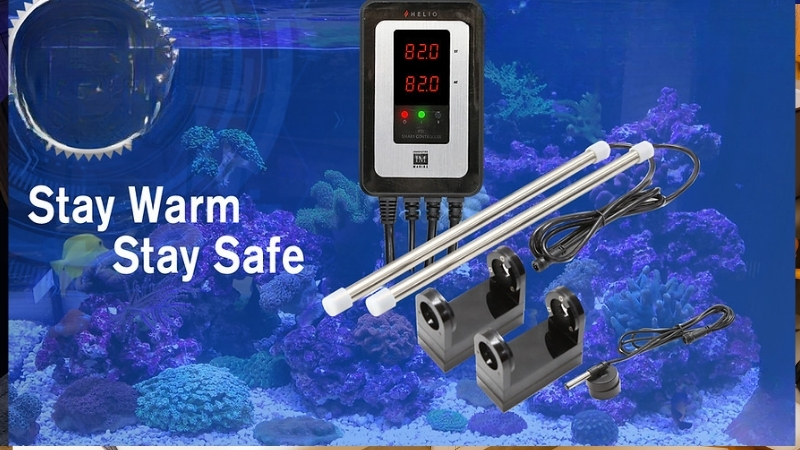
This is titanium’s clear edge. The BRS titanium element is described as shatterproof and fully submersible, while the Aqueon glass heater uses shatter-resistant quartz, which can still crack under impact. In an impact-prone tank, titanium is less likely to break. That is why reef keepers with rockwork and busy livestock often prefer a titanium element.
That advantage is purely mechanical shatter resistance, not chemistry: glass does not corrode in saltwater, so do not choose titanium on a corrosion myth. There is also no shared impact test, so no one can claim a specific percentage stronger. Judge titanium’s edge qualitatively, as impact resistance, rather than by a made-up toughness number.
Temperature Control
Control is where a standalone glass heater can be simpler. The Aqueon glass unit has a built-in thermostat across about 68-88 Fahrenheit, while the BRS titanium element is controller-required, so it needs a separate controller to hold temperature. Neither approach is inherently safer on control; it depends on the quality of the thermostat or controller.
Neither material is inherently more accurate; control depends on the thermostat or controller, not the tube. A self-contained glass heater regulates on its own, while a titanium element inherits the precision of whatever controller you pair with it. That means a titanium element on a good controller can be as accurate as any glass unit, or less if the controller is poor.
Overheat and Dry-Run Protection
Shutdown protection matters as much as material. The Aqueon glass heater includes overheat and improper-submersion shutdown and resets after cooling, so it fails safe on its own. A bare titanium element relies on its controller for equivalent protection. So a glass heater can be safer out of the box if the titanium element lacks a protective controller.
Equal 300-watt ratings and up-to-100-gallon figures do not mean equal safety architecture, because the protections differ. Compare the actual shutdown features of the complete system, not just the element material. A bare element with no controller has no independent shutdown at all, which is a real safety gap.
Match Correct Wattage
Sizing applies to both. Each of these is a 300-watt unit rated up to about 100 gallons, so match wattage to your real volume and room rather than assuming either material changes capacity.
Confirm the exact BRS SKU too: the 300-watt element is 2.5 amps and 10.25 inches, while the 600-watt is 5 amps and 14 inches, so do not swap their specs. Size the heater to the tank first, then weigh material and protection. Both are 300-watt units, so neither material buys you more heating capacity than the other.
Titanium vs Glass by Use Case
Neither material is universally safer, so the right choice depends on use case. Weigh titanium’s shatter resistance against glass’s simpler standalone control, using the comparison below and the notes on where each still needs care. Neither is a universal winner, so the answer depends on your tank and whether you run a controller.
| Product | Best For | Key Spec | Watch Out For |
|---|---|---|---|
| BRS Titanium 300W | Best for Impact-Prone or Controller Systems | shatterproof titanium; 300 W | External controller required |
| Aqueon Glass 300W | Best for Simpler Standalone Control | built-in 68-88 F thermostat + safety shutdowns | Quartz is shatter-resistant, not shatterproof |
When Titanium Makes More Sense
Titanium makes more sense where impact is likely: large cichlids, turtles, busy reef tanks or a sump with equipment moving around. The BRS shatterproof titanium element resists breakage that could crack a glass tube.
It is priced around $75 as of September 2026 as a bare element, so add a controller before comparing it to a complete heater. Choose titanium for durability in rough conditions, not on a belief that glass corrodes. For turtles or large cichlids that ram equipment, the shatterproof element is the safer body.
Titanium With Existing Controller
Titanium fits best when you already run a controller. The BRS 300-watt element draws about 2.5 amps at 120 volts and is rated up to 100 gallons, so an existing Apex, Helio or similar controller can drive it directly.
That makes its element-only price reasonable in context, since you are not buying a controller twice. Confirm your controller supports the load and the temperature range before pairing it with the element. Reusing a controller you already trust also spreads its cost across more equipment.
When Glass Offers Simpler Control
Glass wins on simplicity for a standalone setup. The Aqueon glass 300-watt heater has a built-in thermostat across about 68-88 Fahrenheit plus overheat and improper-submersion shutdown, priced around $60 as of September 2026, so it works alone.
For a straightforward freshwater or saltwater tank without a controller, that self-contained design is easier and cheaper to run. Its quartz body is shatter-resistant, though, not shatterproof, so treat breakage risk as reduced, not eliminated. For a calm community tank without a controller, the self-contained glass heater is simpler and cheaper.
Where Glass Still Needs Mechanical Care
Even a good glass heater needs handling care. Because the quartz tube can crack under impact, keep it away from rocks that could fall, and unplug it before water changes to avoid thermal shock when the level drops.
Both materials still need correct placement and a working shutdown chain, so mechanical care is not unique to glass. Titanium reduces breakage risk but does not remove the need for sensible handling. Unplugging before water changes protects any heater from thermal shock as the level drops.
Frequently Asked Questions
Common questions compare the two materials on shattering, saltwater use and controllers. The answers stay inside the verified specs and correct the common misconception about corrosion.
Can Titanium Shatter?
BRS describes its titanium element as shatterproof, which is a strong resistance to breaking, not a guarantee against every failure. Electrical and thermostat faults remain possible.
So choose titanium for impact resistance, while still using a working controller and shutdowns. Shatterproof addresses breakage, not the whole safety picture. Even a shatterproof element still needs a thermostat or controller and a GFCI outlet.
Can Glass Heaters Be Used in Saltwater?
Yes; Aqueon rates its glass line for saltwater, so a quartz heater is fine in a marine tank. Its shatter-resistant body handles normal use.
Glass does not corrode in saltwater, so that is not a reason to avoid it. Choose based on breakage risk and control needs, not a corrosion myth. Modern glass heaters are rated for marine tanks and hold up fine in normal saltwater use.
Does Titanium Need a Controller?
The BRS bare titanium element does, since it has no built-in thermostat. It relies on a separate controller to regulate temperature and provide shutdown protection.
If you do not already own a controller, a complete glass heater or a titanium system bundle is simpler. Factor that controller into the titanium element’s real price before calling it the cheaper option.
Is Glass Unsafe Because Saltwater Corrodes It?
No; that mechanism is wrong. Glass does not corrode in saltwater, so glass heaters are not unsafe for that reason, and titanium’s advantage is mechanical, not chemical.
The real trade-off is breakage resistance versus standalone control and cost. Compare failure modes rather than repeating a corrosion claim that does not hold. The honest safety difference is breakage resistance, not any chemical weakness in glass.
Final Thoughts
For titanium vs glass aquarium heater which is safer, compare failure modes rather than material labels: titanium clearly resists shattering, while a modern glass heater like the Aqueon offers built-in control and shutdown protection on its own. Match either to your tank’s wattage, keep the BRS element and its controller cost together when comparing prices, and remember glass does not corrode in saltwater, so the choice is durability versus standalone simplicity.
As an Amazon Associate we earn from qualifying purchases at no extra cost to you. Prices and availability are accurate as of the date shown and are subject to change.
Ready to decide? Our #1 pick for 2026 is the BRS Titanium 300W.
Live price & availability on Amazon.
Related Reviews & Guides


Best Stand For Reptile Terrarium And Large Tank: Top Compared

Best Aquarium Water Test Kit: Accuracy, Range and Value