Last Updated: October 4, 2026
Buying by brightness misses the point when you want vivid fish and hardscape. The best rgb aquarium light for color pop gives you independent color channels to make reds, blues and greens stand out, not just a higher lumen figure that flattens everything into daylight white.
As an Amazon Associate we earn from qualifying purchases.
By David Nguyen
What Makes an RGB Aquarium Light Look Better
Color pop comes from control, not raw output. What makes a tank look vivid is the ability to tune individual color channels, balance them against a white channel, and pick presets that flatter your fish and plants. These four criteria separate a punchy display light from a plain bright bar.
Independent RGB/WRGB Control
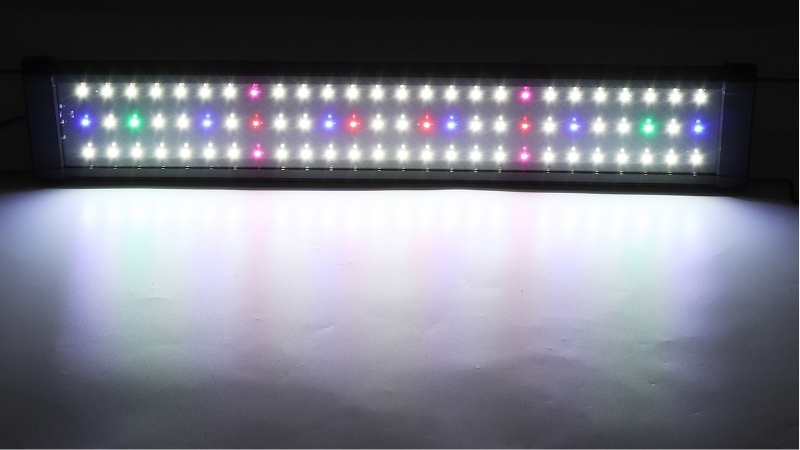
The more independently you can drive red, green and blue, the more color you can push. The Chihiros WRGB II Pro exposes four separate W/R/G/B channels (Chihiros, 2026), while the standard WRGB II uses 3-in-1 RGB diodes on three channels. That extra channel is what lets you fine-tune a look.
Independent channels lift reds for fish and plants without over-blueing the whole tank. A three-channel RGB light still adjusts color but with less separation, and single-preset fixtures give the least control. Match the channel count to how much tuning you actually plan to do rather than to the spec sheet.
White Channel Changes Perceived Naturalness
A dedicated white channel anchors the scene so colors read as vivid rather than artificial. The Fluval Aquasky 3.0 pairs RGB with dual white across 42 LEDs, 28 white and 14 RGB (Fluval, 2026), which keeps the tank looking natural while still allowing a color boost when you want one.
Too much RGB with too little white looks neon and flat; too much white mutes the pop. The balance is personal, so a light that sets white and color separately gives the most flexibility. Start near neutral, then nudge color up until fish stand out without looking staged under normal viewing.
Color Pop Is Not the Same as Plant PAR
A light that looks stunning is not automatically a strong plant light. Color pop is about spectrum balance and rendering, while plant growth depends on usable PAR at depth. An RGB fixture is not the same thing as a full-spectrum plant light, even where the marketing blurs the two together.
If you keep demanding plants, check PAR at your depth separately from how vivid the tank looks. The Finnex Vivid+ 3.0 lists mode-dependent PAR of 48, 60 or 80 µmol/m²/s at 14 inches on the 48-inch model in open air (Finnex, 2026), so output shifts with the color mode you pick.
App Presets vs Manual Color Modes
Control comes in two flavors: app tuning and fixed presets. The WRGB II Pro uses the My Chihiros app over Bluetooth, with Wi-Fi requiring a hub (Chihiros, 2026), giving deep manual control. The Finnex Vivid+ instead offers named modes like Zen, ColorMax and Dutch for quick, repeatable looks.
Presets are faster and foolproof; app control is more flexible but takes setup. If you enjoy dialing in a scene, choose app tuning; if you just want a good look on a button, presets win. Neither is better in the abstract, so match it to how hands-on you want to be.
Best RGB Aquarium Lights for Color Pop
These four range from a deep four-channel controller to a preset-driven look. They are separated by how much color control you get and how you set it, not by brightness alone. Prices move, so treat the figures below as snapshots and relative tiers rather than fixed numbers.
| Product | Best For | Key Spec | Watch Out For |
|---|---|---|---|
| Chihiros WRGB II Pro | Best overall | W/R/G/B, 4 channels | Premium; Wi-Fi needs a hub |
| Chihiros WRGB II | High-tech planted | R/G/B 3-in-1 diodes | Less separation than Pro |
| Fluval Aquasky 3.0 | Best value | 42 LEDs (28W + 14 RGB) | Fewer tuning channels |
| Finnex Vivid+ 3.0 | Preset looks | Zen/ColorMax/Dutch modes | US price not verified |
Chihiros WRGB II Pro
The Chihiros WRGB II Pro takes the top slot because it is verified on the axis that defines this search: four independently adjustable W/R/G/B channels (Chihiros, 2026). That separation gives the finest control over color pop, and the My Chihiros app makes saved scenes and day cycles straightforward to build.
The WRGB II Pro 30 runs around $275 on the official site as of 09/2026, roughly 27% above the standard WRGB II, placing it firmly in the premium tier. Wi-Fi needs a separate hub, which adds cost and setup, but for maximum color control it is the strongest pick here.
Chihiros WRGB II
The standard Chihiros WRGB II uses 3-in-1 RGB diodes on three channels (Chihiros, 2026), a step down in separation from the Pro but still capable of vivid, tunable color for aquascapes. The WRGB II 30 sits around $225 on the official site as of 09/2026, about 21% below the Pro.
It is the pick for high-tech planted tanks that want strong color and app control without the Pro’s premium. The trade-off is less channel separation, so ultra-precise tuning is harder. For most aquascapers chasing a punchy look, three RGB channels are plenty, and the savings over the Pro are meaningful.
Fluval Aquasky 3.0
The Fluval Aquasky 3.0 is the value choice at around $125 at Petco as of 09/2026, roughly half the Pro’s price. It combines RGB with dual white across 42 LEDs, 28 white and 14 RGB, and a 1,550-lumen rating (Fluval, 2026), giving a natural base with a usable color boost.
App control lets you customize the spectrum and program day phases, so it punches above its price for color. It has fewer tuning channels than the Chihiros pair, so separation is coarser. For buyers who want vivid color without a premium spend, it is the best value on this list.
Finnex Vivid+ 3.0
The Finnex Vivid+ 3.0 is built around named color modes, Zen, ColorMax and Dutch (Finnex, 2026), for quick, repeatable looks without app fiddling. Its PAR shifts by mode, listed at 48, 60 or 80 µmol/m²/s at 14 inches on the 48-inch fixture in open air, so brightness follows the scene you select.
It suits anyone who wants a good look on a button rather than deep manual tuning. The main caveat is data: a current US price is not verified, so treat it as a preset-focused option rather than a value-ranked one, and confirm pricing and the exact model before buying.
Frequently Asked Questions
Buyers usually ask the same things about color lighting: whether RGB really makes fish brighter, whether WRGB beats plain RGB, whether these lights grow plants, and which channel pops red. Here are the short answers first, followed by the practical caveats that change the call.
Does RGB make fish colors brighter?
RGB changes how colors are rendered, so fish and plants can look more vivid under the right balance. That is an appearance effect from spectrum and contrast, not a biological change to the fish. A well-tuned red and blue mix makes existing pigments stand out more to your eye.
It will not add color a fish does not have, and pushing saturation too far looks artificial. Aim for a balance that flatters natural coloration, using the white channel to keep the scene believable. The goal is a vivid but realistic look, not a neon one that tires the eye.
Is WRGB better than RGB?
WRGB adds a dedicated white channel to the red, green and blue, which usually gives a more natural base and finer control. The WRGB II Pro’s four channels set white and color separately (Chihiros, 2026), whereas a 3-in-1 RGB diode blends them with less independence between them.
For pure color pop with a natural anchor, WRGB tends to win, but a good RGB light still produces vivid results. If you want maximum tuning, prioritize separate white and color channels; if you just want strong color, either can look excellent with the right settings.
Can RGB grow plants?
RGB light can support plants if it delivers enough usable PAR at their depth, but color performance and plant performance are different jobs. An RGB fixture is not automatically a full-spectrum plant light, so check PAR at your depth rather than assuming a vivid look means strong growth.
Fixtures like the Aquasky include white diodes that help growth, while a pure color-focused profile may not. If plants are the priority, choose a light with verified plant output or run a growth setting; if color is the priority, tune for looks and add PAR separately if needed.
Which channel makes red plants look redder?
The red channel does most of the work, with green and blue balanced to avoid washing it out. On a four-channel light like the WRGB II Pro you can raise red directly (Chihiros, 2026); on a 3-in-1 RGB light you shift the blend toward red within the three channels.
Adding a touch of the white channel keeps the scene from looking artificial while still letting reds dominate. Nudge red up gradually and check under normal room light, since a profile that looks great in a dark room can read oversaturated during the day.
Final Thoughts
The best rgb aquarium light for color pop is the one that gives you the color control you will actually use, anchored by a white channel so vivid never tips into artificial. The WRGB II Pro leads on four-channel tuning, the WRGB II and Aquasky deliver strong value, and the Vivid+ covers preset looks. Match channels to how hands-on you want to be.
As an Amazon Associate we earn from qualifying purchases at no extra cost to you. Prices and availability are accurate as of the date shown and are subject to change.
10 Best Submersible Heaters For Fish Tank 2026
Best Aquarium Heater Guard to Protect Fish: Safer Choices